The rainbow flag, sometimes called by the English “rainbow flag” is made up of 6 horizontal stripes: red, orange, yellow, green, blue and purple. Designed by the designer Gilbert Baker, the flag made its appearance at the San Francisco Pride of 25 June 1978 in the eight -colored version, reduced shortly after six. Since the 80s he has spread all over the world and his colors have become the best known symbol of the LGBT movement. Today of the flag there are countless variants, for some years the progressive pride version has become popular, which includes a triangle with five additional colors (black, brown, blue, pink and white).
The meaning of the rainbow flag
The rainbow flag is the main symbol of LGBT movements. It appears every year on the occasion of the Pride and in all the initiatives organized in defense of the rights of homosexual, transgender and non -binary people. It consists of six horizontal stripes of equal size of the following colors (from top to bottom): red, orange, yellow, green, blue, purple.
Thanks to the flag, the rainbow colors have become a symbol of the LGBT movement and appear on gadgets, signs, objects of various kinds: in 2015, for example, in the United States, many government buildings, including the White House, were illuminated with rainbow colors to celebrate the fifty anniversary of the legalization of marriages between people of the same sex.
The rainbow flag is not confused with the flag of peace, composed of strips of the same colors but arranged in reverse order (the red is below and the purple is above) and bearing the word “peace” in the center.
History of the rainbow flag
The rainbow flag was created by Gilbert Baker, an artist and activist of the LGBT movement. Baker made the flag for the Pride of San Francisco, which took place on June 25, 1978. The original flag was made up of eight colors, each of which associated with an element: pink for sexuality, red for life, orange for health, yellow for sunlight, green for nature, turquoise for art, indigo for harmony and viola for spirituality. The first flag, hand -sewn by Baker, was purchased in 2015 by the Museum of Modern Art in New York.
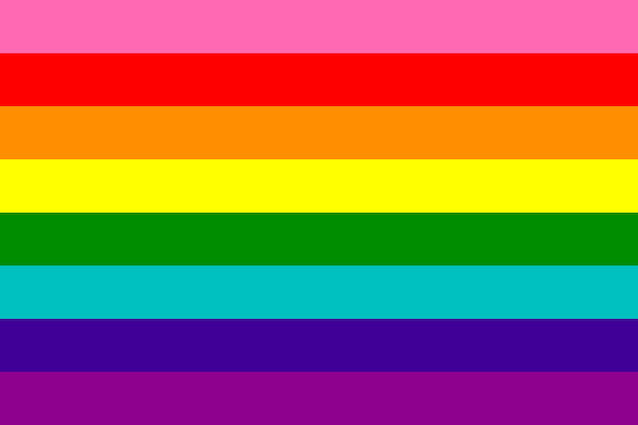
The eight -colored configuration, however, had a short life: the pink strip was eliminated a few months after the pride of San Francisco, because the fabric of that color was difficult to find on the market and in 1979, the indigo and turquoise stripes were merged into a single blue strip. The flag thus assumed the current six -colored appearance and in the 80s he established himself as the main emblem of the LGBT community.
Variants of the Arcobaleno flag
In addition to the “classic” configuration, there are numerous variants of the rainbow flag. For some years the most popular has been the “Progressive Pride” flag, created in 2019 by the designer Daniel Quasar, which on one of the two short sides contains a triangle with stripes of five colors: white, pink, blue, brown and black. The first three are the trans flag colors, while brown and black symbolize LGBT people with black skin (the flag was born in the protests of the Black Lives Matter movement). The “progress pride intersex inclusive” flag instead also includes a yellow triangle and, inside, a circle, symbol of the intersex movement. In many cases, symbols of associations and movements appear on the rainbow, such as in Italy, for example, Arcigay.