At the end of every tennis season, when most of the tournaments have already delivered their verdicts, there is still one stage that remains illuminated: the ATP Finals. It is the tournament of the best 8 in the world, a sort of tennis “champion’s cup”.
But behind the lights and special effects of the current tournament, the Finals hide a history spanning more than fifty years, made up of experiments, unlikely surfaces, movements from one continent to another and a champion who has never managed to conquer them.
From Japanese origins to global consecration
The ATP Finals were born in 1970, in an era in which tennis was becoming global and professional. The idea was simple but revolutionary: create a tournament that brought together the best players of the year, regardless of the Slams won, to crown the true “Master”.
The first edition was played in Tokyo, on the synthetic carpet, and was won by Stan Smith, the man who would later give his name to the famous Adidas shoes.
In the 70s the tournament was called Masters Grand Prix and often changed location: Paris, Barcelona, Stockholm, Melbourne. The idea was still being defined, but the first legends were already born then. The Romanian Ilie Năstase, for example, won four editions between 1971 and 1975: a dominance that established him as the first true irreverent genius of modern tennis – capable of surprising shots and pranks, such as the famous ‘black cat’ brought onto the court to distract the Italian Adriano Panatta.
In 1977, the tournament found its first “permanent home”: Madison Square Garden in New York. This is where the Finals become a global spectacle. The 80s brought John McEnroe, Björn Borg and Ivan Lendl to the stage, protagonists of high-voltage duels. Lendl, in particular, turned consistency into art: eight consecutive finals and five titles, a record for the time.
In the 1990s, tennis entered the modern era: the ATP Tour was born, and the tournament changed its name to ATP Tour World Championships. It is played in Europe – first in Frankfurt, then in Hannover – and the technical level becomes very high. The fast courts enhance the attacking play of champions like Pete Sampras, who won five editions and consolidated his legend.
From 2000 to 2008 the event was called Tennis Masters Cup and travels to Shanghai, symbol of global tennis. But it was in 2009, with the arrival at the O₂ Arena in London, that the tournament entered the era of pure show business: blue lights, film-like intros and the audience transformed into a theatrical audience. In that decade, Roger Federer and Novak Djokovic shared most of the trophies and both held a record: Federer was the player with the most participations in the Finals (18), symbol of a career of consistency and longevity, while Djokovic was the man with the most titles won (7), testifying to an almost scientific precision in decisive moments.
From 2021, the baton passes to Turin and the Pala Alpitour, where the Finals find new energy and a very warm audience. Here, in 2024, Jannik Sinner writes history: the first Italian to win the tournament and to literally become the “Master in the house”.
The 4 surfaces of the most selective tournament in the world
The Finals have also changed over time in the surface on which they are played. Today the images always show us the bright blue of indoor concrete, but it wasn’t always like this. Throughout its history, the tournament has been played on four different surfaces:
- Carpet (synthetic carpet): the most used until the 2000s, very fast and unpredictable. It required instant reflexes and aggressive play.
- Grass: a very rare exception, in 1974 in Melbourne. An “experimental” edition that transformed the tournament into a mini Wimbledon.
- Hard indoor: the most stable surface, adopted in London and then in Turin. It offers balance and precision, reducing the advantage of service specialists.
- Hard outdoor: Used in Houston in 2003 and 2004, the only recent time the tournament was played outdoors.
This variety of surfaces tells of the evolution of tennis itself: from a sport of explosiveness to a discipline of resistance and control. Today indoor hard courts represent the perfect synthesis between speed and regularity, a compromise that tests everyone without favoring anyone.
Nadal and the “curse” of the Finals
However, there is a great champion who, despite having won everything, has never managed to conquer the ATP Finals: Rafael Nadal. It’s not a question of talent or lack of determination: Nadal has qualified for 17 editions, reaching two finals (2010 and 2013), but without ever lifting the trophy.
The main reason is related to the time of the season. The Finals are played in November, on a fast, indoor surface — exactly the opposite of Rafa’s natural habitat of red clay and grueling matches under the sun. Reaching the end of the year with an intact body was a more difficult challenge for him than any opponent and in many editions he withdrew due to injury or played in less than his best condition. Yet, even without that title, Nadal remains an essential part of the history of the tournament: his competitive spirit has made each edition more lively and unpredictable.
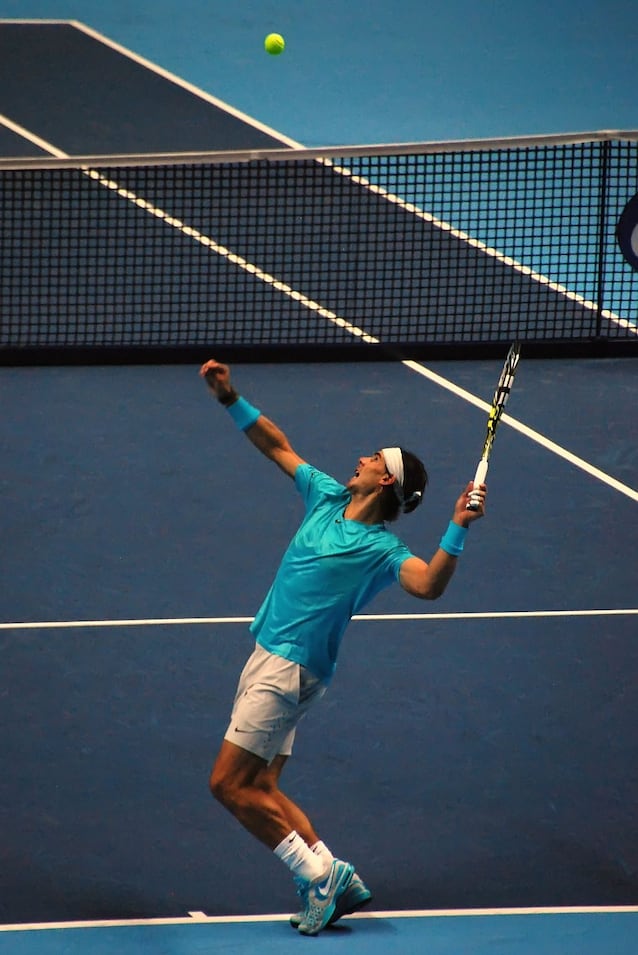
Today Turin preserves the legacy of the ATP with an all-Italian soul, made of passion and entertainment. And when the arena becomes silent and the first serve cuts through the air, the audience understands that the last chapter of the year is beginning: the moment in which tennis crowns its true Master.