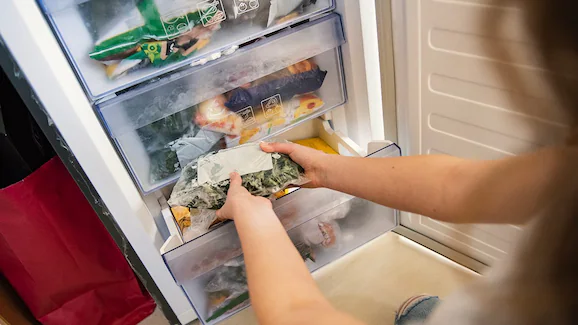
Freezing is one of the best known and most used food preservation techniques, especially in the home. When the temperature is lowered, microorganisms stop growing, furthermore the cold slows down the chemical and enzymatic reactions that cause them to oxidize, darken or change the consistency over time. But when defrosting, especially meat or fish, leaving food at room temperature is risky: the inside remains frozen while the outside becomes an ideal environment for microorganisms, the surface quickly exceeds 5°C, entering the so-called “danger zone”, where bacteria quickly multiply again. Among the most used methods are the refrigerator, the use of running water, leaving at room temperature and the “defrost” function of the microwave. Defrosting in the refrigerator takes longer, but always keeps food below 5°C, ensuring safety and limiting bacterial growth. It is advisable to place the food on the lowest shelf to avoid contamination from any released liquids.
Thawing at room temperature is risky
Let’s consider, for example, a piece of meat: when we put it in the freezer, the water contained in its cells solidifies into ice crystals. It is important that this process occurs quickly: if freezing is too slow, large crystals (macrocrystals) form, capable of damaging cell membranes. But what happens in the opposite moment, when we defrost the meat to cook it? And above all: what is the best way to do it?
The most intuitive way, and perhaps also the most widespread, is to leave the food on a kitchen shelf waiting for it to defrost at room temperature. In fact, the increase in temperature allows the water contained in the food to return to its liquid state, making the meat softer and ready to be put in the pan. However, the IFT (Institute of Food Technologists), warns about this method, drawing attention to a very specific problem: as it defrosts, food passes through a temperature range between 5 °C and 60 °C, defined by international guidelines (such as those ofUSDA, the United States Department of Agriculture) danger zoneor “dangerous area”.
In this range, the bacteria begin to multiply again very quickly, because they find liquid water available again and an environment warm enough to activate their vital processes again. Furthermore, when we leave frozen food at room temperature, the defrosting is unlikely to be uniform: the inside remains frozen for a long time, while the surface defrosts quickly exceeding 5°C. And right there, on the outermost layer, the bacteria have everything they need to start proliferating again, often reaching concentrations that can become risky even before the food is completely defrosted.
Among the main bacteria that can proliferate during incorrect defrosting are Salmonella and Escherichia Colivery common in contaminated foods. Their growth can cause food poisoning, with typical symptoms such as diarrhea, vomiting or abdominal cramps.
Transferring from the freezer to the refrigerator is the safest choice
The situation changes if we defrost the food in the refrigerator. It may seem counterintuitive, because the fridge is perceived as a place that is too cold to allow defrosting. In reality, its temperature – while remaining low – never goes below zero, allowing the water to gradually transition into a liquid state. Furthermore, the refrigerator keeps the food below 5°C, preventing it from entering the famous “danger zone”. The process will take longer, but it will be decidedly safer, allowing controlled defrosting and avoiding an excessive increase in the microbial load. It is best to avoid refreezing if the product is not cooked and, in general, consume it within a few hours of defrosting.
When you choose to defrost in the refrigerator, it is advisable to place the food on the lowest shelf. Not only because it is usually the area that most often maintains the temperature between 2°C and 4°C (therefore well below the critical threshold), but also for a practical reason: during defrosting, especially for meat and fish, liquids can escape which, if they drip onto other foods, can contaminate them.