The terrorist attack known as the “Piazza Fontana massacre” saw the detonation of a bomb in the Banca Nazionale dell’Agricoltura, in Piazza Fontana in Milan, which on 12 December 1969 caused a total of 17 victims and 88 injuries. It was an indiscriminate massacre of unarmed civilians, unclaimed and unprecedented in Italy after the Second World War. In conjunction with the attack, another bomb was found unexploded in Piazza della Scala and three devices exploded in Rome, injuring 16 people. The massacre in Milan, almost as if it were an act of war in peacetime, risked triggering a process of breakdown of the democratic order.
To understand what happened in Piazza Fontana, three trials took place over a period of 36 years. The latest procedural result capable of better outlining the contours of the case, without imposing penalties from a legal point of view, was provided by the Court of Cassation in 2005.
To give an account of the tortuous judicial process, the essayist Benedetta Tobagi wrote a book with the indicative title: Fountain Square. The impossible process.
The Piazza Fontana massacre: the story
The political color to which the massacre should be attributed, based on the available evidence, is not a mystery: it is black. The main responsibilities for the attack, despite several definitive acquittals, have been traced back to a small subversive group established in Veneto in the 1960s and active within the wider extra-parliamentary neo-fascist galaxy.
Also on the level of collective memory, an attempt was made to provide reference coordinates. For example, a few days before the fiftieth anniversary, in 2019, seventeen tiles were placed on the pavement of Piazza Fontana with the names of the victims and a commemorative stone with the coat of arms of the Municipality of Milan and these words: “12 December 1969. Piazza Fontana massacre, 17 victims. Bomb placed by the far-right terrorist group Ordine Nuovo”.
However, a completely exhaustive reconstruction from a strictly judicial point of view has not been achieved, also due to the lack, over the years, of detailed documentary evidence. Furthermore, there is a factor to consider: already close to the massacre and then later on, representatives of the state structures, in particular of the security apparatus, moved to steal information and interfere with the investigations, thus attempting to fragment the overall picture.
From a historical perspective, however, the sum of the knowledge gained over the decades has produced solid results, placing Piazza Fontana at the center of the strategy of tension.

The context of the massacre
The Piazza Fontana massacre took place in a specific historical context, just over twenty years after the Liberation. Italy had experienced great transformations with industrial development, was a member of NATO included in the US-led Western bloc and among the founding countries of the European Economic Community (EEC). However, during the Cold War, it was located near one of the hottest frontiers of the continent, Eastern Europe, and was surrounded by three authoritarian regimes (the Francoist one in Spain, the Salazarist one in Portugal and that of the colonels in Greece).
It was also marked by deep fault lines and had parties, movements and associations which, referring to socialism or communism, represented large segments of the population. The Italian Communist Party (PCI) was viewed with suspicion due to its ties to the Soviet Union.
At the end of the 1960s, social and trade union conflict was intense, with frequent protests and strikes. A minority but not marginal part of the ruling class (political, economic, cultural) feared that Italy could break away from the Atlantic Alliance and favor the USSR. Behind the processes of modernization we can glimpse the specter of subversion. And the space for action of black extremists had already expanded, also due to contacts between military and civilians carried out out of interest or ideological convergence, with an anti-communist function.
Throughout 1969, dozens of bomb attacks were recorded, with no deaths or claims claimed. With the Piazza Fontana massacre, the strategy of tension was then configured: a series of acts and initiatives which, by orienting public opinion and criminalizing dissent, should have aroused alarm and facilitated moderate political stabilization or even a transition towards a new constitutional structure.
There was no single direction, but the activation of a plurality of designs. Those who acted did so with different motivations, at different times and on different levels, but with at least one shared objective: to divert the trajectory of Italian democracy.
In the midst of all this, there was the advance of the extra-parliamentary far right. That is, that heterogeneous political area that did not have representation in parliament (also because it often did not recognize its legitimacy) and was located to the right of the Italian Social Movement (MSI), the neo-fascist-inspired formation present in parliamentary institutions and formed in 1946 by veterans of the Italian Social Republic (RSI).
The political subjects of the extra-parliamentary far right drew strength from the fascist legacy that survived the twenty-year period, they did not constitute a single entity and had a rather considerable consistency. They were then united, in minimal terms, by the rejection of constitutional democracy and hostility to the left. One of the reasons for the intensification of the political use of violence in republican Italy depended precisely on the radicalization of some components of the extra-parliamentary far right.
For the historian Guido Crainz, the “most serious neo-fascist offensive ever attempted in republican Italy” then took place. Black violence raged in the streets, in the squares, in the universities. In the meantime, projects followed one another that did not exclude or take into account the use of violence as a means of political struggle. There were reactionary maneuvers, attempted coups d’état and a series of massacres, such as that of Brescia in 1974.
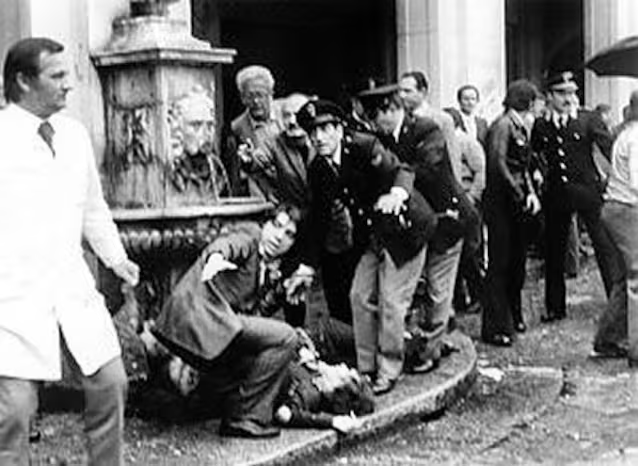
The Piazza Fontana bomb therefore kicked off a dark five-year period (1969-1974) which made Italy a unique case in the Western context and was overcome at a very high price.
What Piazza Fontana left behind
Some events relating to the 1969 massacre are still discussed today: such as the shadow of the secret services’ misdirections, the unexpected and disturbing death of the anarchist railway worker Giuseppe Pinelli in the premises of the Milan police station, the accusations against the anarchist Pietro Valpreda, first arrested and fingered as the culprit and then freed and acquitted. As the magazine wrote The Astrolabethere seemed to be, immediately, a “desire for indiscriminate repression, or, better, repression of so-called left-wing extremism”.
Only later did the black trail open up, revealing a network of connections that was not easy to interpret at first. For this reason, the gash opened by the bomb in Piazza Fontana remained clearly visible, even when in the mid-1970s right-wing extremism was reduced, there was a strong anti-fascist mobilization and an evolution of the national and international scenario.
Piazza Fontana also had a direct effect on the extra-parliamentary left, spreading a negative perception of the State and fueling the belief that democracy actually had a dark and authoritarian face. Furthermore, even those who had already switched to or were planning to switch to armed struggle were influenced by it. The phase of the massacre that began with Piazza Fontana does not, in itself, explain the subsequent phenomenon of far-left armed struggle. However, it constituted a precedent and at the same time an accelerator.
On the tenth anniversary of the attack, in 1979, the mayor of Milan, Carlo Tognoli, wrote in the newspaper l’After you that the bomb, the events related to the massacre and the slowness of justice had been at the origin of the “spiral of terror”.
A few months earlier a reference to Piazza Fontana had been inserted by the singer-songwriter Francesco De Gregori in Long live Italya vibrant song capable of evoking a country made of contrasts, suffering and hopes. Which ended like this: “Long live Italy, the Italy of December 12th, / Italy with the flags, Italy naked as always, / Italy with its eyes open in the sad night, / long live Italy, the Italy that resists”.
The massacre was one of the symbols of a period in national history characterized by protests, proposals, participation and reforms but also by serious collective traumas. A large part of public opinion had to reflect deeply on the relationship between democracy, truth and power. The writer Corrado Stajano, a chronicler in those years, then observed: “Piazza Fontana and what followed was an event that was a caesura in the life of an entire generation. There was a before and an after”.