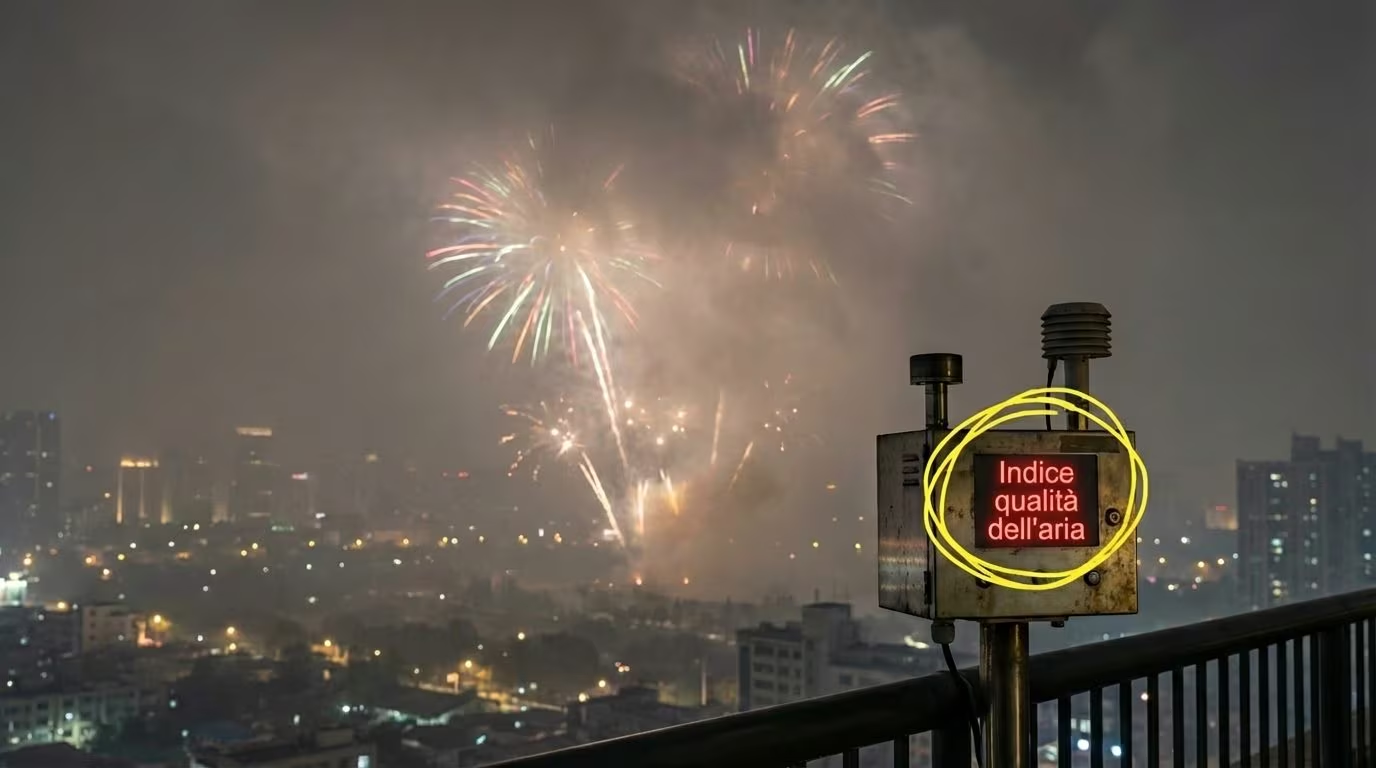
The “New Year’s Eve bangs”, in addition to causing victims and injuries and scaring domestic animals, pollute the environment: despite being a difficult tradition to eradicate, in fact, firecrackers and fireworks have a notable impact – even if only for a few hours – on the quality of the air we breathe and, in particular, on the concentration of fine particles (PM10 and PM2.5). As the name suggests, PM10 are particles with a diameter less than 10 micrometers, while PM2.5 has a diameter of less than 2.5 micrometres, about 30 times smaller than a hair. So let’s see the results of the findings World’s Air Pollution, which measures air quality in real time, for the cities of Milan, Rome and Naples.
Concentrations of fine dust in Milan
One of the detection stations in Milan, located in via Cardinale Branda Castiglioni, detected PM 2.5 concentrations of 256.65 μg/m at 02:00 on 1 January 20263with an air quality score of 306. PM10 concentrations instead reached a peak of 535.88 μg/m3equivalent to a score of 431.
To get an idea, according to Italian legislation PM2.5 concentrations should not exceed the annual average of 25 μg/m3, while for the PM10 the daily average of 50 μg/m3 (for a maximum of 35 days in a calendar year).
As regards the indices (Air Quality IndexAQI), a score above 300 indicates a serious health hazard, with the population recommended to remain inside buildings with windows closed. It must be said that the risks become concrete in the face of much more prolonged exposure (i.e. for several consecutive days), but the drastic increase in particulate concentrations in the hours following the “midnight explosions” is undeniable. Particulate matter which then, once the peak presence in the air is over, settles on land and water.
As also visible in the graph above, the Lombardy capital has maintained high concentrations of pollutants in the air, finding itself in one of the most polluted areas in Europe.
Concentrations of fine dust in Rome
The Rome station located in Via Clelia recorded a concentration of PM2.5 in the city equal to 96.3 μg/m3 at 02:00 on January 1st, equivalent to an air quality score of 172. The capital, in the comparison between the three cities, was found to be the one with the lowest concentration of fine particles due to fireworks, with PM10 reaching 159.38 μg/m3 and an air quality index of 102.
From the graph above it is possible to see how air quality, which was classified as “unhealthy” in the early hours of 2026, soon returned to normal values.
Concentrations of fine dust in Naples
As for Naples, the city has the sad record for the greatest pollution following fireworks: despite the official data of concentrations in μg/m3 have not yet been released at the time we publish this article, at 01:00 on January 1, 2026 the air quality index for PM2.5 concentration reached a peak of 863 points. According to the detector positioned near the National Museum of the Campania capital, the PM10 particles instead brought the air quality score to 970.
The air quality in the Neapolitan city has therefore undergone a drastic worsening, as confirmed by the graph below: between the end of 2025 and the beginning of 2026, the New Year’s Eve explosions actually made the air unbreathable.

We reiterate that these peaks in pollutant concentrations were short-lived, with air quality returning to normal values within a few hours, as the graphs also show us. Exposure for those who were outdoors during those hours was therefore limited. This does not mean that the impact of the “New Year’s Eve explosions” on air quality, even if temporary, is clearly visible and far from negligible.