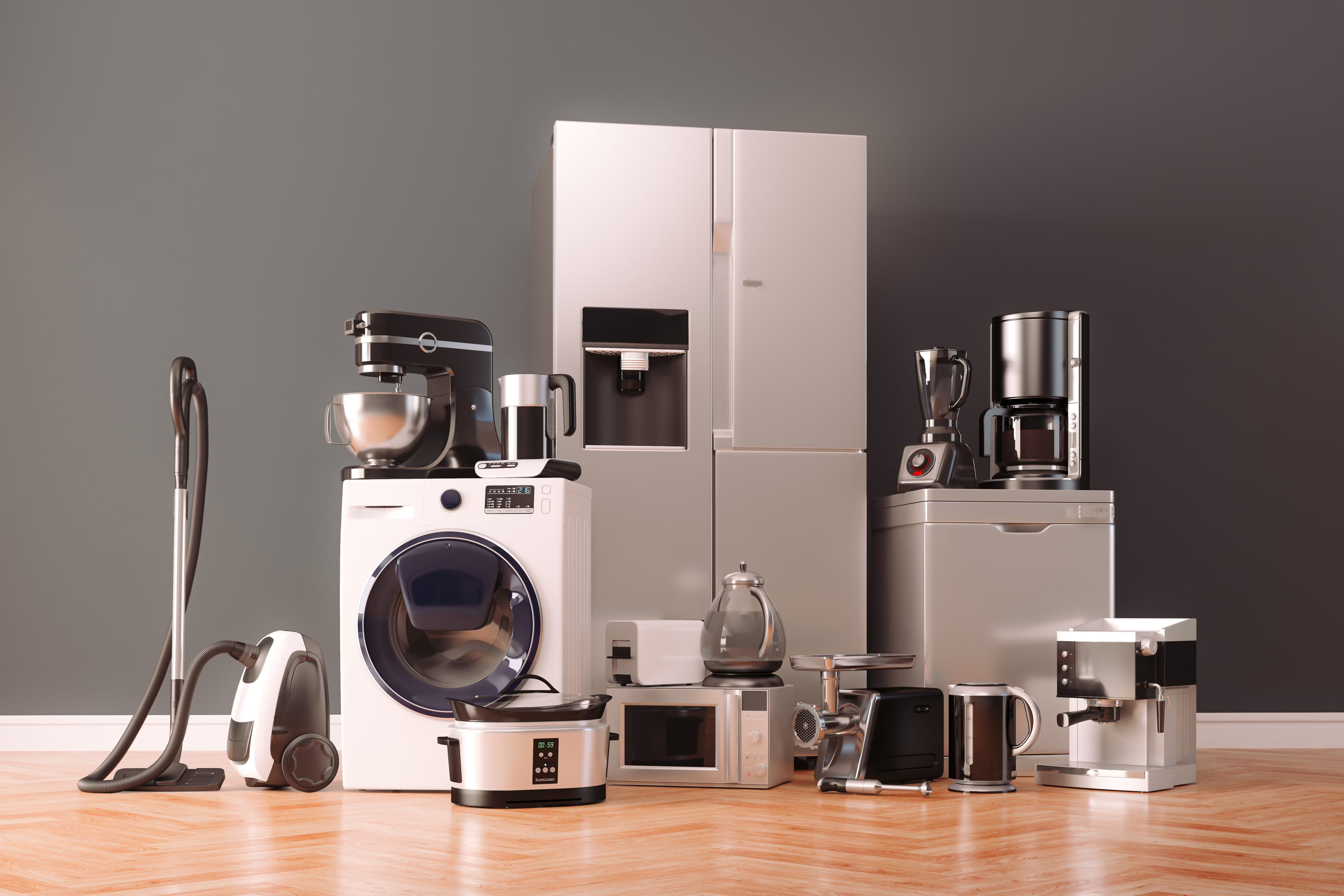
How much do our household appliances consume in a year? To answer this question precisely, you need to start by reading the energy label of the device under consideration, which indicates an estimate of the average annual consumption, after which you need to apply some simple mathematical formulas that allow the actual calculation. We would like to point out that the calculations we are going to propose concern the consumption of household appliances when they are in use, but we must not forget that many devices continue to consume energy even when they appear to be switched off: these “phantom loads” affect televisions, computers, stereos and small household appliances, and can be reduced by unplugging the appliance or using switched sockets. We have already told you about it in another in-depth article in which we explained how to calculate the consumption of appliances in standby. Having made this necessary premise, let’s see how to calculate the annual consumption of household appliances when they are used.
- 1Determine the actual usage time of an appliance
- 2Know the power of the appliance
- 3Use the formulas to calculate the cost on your bill
1. Determine the actual usage time of an appliance
To calculate the annual consumption of an appliance, we must first estimate how many hours a day we use it. We can make a rough estimate based on the daily use we know or, much better, keep an accurate log of the operating hours. What about large appliances that are constantly running? If we take a refrigerator as an example, even if it is true that it is always connected to the electricity, 24 hours a day, 7 days a week, it actually works at its maximum power only for a third of the time, turning on and off automatically to maintain the internal temperature. In this case, therefore, this aspect must be taken into account when calculating the actual usage time.
2. Know the power of the appliance
The next step is to know the power of the device, expressed in watts (W), which represents the maximum energy it can absorb. We usually find it on the label or plate of the appliance; if it is not indicated, we can multiply the current absorbed in amperes (A) by the voltage in volts (V). In Italy most domestic devices operate on 230 V, while some large appliances may have different specifications.
3. Use the formulas to calculate the cost on your bill
At this point we can calculate the daily consumption in kWh using this first formula:
- Wattage x Total hours of use per day ÷ 1000 = Daily consumption in Kilowatt hours (kWh)
To calculate the annual consumption, then, you need to apply this second formula:
- Daily kWh consumption x number of days used per year = Annual energy consumption
Now that the annual energy consumption is clear to you, simply apply this third formula to determine how much the appliance you are considering affects your bill:
- Annual energy consumption x user fee per kWh = Annual cost of the appliance turned on
If it all seems rather difficult, consider the following explanatory example.
Let’s say you own an electric kettle and use it for about half an hour a day. The kettle in question has a power of 1500 W. Here’s how to determine its daily consumption in KWh.
- 1500 (W) x 0.5 (use time) ÷ 1000 = 0.75 kWh (estimated consumption per day)
Now, since you use this kettle 5 times a week (i.e. 260 days a year), you will need to apply the second formula we referenced earlier:
- 0.75k Wh (estimated consumption per day) x 260 (the total number of days of use per year) = 195 kWh (estimated consumption per year)
Finally, multiply the estimated consumption per year by the rate applied on your bill by your energy provider. Just to say, if the latter amounts to 0.15 euros/kWh, applying the third formula this is what will come out:
- 195 kWh (estimated consumption per year) x 0.15 euros/kWh = 29.25 euros (Annual cost of the appliance)