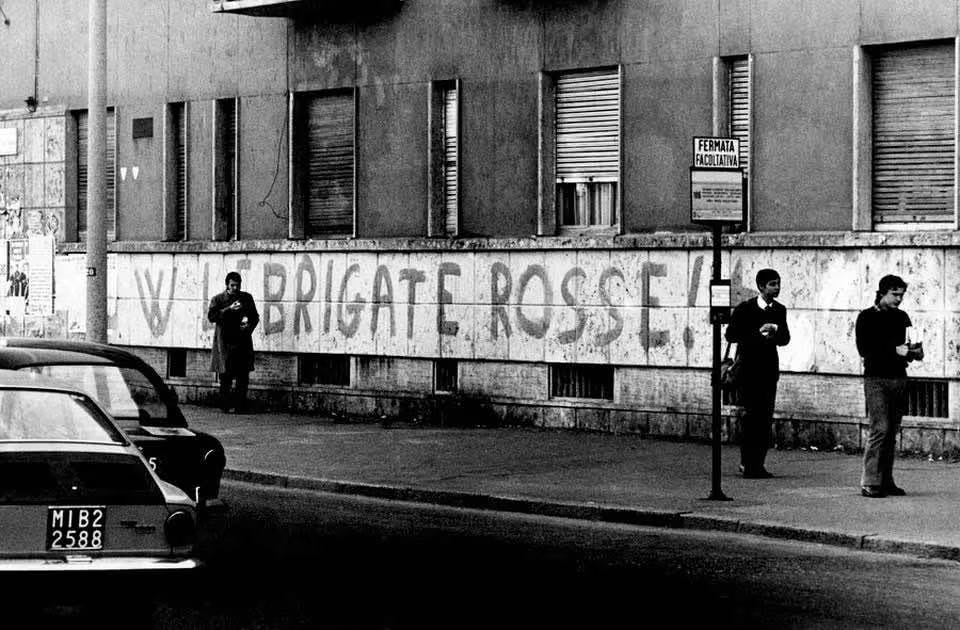
The Red Brigades, born in 1970 and remaining active until the second half of the 1980s, were the largest far-left terrorist organization active in Italy during the Years of Lead. They were born in the climate resulting from 1968 and the hot autumn thanks to the confluence of different political groups. Originally they carried out demonstration actions, but in the mid-1970s they raised the level of conflict, starting to carry out kidnappings and murders. The best-known action was the kidnapping of Aldo Moro, which took place in 1978. Having split into various groups at the beginning of the 1980s, the BR underwent a progressive decline, also due to the arrest of most of the militants. In 1987 the historical leaders declared the end of the experience of armed struggle. The conspiracy theories, according to which the Red Brigades were directed by alleged occult powers (secret services, Freemasonry, etc.), have never been confirmed.
The origins of the BR and the ideology
The birth of the Red Brigades takes place in the political climate that arose in the 1960s, in particular, during the 1968 movement and the cycle of workers’ struggles of the “hot autumn” of 1969. A “new left” was born in Italy, which did not recognize the institutional left, represented by the Communist Party, and proposed a more radical approach. Furthermore, from the end of the 1960s, political tension increased dangerously: far-right groups, linked to state apparatus, implemented a strategy of tension from 1969, carrying out bomb attacks and causing victims with the aim of destabilizing democratic institutions and encouraging the establishment of a fascist dictatorship.
In this context the Red Brigades were born. Some radical fringes emerged in the new left movements, which intended to promote the use of violence. Between 1969 and 1970 the movements organized some conferences and assemblies to discuss the political line. The best known was the conference held in Pecorile, in the province of Reggio Emilia, between 17 and 22 August 1970, with around one hundred present. During the meetings the decision was made to go underground and to armed struggle. The Pecorile conference is generally considered the moment of foundation of the BR.
Representatives from different political environments converged within the organization. Some were former university students who had participated in the protests of 1968, such as Renato Curcio and Mara Cagol; others were factory workers in Milan, like Mario Moretti; still others came from the PCI federation of Reggio Emilia (Alberto Franceschini, Prospero Gallinari).
The name Red Brigade (originally in the singular) was chosen in homage to the partisan brigades that had fought against the fascists.
The first actions of the far-left organization
The name “Red Brigade” appeared for the first time in the summer of 1970 to sign leaflets distributed clandestinely in some factories in Milan. On September 17, the first violent action took place: the burning of the car of a Sit-Siemens manager.
The BR’s first initiatives, however, were not lethal, but simply demonstrative, such as damaging cars and flash kidnappings of company executives, who were often photographed with placards around their necks and then released.
Gradually the organization strengthened and branched out across the territory, structuring itself into formations called “columns”: after that of Milan, others were formed in the cities with the greatest working class presence, Turin and Genoa and, in the following years, also in Rome, Veneto, and Naples. The political leadership of the BR was entrusted to a “strategic direction”, which coordinated the work of the columns. The financing took place through robberies, called “expropriations” by the Red Brigades, and kidnappings for the purpose of extortion.
The BR found some support (very much a minority) in the factories, but no support from the institutional left, which was determined to fight them with all means.
The ideology of the Red Brigades was rather confused and was based on a radical interpretation of Marxism-Leninism, placing the working class at the center of the revolutionary process and considering the State as the representative of capital (“the imperialist state of the multinationals”).
The BR’s leap in quality occurred in 1974: on 18 April in Genoa they kidnapped judge Mario Sossi, who was held captive for over a month and released on 20 May on the promise of the release of some prisoners.
The beginning of the murders
Between 1974 and 1975 the BR underwent an evolution. In 1974 Curcio and Franceschini were arrested. Curcio was then freed by a commando led by Cagol and Moretti in early 1975, but arrested again in January 1976. Furthermore, in June 1975 Cagol was killed in a firefight with the police.
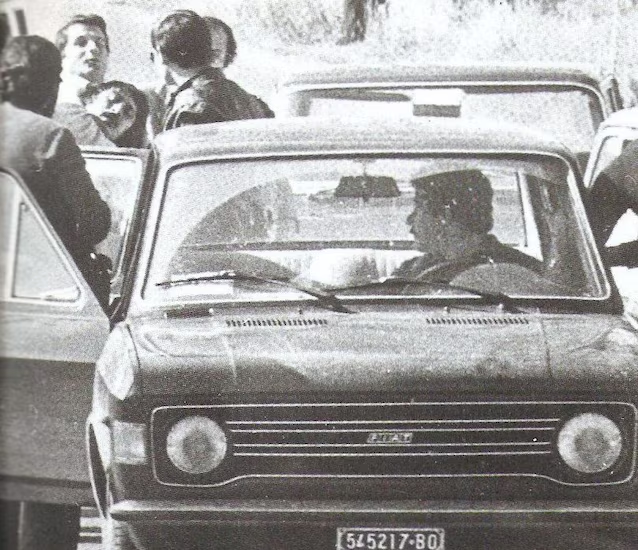
Once the historical nucleus disappeared, the political weight of Moretti increased, sometimes considered “the head of the Red Brigades”, although in reality such a figure did not exist.
In 1976 the Red Brigades carried out the first premeditated murder: on 8 June they killed Francesco Coco in Genoa, the prosecutor who had refused to release the prisoners whose release had been promised during the Sossi kidnapping. It was not the first time that the Red Brigades had killed: in previous years they had killed two militants from the Italian Social Movement and some members of the police force. However, the killings were not premeditated. The Coco murder therefore represented a leap in quality.
The attack on the heart of the State: kidnapping and killing of Aldo Moro
In the following years the BR gathered new militants and founded new columns, facilitated by the fact that in 1977 a strong protest movement developed in Italy, some minorities of which did not disdain collaborating with the Red Brigades. The most frequent actions of the Red Brigades were murders and “leg shootings” (shooting targets in the legs, to wound without killing). Victims were members of the police force, journalists and lawyers.
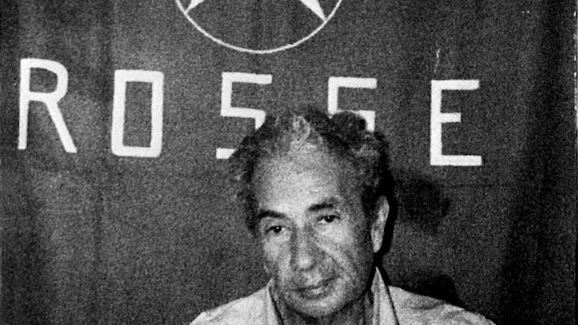
In 1978 the Red Brigades decided to carry out the “attack on the heart of the State”. On 16 March 1978 they carried out their most famous action: they kidnapped Aldo Moro, president of the Christian Democrats and former prime minister, killing the five escort agents, and kept him kidnapped for 55 days, finally killing him on 9 May.
In the same years, other far-left terrorist organizations also strengthened, such as Prima Linea and the Proletarian Armed Nuclei.
The State reacted by increasing control of the territory and tightening some measures, but without resorting to special anti-terrorism laws.
The splits and decline of the Red Brigades
Moro’s murder represented the moment of maximum expansion of the BR, but also the beginning of its decline. The State had refused to negotiate and had not recognized the Red Brigades as interlocutors, which was a political defeat. Furthermore, on 24 January 1979, in Genoa the BR killed a communist worker: Guido Rossa, an appreciated trade unionist, who had denounced a member of the Red Brigades. The murder caused the organization to lose further support.
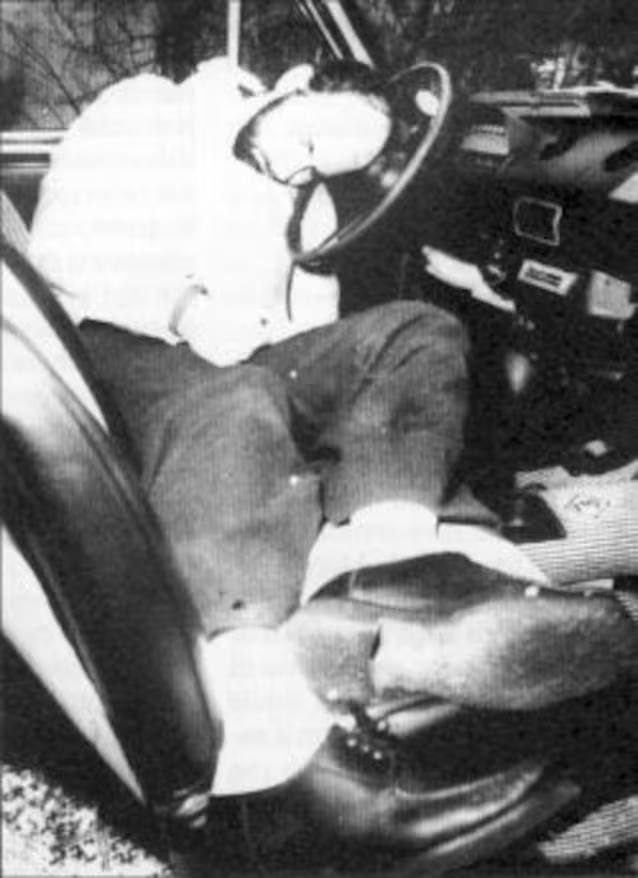
The counteractions of the police allowed the arrest of numerous Red Brigade members, including Mario Moretti, captured on 4 April 1981 in Milan. The first repentants also emerged, the best known of whom was Patrizio Peci, arrested in 1980.
The Red Brigades continued to kill and carry out attacks, but in the early 1980s they split into various groups, divided by political strategies. The main ones were the Red Brigades – Communist Fighting Party, which followed Moretti’s militarist line, and the Red Brigades – Guerrilla Party, more attentive to the relationship with the movements.
In the 1980s the number of attacks progressively declined and many more militants were arrested. In 1987 Curcio and Moretti declared the experience of armed struggle over from prison. The last murder, that of Senator Roberto Ruffilli, occurred the following year.