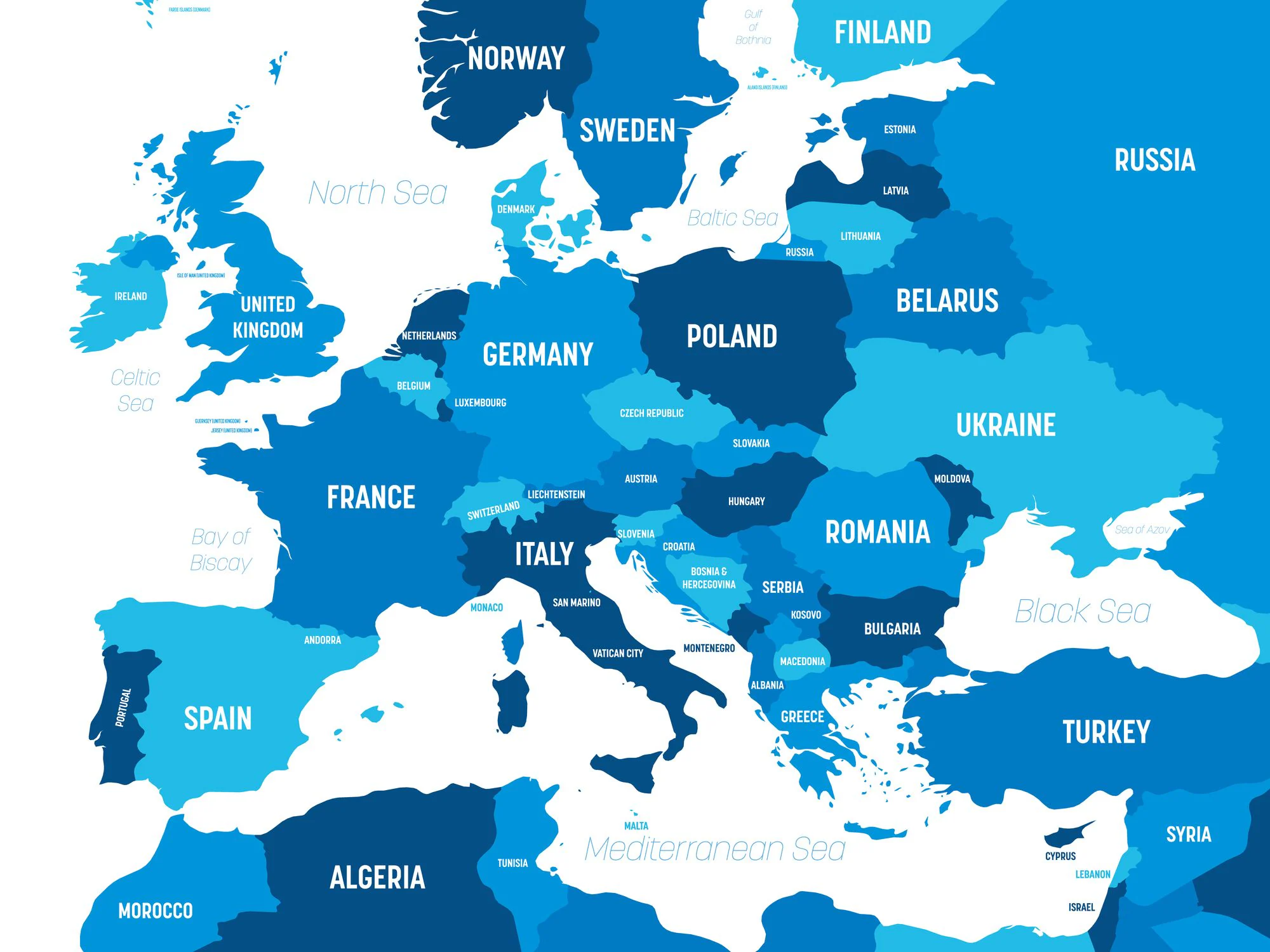
Over the last thirty years, populist parties and more radical political forces have gained more and more space in Europe. According to the OECD, in 31 European democracies their overall vote share rose from around 12% in the early 1990s to 30% in 2022. The AfD’s victory in Saxony-Anhalt fits into this trend, but it does not mean that all of Europe is simply “going right”. In some countries the radical right governs, in others it supports center-right executives or is in opposition. Let’s look together at some specific examples in Europe.
The result of the AfD in Germany
In the regional elections on 6 September 2026 in Saxony-Anhalt, eastern Germany, the Alternative für Deutschland (AfD) party obtained approximately 43.8% of the votes, winning 39 of the 83 seats in the regional parliament. Despite coming first, however, the AfD does not have an absolute majority and will therefore have to find allies to form a government. The main German parties maintain the so-called Brandmauer, the “containment wall” that prevents government coalitions with the AfD, but the result is still historic: for the first time since the birth of the Federal Republic a far-right party finds itself concretely in the position of being able to lead a regional government. And the figure becomes even more significant when compared with the 2025 federal elections: at a national level, the AfD had obtained 20.8% of the votes cast for the party lists, becoming the second party in the Bundestag with 152 seats, while CDU and CSU, which form the conservative alliance led by Friedrich Merz, had come first. The AfD will therefore not automatically govern the Land, as to do so it will have to find allies, but this result shows how close the party is now to being able to lead a regional government.
The weight of the radical right in Europe
When talking about the phenomenon of the rise of the right in Europe a distinction must be made: conservative right, national-conservative right and radical right are not the same thing. Let’s look at some examples of right-wing governments in Europe and their differences.
Italy: the radical right has been in government for about four years
Italy is one of the most emblematic cases in the European panorama. Giorgia Meloni has led a coalition made up of Fratelli d’Italia, Lega and Forza Italia since 2022. Brothers of Italy, his party, was founded in 2012 by members of the National Alliance, the party born in 1995 from the transformation of the Italian Social Movement (MSI), a formation of the Italian radical right and today one of the main forces of the European conservative right. However, once she came to government, Giorgia Meloni maintained a strongly Atlanticist and pro-Ukraine position, simultaneously trying to make her party a stable interlocutor of the European institutions. The Italian case is a clear example of a political force born in the area of the radical right which, once in government, tries to adopt a more pragmatic line on the international level to gain consensus and favor the duration of its mandate.
Finland: the radical right is inside the government
In Finland the government led by Petteri Orpo is a centre-right coalition in which the Finns Party, a nationalist and populist formation of the radical right, is also present. It is a model similar to the Italian one, in which a radical right force participates directly in a coalition led by a centre-right party, becoming indispensable for building a parliamentary majority.
Czech Republic: Babiš’s return shifts the government to the right
In the Czech Republic, the government of Andrej Babiš, which took office at the end of 2025, leads a coalition made up of his populist movement ANO, the radical right-wing party SPD (Freedom and Direct Democracy) and the right-wing Eurosceptic group Motoristé sobě. The coalition controls 108 of the 200 seats in the House. Among his priorities are a reduction in military support for Ukraine and greater opposition to some EU environmental policies. Again, a radical right party participates directly in a government coalition led by a larger party.
Slovakia: the case of Robert Fico
In Slovakia the case is different: Prime Minister Robert Fico is not an exponent of the far right and his party, Smer-SD, is generally placed in the area of the nationalist and populist left. Since 2023, Fico has led a coalition together with the centre-left Hlas-SD and the nationalist Slovak National Party (SNS). The coalition now has 78 out of 150 seats and is characterized by a much more critical position towards European support for Ukraine than most EU governments. In June 2026 the government faced a vote of confidence after the public debt exceeded the threshold set by the Slovak Constitution: the government obtained confidence with all 78 majority votes. Slovakia, therefore, should not be considered among the countries governed by the radical right, but it is an interesting case for another reason: Fico has taken nationalist and highly critical positions towards some EU policies, as well as having stopped state military aid to Ukraine. On some of these issues, Fico’s positions coincide with those of various parties of the European radical right, although Smer-SD remains politically distinct from these formations.
Sweden: the radical right is losing ground
The elections of 13 September 2026 produced a much more uncertain result than expected and have not yet rewarded the further advance of the radical right. The final result has yet to be confirmed with the counting of votes from abroad, but the centre-left bloc led by Social Democrat Magdalena Andersson is currently leading with 176 seats compared to 173 for the right-wing bloc of outgoing Prime Minister Ulf Kristersson. The interesting fact, however, concerns the Sweden Democrats: the radical right party which has roots in the far right and which in recent years has acquired a central role especially on issues such as migration policy and security had become the main parliamentary ally of the Kristersson government and hoped to enter the executive directly. Jimmie Åkesson’s party instead fell below 18% and on the contrary lost seats, placing it in third place among the Swedish political forces. If this result is confirmed, Sweden could represent one of the first recent cases of reversal compared to the trend of recent years.
France
France represents the great electoral event of 2027, important for the entire European political direction. The 2027 presidential elections could bring the Rassemblement National party of Marine Le Pen or Jordan Bardella to the Elysée. Rassemblement National is now one of the main political forces in the country and the possibility of its victory is considered a concrete scenario. In the 2024 European elections it obtained 31.4% of the votes, while in the legislative elections of the same year it reached 33.2% in the first round and won 125 seats in the National Assembly. A victory for the Rassemblement National in France would therefore have significant weight for the European Union: France and Germany are in fact among the largest member states and many of the European political balances depend on them.
Austria: winning does not necessarily mean governing
Another interesting case is Austria. In 2024 the Freedom Party (FPÖ), a radical right formation, had obtained the highest number of votes in the parliamentary elections, around 29%. Yet he failed to form a government: in March 2025 conservatives, social democrats and liberals formed a coalition excluding the FPÖ from the executive. This is also a fundamental point for reading the German situation: the electoral success of a party does not automatically coincide with its ability to govern. We need parliamentary majorities and, above all, allies willing to collaborate.
Hungary: is the Orbán case already over?
For sixteen years Viktor Orbán has been one of the main points of reference of the European nationalist right. But in the April 2026 elections he was defeated by the centre-right centrist party Tisza, led by Péter Magyar. Tisza won a large parliamentary majority, with 141 out of 199 seats, and Magyar became prime minister in May. Tisza MEPs sit in the European People’s Party group. The Hungarian case aroused surprise, and is a clear example of how the European radical right is not a linear and irreversible process: a party can grow, get to government and subsequently lose consensus.
The Netherlands has also changed direction
The Netherlands represents another example of how quickly the political landscape can change. After the season of the government supported by Geert Wilders and the PVV, the 2025 elections led to the victory of the liberal and pro-European D66 party. Since February 2026, the prime minister has been Rob Jetten, leading a minority coalition made up of D66 (liberal-progressive and strongly pro-European party), VVD (People’s Party for Freedom and Democracy, centre-right liberal) and CDA (Christian Democratic Appeal, centre-right party of Christian-democratic tradition). The government only has 66 of the 150 seats in the Chamber and must therefore seek support from the opposition from time to time.
A fragmented European political framework
Saying that “Europe is becoming right-wing” is a simplification: in 2026 some countries have moved clearly to the right, while others have changed direction. Denmark, for example, after the March 2026 elections saw the reconfirmation of the social democrat Mette Frederiksen, at the head of a new centre-left government. In Lithuania, the Social Democrats have expelled the populist Nemunas Dawn party from the coalition, following growing radicalization of its leader. What is evident, however, is that in many countries traditional parties are losing votes, political systems are more fragmented and the radical right is becoming a structural component of the political system. The data to observe, therefore, is not simply how many governments are led by the radical right, but rather how much the presence of these parties is also influencing the parties of the liberal right.
The radical right can change politics even without governing
In some European countries the radical right is in government, in others it supports centre-right executives, in still others it is the main opposition force. Even when it does not reach government it can influence the policies of traditional parties and the entire European political debate, especially on issues such as immigration, security, border control and national identity. The victory of the AfD in Germany fits into this framework: it does not mean that the party will govern automatically, but it confirms how difficult it is now for other parties to ignore its electoral weight. This is perhaps the point to focus on: the electoral success of radical parties can shift the entire political debate to the right, both at a national and European level.