According to the data provided by the Ministry of Infrastructure and Transport, in 2024 40% of Italian candidates were rejected to the theoretical driving license exam. Ten years ago, in 2014, the same percentage was around 30%. This significant increase in the number of rejected tells of young people (and less young) increasingly challenged by the rules of the road, especially in quiz questions.
Official data on the number of licenses required and rejected
The official statistics relating to the activities carried out in 2024 for the achievement of the driving licenses, tell us that the number of exam tests (which includes both the theory tests and those of driving) has risen to 2,267,019, exceeding 40,960 units the data 2023, and returning in line with values that were recorded until 2010. The second decade of the new millennium had in fact been characterized by a calo of the licenses, culminating in a historical minimum recorded in 2020.
While maintaining the same trend, the increase compared to 2023, however, is much less marked if we focus only on licenses B (the most common): in 2024 1,623,986 exam tests were held, only 482 more than the previous year. The graph below shows us in detail this trend, but it also allows us to notice how not all candidates are promoted to the driving exam. But if in 2005 only 22% on average was rejected at the exam for driving license B, in 2024 this percentage rose to 29%: from 2021 every year there has been an increasing percentage of rejected.
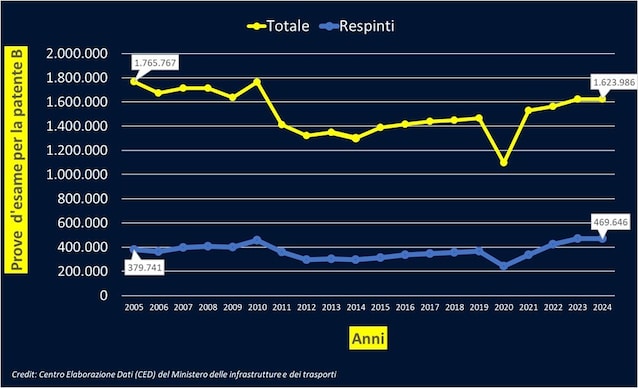
The data of the Ministry of Infrastructure and Transport tell us that, overall, more than 1 out of 4 candidate (26.33%) is rejected, with shares ranging from 18.97% in Sicily to 35.73% in Sardinia. The province in which you are most rejected is however Savona, in Liguria, with 37.74% of rejected candidates, while the one with the highest suitable rate is the Sicilian Ragusa (85.80%).
In short, taking the license today is no longer as simple as one might think.
In particular, to be more difficult to overcome is the theory exam, in which more than 1 candidate out of 3 (38.01%) is rejected at national level. Sicily is confirmed by the region with the lowest rejection rate (32.14%), in particular in Ragusa (25.15%) while in Trentino-Alto Adige that are more rejected (42.78%), in particular in Bolzano (45.08%).
Once the rock of the theory has been passed, the road turns out to be downhill: at national level, only 14% are rejected to the driving exam. In practice, however, stronger territorial differences emerge, with percentages ranging for just over 2% for Campania to over 32% in Sardinia.
The possible causes of the increase in rejected to the exam tests for the license
A first motivation can be sought in the choice of preparation for the theory exam: almost two thirds (63.61%) of those who choose to rely on a driving school are promoted, against less than a third (28.95%) of those who choose to apply as a privatist.
However, this gap is not enough to explain the reasons for so many rejection, as at national level more than 96% of the candidates has chosen to rely on a driving school, a percentage almost unchanged compared to 2023, and with percentages that have ranged by just under 86% of the Aosta Valley to over 98% in Emilia-Romagna, Veneto and Campania. This is a sign that the professionalism and training that the guide schools offer to candidates are appreciated and constitute an important reference for the preparation for the achievement of the licenses.
However, in recent years the quiz has been updated with new questions: sustainable mobility, recent signals, anti-pollution regulations. The result? The exam has become more difficult. And the increasingly massive use of electronic devices such as the smartphone contributes to reducing our level of concentration and attention, instead crucial factors to pass a written exam like the current one of the license.
In the evidence of theory, however, significant gender differences do not emerge, with 39% of rejected between men and 37% between women for the categories of lower licenses (A – B – BE – AM – BS) and 32% for both sexes in the other categories.
A further element of disparity can be found in the age of candidates. Not all licenses issued in 2024 are “young”. In fact, by examining the data, it is noted that, out of a total of 1,193,480 licenses achieved in 2024, only 738.133 (about 62% of the total) were achieved by children with an age of less than 21 years. Further 140,202 licenses (12% of the total) were achieved by young people between 21 and 24 years old. This means that more than a quarter of the candidates are 25 or more years.
The idea of ”taking the driving license immediately” is in fact less felt than in the past, as especially in large cities there are many who prefer public or alternative transport to move. However, the license is not just a piece of paper: for many young people the entrance door to an indispensable mobility for work and life needs. And the drop in overcoming the theoretical exams tells us that more attention is needed to training, but also that the new generations are experiencing mobility in a different way.