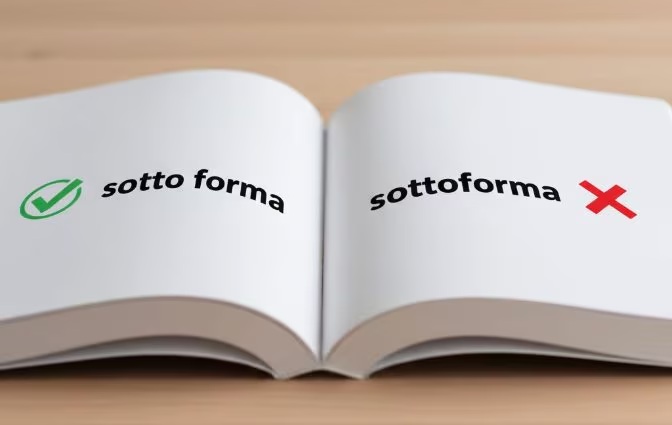
Is it written “alongside” or “next to”? “In form” or “in form”? “OK” or “alright”? Beyond or afterlife? It often happens that many Italians have doubts about whether or not to write two terms by separating them (or interposing an apostrophe between them), and grammatical errors are the order of the day. The causes are to be found primarily in the evolution of the language: once upon a time, in fact, many words were separate, and only later were they united. Then there is the aspect of phonetic perception: words pronounced quickly can in fact seem like a single word.
In this article we therefore clarify a series of words that we most often write wrong, explaining when they should be combined, when separated and why.
The words that are written together
In our language there are some compound words which, having undergone a process of univerbation (i.e. the union of two words into a single lexical unit) do not require separation, under penalty of spelling error. An example of this are the words where, well, until (since it is an archaic form), so far, or, nevertheless, such, still, sometimes (which some of us separate, mistakenly, with apostrophes), sometimes, in front and background.
Adverbial and subjunctive phrases, therefore, generally go together: not even, not even, although, if anything, although.
The words that must be written separately
Then there are words that must be strictly separated, even though it seems to us, when pronouncing them, that they should be united.
An example of this are the words: above, below, alongside, in place, common sense, on the other hand, in agreement, in form, all one and all at most.
The expressions whose spelling is correct in both cases
Then there are expressions that are accepted both together and separately, such as so and so that, after all and after all (the first form is more common), exceedingly and beyond way (the first form is more common), much less and much less (the first form is more common), moreover and for another or mostly and mostly.
Then there is the adverbial phrase beyond (which means “on the other side” or independently of”) and which is completely different from the noun afterlife, which indicates the world beyond death.









