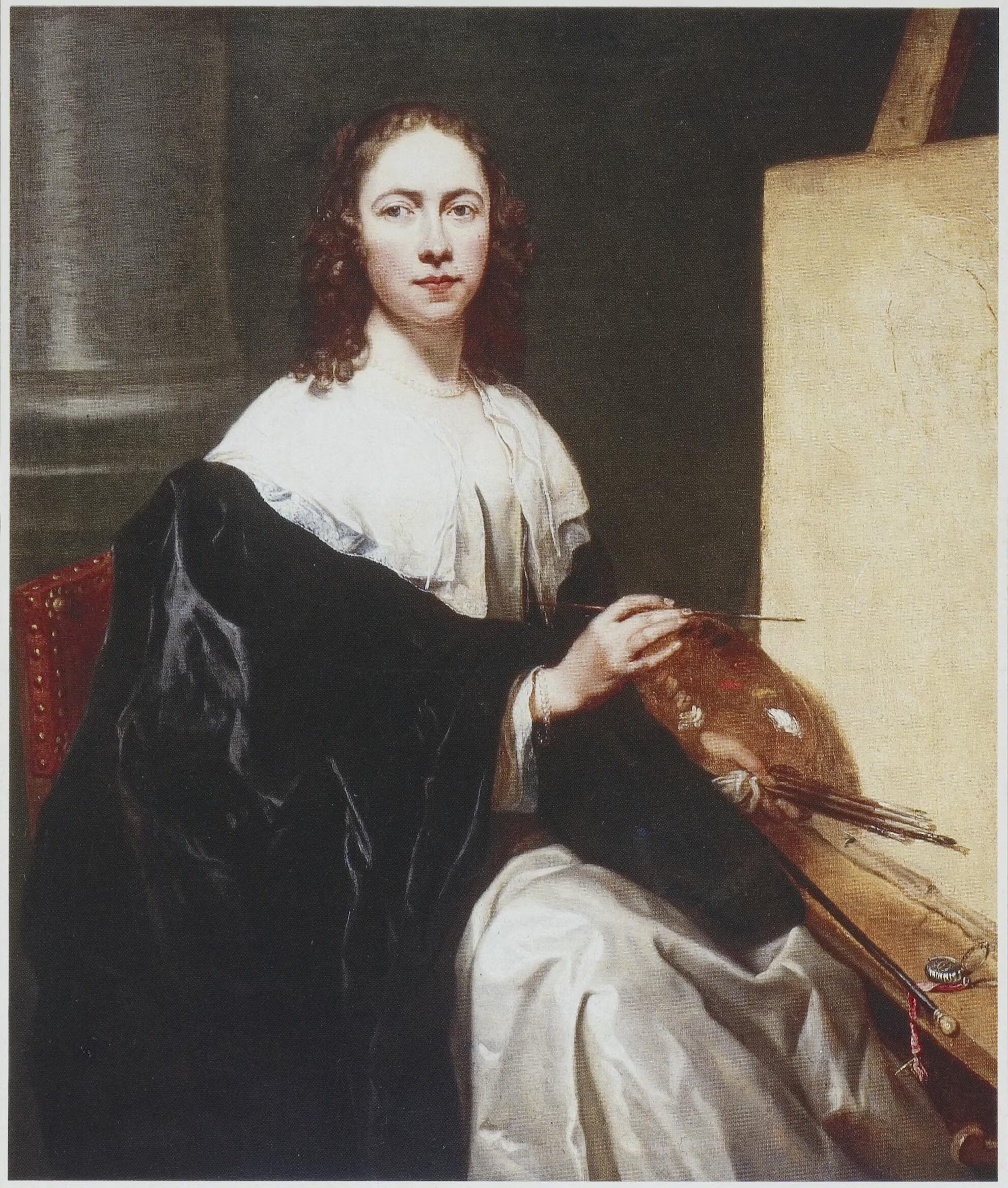
You have probably never heard of Michaelina Wautier: for years, in fact, the paintings of this Flemish painter, active in Central Europe in the mid-17th century, were attributed to male artists who were her contemporaries. Only recently has her work been rediscovered – as had already happened for other artists, including Artemisia Gentileschi – and its importance in the history of world art has finally been recognized. She is the only female Baroque artist to have had such a notable production in terms of variety, size and number of works.
Little is known about her life, born in 1614 in Mons, in what is now Belgium, she had an older brother who worked as a professional artist. What we can deduce from his works was that he had access to rare pigments (such as ultramarine, derived from lapis lazuli) and that he prepared the canvas with layers of paint to study its influence on the colors. Not only that: given that several of his paintings were part of the collection of the Archduke of Austria Leopold Wilhelm, then governor of the Spanish Netherlands, it is assumed that he had a connection with the aristocracy.
Wautier created portraits, large-scale historical and mythological scenes and still lifes. His technical skill and the freedom with which he experimented were so astonishing that, for a long time, scholars could not believe that those paintings were really his work. Michaelina Wautier’s canvases were thus attributed to male artists, such as Antoon van Dyck or even her brother Charles, because it seemed impossible that a woman in the Spanish Netherlands of the seventeenth century could try her hand at so many different genres, and do so with such mastery.
What brought the truth to light, thirty years ago, was a discovery by the art historian Katlijne Van der Stighelen, who came across a painting by this artist in the archive of the Kunsthistorisches Museum in Vienna, the grandiose “Triumph of Bacchus”: a huge oil painting measuring 2.7 meters by 3.5 meters depicting a parade of drunk, writhing, naked people. “I couldn’t believe my eyes“Van der Stighelen told the Guardian “I know 17th century Flemish painting well, but when I saw this painting I couldn’t compare it to anything I knew“. The archivist informed her that it was believed to be the work of a woman. Thus began a very long journey, now ending with the largest exhibition of Wautier’s works ever held.
As Van der Stighelen herself points out to the Guardian, such an extensive and varied production is an absolute unicum for female artists of the Baroque era: “At the time there were excellent female artists who painted flowers or still lifes, but in general their works were much smaller than those of men, largely because they did not have their own workshops. Wautier is a complete exception to the rule“. The sensitivity he exhibits in these works is also very modern.
Today Michaelina Wautier is finally recognized as one of the most extraordinary figures of her time, capable of competing with masters of the caliber of Peter Paul Rubens and of rewriting, with her talent, a forgotten part of art history.