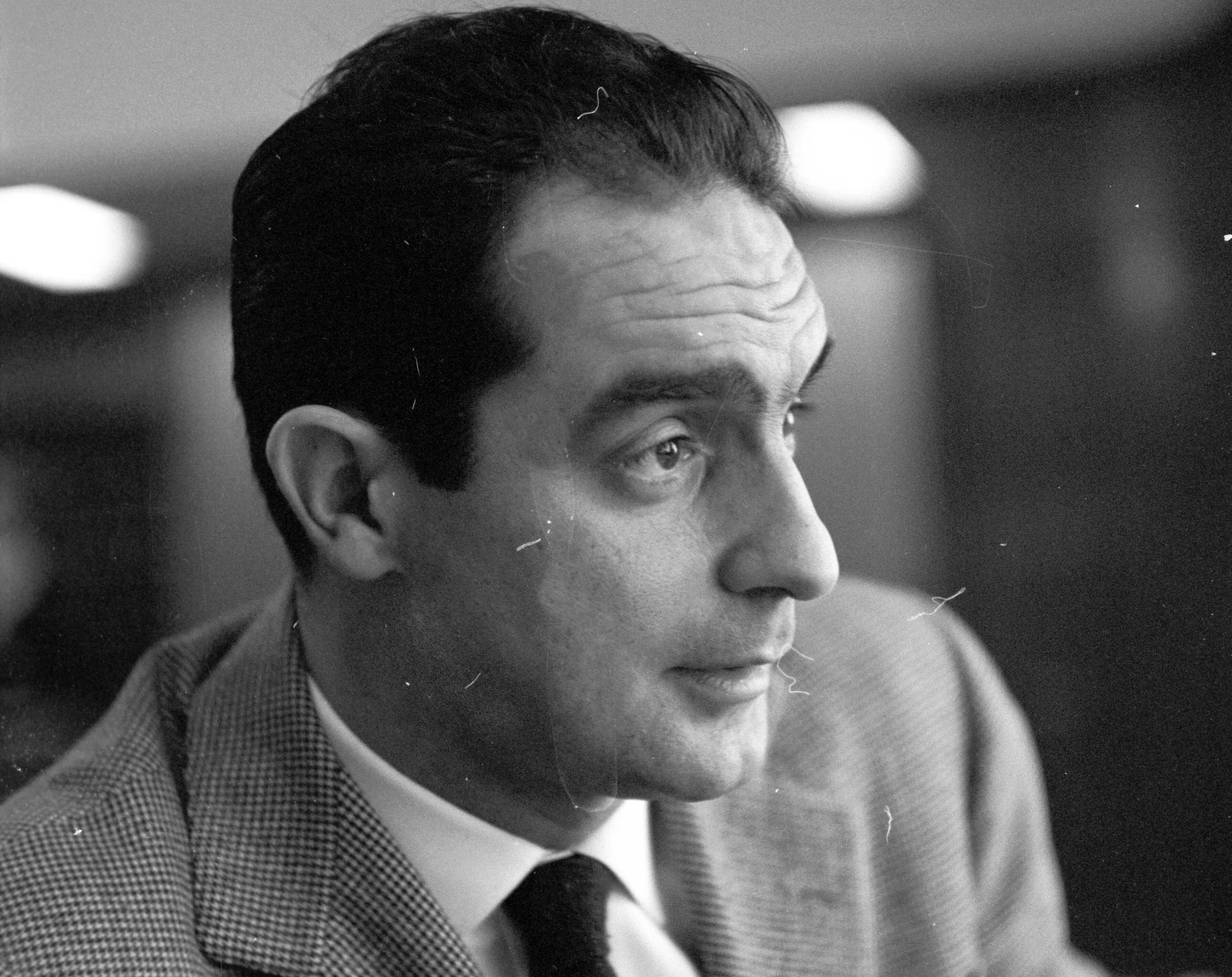
Italo Calvino is one of the most eclectic and well-known Italian writers at home (and abroad!), who has written some of the most important titles in Italian literature, including novels, short stories and essays, from The spider’s nest trail (1947) a Invisible cities (1972), from the trilogy Our ancestors to the adventures of Marcovaldo, Calvino was also the author of comics and song lyrics and worked for a long time for the Einaudi publishing house.
He died on 19 September 1985 in Siena, at just 61 years old due to a stroke, while he was concluding his famous American Lessonsintended for students of Harvard University. He therefore did not see the New Millennium, even if he hypothesized the three talismans to carry with him: learning many poems by heart, even when elderly; preferring those things that require effort, distrusting ease and “knowing that everything we have can be taken away from us at any moment”.
Here are some curiosities about the author that you may not know, such as the fact that an asteroid was named after him, 22370 Italo Calvino, discovered on 15 October 1993 by the Bassano Bresciano observatory.
He was not born in Italy, but in Santiago de Las Vegas, Cuba
Calvino was born on October 15, 1923 in Cuba: precisely in Santiago de Las Vegas, near Havana. His parents, both scholars of natural and agricultural sciences, ran an experimental floriculture station there: Mario Calvino, a Ligurian agronomist and botanist from Sanremo, and Eva Mameli, a botanist and naturalist of Sardinian origins, decided to call him “Italo” also to underline his Italian origins, despite having been born abroad. The name was chosen by the mother so that she would not forget the homeland of her ancestors.
Calvino, in his brief biographical notes, sometimes replaced Cuba, of which he had no direct memories due to his young age, with Sanremo as his place of birth. He returned to the island in 1964, when he met Ernesto Che Guevara in Havana. Even today, Cuba dedicates a cultural committee and a biennial literary prize to him.
Sanremo has become the city of flowers thanks to the Calvino family
The family returned to their homeland two years later and the future writer spent his childhood in Liguria, not only among the native and spontaneous vegetation, but also among the gardens full of exotic species looked after by his parents (avocado, papaya, guyaba), developing a very specific imagination linked to nature. Not everyone knows that it was the work of the Calvino family that contributed to transforming Sanremo into the city of flowers. He was the firstborn: in 1927 his brother Floriano was also born in Sanremo. The family was made up of scientists, while he, he joked, was the black sheep who had devoted himself to literature: he enrolled in Agriculture, first in Turin and then in Florence, but he did not complete that path and after the war he switched to Literature, graduating with a thesis on Joseph Conrad.
Who knows, maybe this naturalistically rich context also inspired the writing of one of his best-known works, The Baron in the Trees, published in 1957 and part of the so-called heraldic trilogy Our ancestorsof which they are also part The viscount halved (1952) e The non-existent knight (1959): the protagonist, Cosimo Piovasco di Rondò, argues with his parents and at the age of 12 climbs a tree in the garden, declaring that he will never come down again. Cosimo was also inspired by the botanist Libereso Guglielmi, a friend of Calvino, and by a story he heard in a tavern in Rome.
He was a great fan of comics, cinema and songs
As a child, Italo Calvino was a passionate reader of comics, particularly those published in the Corriere dei Piccolialso said Courierthe first Italian weekly comic magazine, published from 1908 to 1995: he cut them out and recomposed cartoons and plots, developing his narrative skills early and internalizing a visual language that would return a few years later. Calvino himself ended up, in the following years, on what became the Children’s Courier, with the publication of some stories taken from the collection of twenty short stories Marcovaldo or The Seasons in the City, illustrated by Sergio Tofano.
In adolescence, intolerant of fascist ideology, he took refuge in the cinema, spending most of his afternoons consuming films and writing reviews, but also in humorous weeklies and above all in drawing: he signed himself Jago and published some of his humorous cartoons in the «Il basket» column of the magazine Il Bertoldo, in 1940.
Furthermore, he also wrote the lyrics of some songs, with music by Sergio Liberovici, as part of the counterculture movement of Cantacronache, a musical and literary collective founded by Fausto Amodei, Michele Straniero and Liberovici, active in Turin between 1958 and 1962 and considered a precursor of Italian songwriting. Among these lyrics Where does the vulture fly?written together with Liberovici in 1958 and sung by Pietro Buttarelli, anti-militarist songs very famous in the post-war period; Over the bridge, dedicated to the partisan resistance, with a dialogue between an elderly former partisan and a girl and Sad song, dedicated to blue-collar work and grueling factory shifts. Along with these, there were also the Storyteller intended for children.
He was a fervent anti-fascist, active in the Resistance
He often repeated: “The Resistance brought me into the world”, considering it the experience that most of all was at the origin of his writing, even before his studies. During the German occupation he fought with Garibaldi’s partisan brigades in Liguria: he enlisted in the XVI detachment of Garibaldi’s IX brigade in 1944 and chose “Santiago” as his battle name, to remember his place of birth. Following the disbandment he re-enlisted in a Badogliana blue band and then returned to Garibaldi’s brigades. He participated in several battles, including that of Bregalla, victorious, and that of Baiardo, where they were defeated, and, captured, managed to save himself from being shot.
The partisan spirit accompanied him throughout the post-war period, as an «aptitude to overcome dangers and difficulties in moving forward, a mixture of warrior pride and self-irony (…), an attitude that was sometimes a bit boastful and truculent but always animated by generosity (…)», as he wrote in Youth political autobiography (1962). After the Liberation he became an activist of the Italian Communist Party, first in Imperia and then in Turin, where he met Cesare Pavese and Elio Vittorini and began to collaborate on the Milanese magazine Polytechnic and then to the newspaper The Unity, responsible for the cultural page.
His communist militancy continued even during the years of the Cold War, during which he traveled extensively as a journalist.
He was a severe editor: the teaspoon theory
In an autobiographical text in 1980 he wrote: «Working in a publishing house, I dedicated more time to other people’s books than to my own. I don’t regret it: all that is needed for civil coexistence as a whole is energy well spent.” Calvino in fact worked for decades with the Einaudi publishing house, starting from the end of the Second World War, collaborating with figures such as Cesare Pavese and Elio Vittorini. At first he sold books in installments, then moved on to the role of editor, press office and editor.
He devoted himself for years to evaluating unpublished manuscripts, as well as maintaining relationships with authors and translators. It is no coincidence that the prestigious literary prize dedicated to debuting Italian writers bears his name: it was founded in Turin in 1985, shortly after his death, on the initiative of a group of friends and colleagues, from Norberto Bobbio to Natalia Ginzburg, conceived by the scholar Delia Frigessi.
His rejection letters to the authors of the manuscripts became famous: they were real mini-critical reviews that explained to the authors how to improve the text. Many of them (about five thousand!) are preserved in the Einaudi archive and some have been published since the nineties. Calvino maintained that he didn’t need to read an entire book to judge it: in fact, “a teaspoon”, that is, a few lines chosen at random, was enough to understand if the prose held up.