The rhombus of the engines that pierces the peace of the park, the red tide after the Ferrari victories and the very high speeds are distinctive features of the Monza National Highcon, the circuit where the Formula 1 Italian Grand Prix is held every year. I 5,793 meters Asphalt with 11 curves, this year protagonists during the weekend from 5 to 7 September with the race scheduled for Sunday at 15.00, constitute the “Temple of speed”, a place where – for better or for worse – the history of Motorsport was written.
The Brianza track, born in 1922, was modeled in its over 100 years of history because of its very nature. The long straights and the iconic elevated curves of the speed ring, combined with the constant technological innovation that made the cars faster, were the scene of numerous and tragic accidents which over time have imposed an adaptation of the circuit to ensure the safety of the pilots and the public. These changes have not distorted the soul of the motor driver which still remains the fastest route of the Formula 1 championship today (for average speed – 264.362 km/h). In its long history, the Lombard asphalt, which can be visited all year round with special tours, was the theater of numerous Ferrari triumphs, a stable that has a strong link with this track as demonstrated by the 20 victories obtained at the GP of Italy in history.
The origins of the National Autodrome of Monza where the Formula 1 Grand Prix is held
In the early 1920s, the Italian car manufacturers returned from excellent results abroad, were looking for a level headquarters to host the Italian Grand Prix. So it was that in 1922 the Automobile Club of Milan, on the occasion of the 25th anniversary of the Association, decided to build the Monza autodrome. With an initial cost of about 6 million lire, the track was built inside the Monza Park in record time: it took only 110 days (from May 15 to July 28) thanks to the use of 3500 workers and numerous means of work. The original design of the third permanent selfodrome in the world after Indianapolis and Brooklands, provided for a total of 1st km of asphalt, divided into two routes that intersected on two levels through an underpass; 5.5 km were part of a road route and 4.5 km were a speed ring with two elevated curves combined with two straight of about 1 km capable of reaching the theoretical speed of 180/190 km/h.
In the years following the official opening on 3 September of the same year, several car and motorcycle competitions were played on the Brianza circuit as well as numerous attempts at speed records. Currently, it is owned by theMONZA National Autodromo Company Increment Authority and Sport SIS SPA.
The accidents that have changed Monza and Formula 1
With the limited safety standards of the time, the Monza circuit was a ruthless track, where the safety of the pilots, but also that of the public, were not guaranteed. Some tragic accidents demonstrate this which have not only imposed changes to the circuit, but have also marked a turning point for safety in motorsport.
Mattress accident (1928)
During the 17th round of the 8th Italian Grand Prix, the Italian pilot Emilio Materassi who ran with the Talbot during an attempt to overtake on the reptilinear after being at great speed from the last curve I stumbled upon and ended at full speed on the stands on the edge of the track. The balance was tragic, in addition to mattresses, died 21 spectators. However, the race was completed and won by the French Chiron. The Italian Grand Prix was suspended for two years and, for safety reasons, more slow alternative tracks such as the “Florio Circuit” 6,680 meters.
Triple mortal accident of 1933
In 1932 he returned to the use of the complete route until 10 September 1933, when the Monza racetrack lived his “black day”. During the Monza Grand Prix – a competition separated from the Italian Grand Prix – three of the greatest pilots of the time lost life: Giuseppe Campari, Baconin Borzacchini and Stanisław Czaykowski. The tragedy took place in two distinct accidents: during the first heat, Campari and Borzacchini came out of the track at the same point, probably due to one oil stain left by another car. Incredibly the race was not interrupted and, in a subsequent heat, the Polish pilot Czaykowski crashed into the same area as the unfortunate Italian pilots.
Initially, to reduce speeds, artificial chicane which lowered the middle school on the rounds up to about 105 km/h but in 1939 a program of changes was started that changed the face of the circuit: the Historical elevated curves were demolished And the road route was redesigned, leading to the birth of a new 6,300 meters track that was used until the 1950s.
The post -war period marked a new era for the Monza car circuit
At the end of the Second World War, the Monza Autodrome was unusable due to the structural damage caused by its use as a war storage site. Thanks to a restoration project started in 1948, the circuit returned to live the following year, with an inaugural race won by Alberto Ascari’s Ferrari. In 1950 Monza was chosen to host a stage of the first, historic Formula 1 world championship.
The return of the speed ring with the elevates
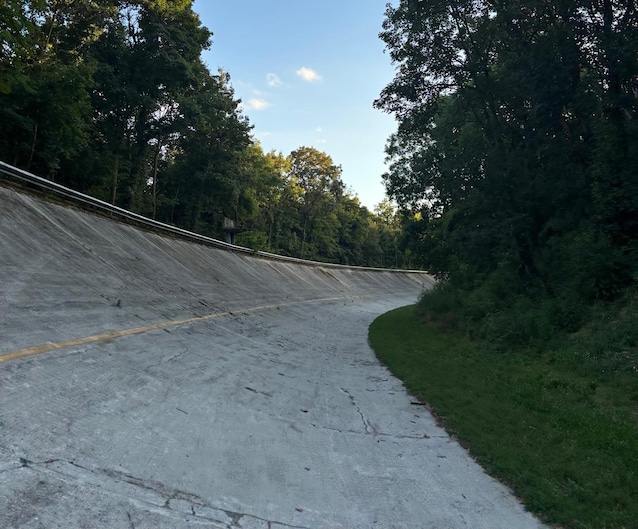
Five years later, the Brianza racetrack underwent yet another change that brought it back to its origins. In fact, a new high -speed ring (the Monza basin) was made similar in the conception to the original one of 1922 but more modern and adequate to new technologies. Built on reinforced concrete structures and not on embankment, the ring, of a total length of 4250 meters, consisted of 2 straights of 875 meters each and 2 elevated curves with a radius of 320 meters and a maximum slope of 80%. These characteristics allowed cars to reach speeds of 285/300 km/h avoiding travel changes and the use of the brakes.
Even the two straights of the road route underwent changes coming together by a new, wide curve with a radius that widens towards the exit, which took the name of “Parabolic”.
The complete 10 km track was the stage of the Italian Grand Prix until 1961 while the only high -speed ring continued to host other competitions, such as the thousand kilometers of Monza and numerous record attempts. In 1955 he was the scene of another tragedy: during an improvised test aboard a Ferrari 750 Sport lost his life, the champion Alberto Ascari, the only Italian to have won the Formula 1 championship 2 times; In his memory, the “Variant of the Vialone” today bears his name.
Von Trips accident (1961)
On September 10, 1961, during the second lap of the Italian Grand Prix, the most serious tragedy in the history of the circuit and Formula 1 known as “The massacre of Monza” was consumed. Wolfgang von Trips, behind the wheel of his Ferrari and in full struggle for the world title, was approaching the detached of the parabolic curve. After a contact with the Lotus of Jim Clark, the Ferrari of Von Trips came out of the track ending up against the fragile networks to protect the public. In the impact, the pilot was thrown out of the passenger compartment, dying instantly and the car plunged on the crowd on the track killing 14 spectators. Also in this case, the race was not interrupted, and his teammate Phil Hill won the race and the world title, becoming aware of the tragedy only at the end of the Grand Prix.
The painful event led to the introduction of new safety measures for the public and the definitive abandonment of the high -speed ring for Formula 1. Today, the iconic curves are still standing and it is possible to visit them to realize the person of their impressive slope.
The changes that brought the circuit to the current conformation
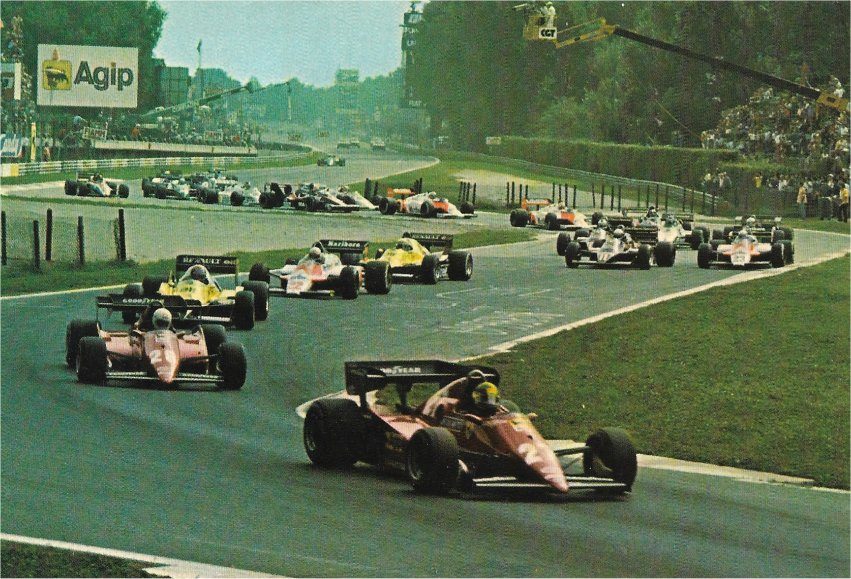
Despite the numerous accidents, also mortal, Monza is the circuit that hosted the most great prizes in the history of Formula 1 (over 70 editions), remaining a fixed appointment in the calendar for a reason: the show. His long straights have always given exciting races, dominated by scie games and arrivals to the photo finish, as happened several times in the early 70s.
At that time, technological progress – from the introduction of more efficient tires to the Alattoni – had pushed cars at average speeds close to 250 km/h. To ensure further security, the main changes took place in two phases. In the 1972 were inserted some Provisional chicane To slow down the straights that in 1976 were replaced by permanent and slower variantswho made the safest track while keeping his DNA.
This configuration remained almost unchanged for almost twenty years. After the death of Ayrton Senna in 1994, the consequent revolution in the security field led to further small changes also in Monza. The last significant modification dates back to 2000with the redesign of the 1st variant (the “variant of the reptifile”) in the right-left configuration that we know today, an iconic point that has become iconic of the 5 793 m route.