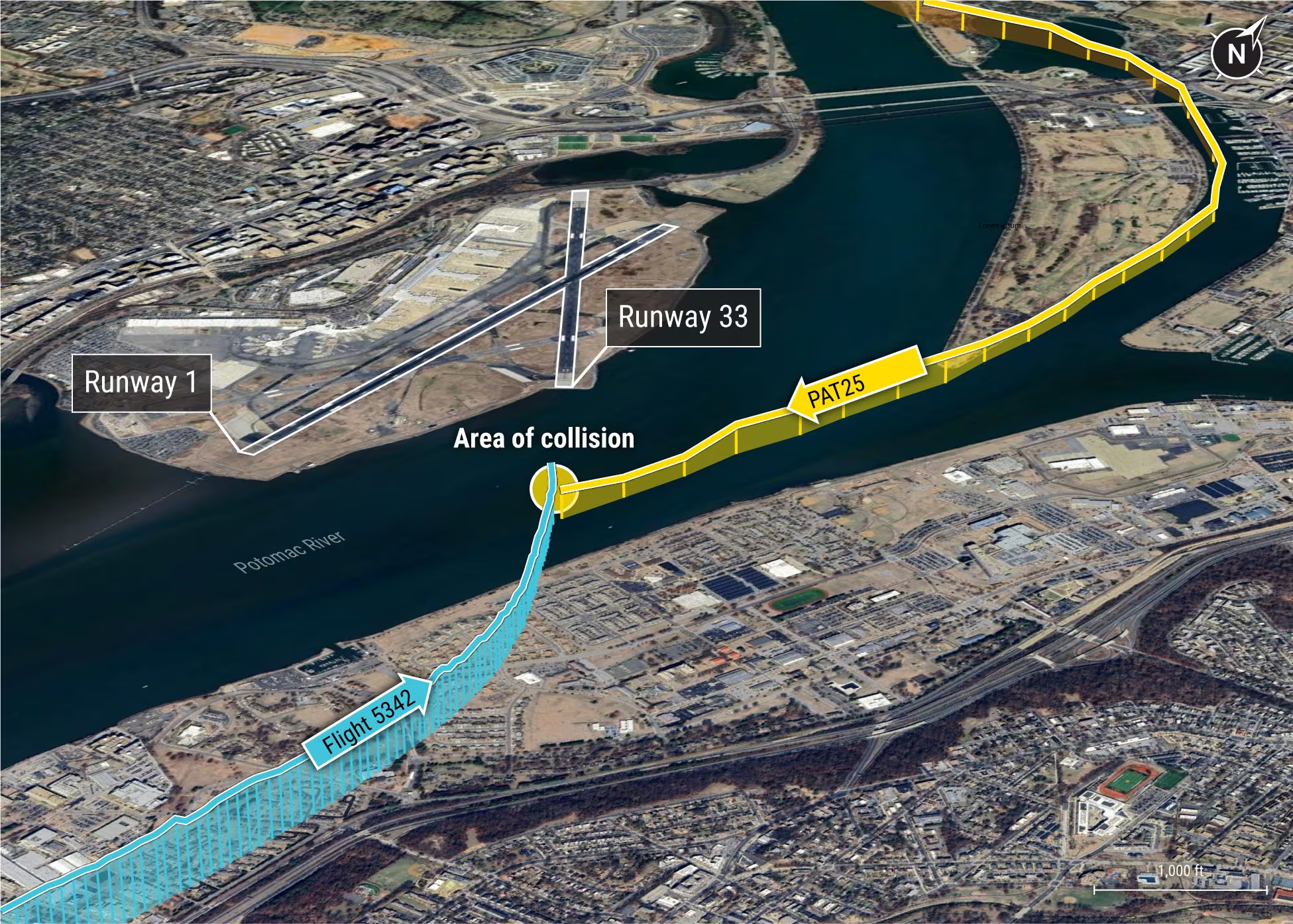
The Washington plane crash was the result of a “multitude of errors” and systemic problems linked to various organizations: this is what has been established by National Transportation Safety Board (NTSB, the US transport safety agency) on the disaster that on January 29, 2025 caused the death of 67 people following the collision between an airliner and a military helicopter.
The authority confirmed that the accident, which occurred at Ronald Reagan airport in Washington DC, was entirely avoidable and was to be attributed to the FAA’s decision (Federal Aviation Administration, the US authority that regulates civil aviation) to allow helicopters to fly near the airport without adequate safety measures (with a single controller managing 11 arriving aircraft), and to the absence of a real-time tracking system on board the aircraft, which would have guaranteed the pilots reaction time to avoid the collision.
The reconstruction of the plane crash that caused the death of 67 people
The January 29, 2025 the CRJ-700 airliner (flight AA5342), operated by PSA Airlines on behalf of American Airlines with 64 people on board, takes off from Wichita, Kansas, bound for Ronald Reagan Washington Airport (DCA).
At 20:15, the aircraft begins its descent towards the airport: at 20:43:06, the CRJ700 contacts the DCA airport tower, which requests whether the crew is available to change approach and land on runway 33.
Three minutes later, at 8.46pm, the control tower transmits an alert to the helicopter military UH-60L Black Hawk (PAT 25) reporting traffic at 1,200 feet on approach to Runway 33. The 3 crew members respond affirmatively, meaning that at that point the helicopter was responsible for visual separation with the approaching jet.
At 20:47:42, the tower orders PAT 25 to pass behind the CRJ700 to maintain separation, but just 18 seconds later, at 8.48pm (02.48 in Italy) the mid-air collision occurs over the Potomac River in Washington DC: both aircraft crash into the river, causing the death of all 67 people involved.
What the National Transportation Safety Board investigation reveals
As confirmed by investigators, Ronald Reagan airport is one of the busiest in the United States, which is why air traffic controllers were often called upon to direct arriving planes to the reserve runway, runway 33, thus placing them in close proximity to helicopters.
This led air traffic managers to overly rely on so-called “visual separation” (see and avoid), a procedure whereby pilots maintain a safe distance from other aircraft based on direct visual observation, which was defined by the NTSB as a practice that “introduced an unacceptable risk” to the airspace.
However, the committee did not hold the pilots responsible for the collision, ruling that the helicopter crew had requested visual separation too early – and therefore would not have had time to notice the second aircraft – while the plane’s pilots were too busy preparing for landing to notice the helicopter’s approach, of which the air traffic controller had not warned them. This last error is probably linked to the fact that, that evening, the management of plane and helicopter traffic had been entrusted to only one person: the NTSB, however, concluded that this lack was not due to the absence of personnel in the control tower.
The investigators finally underlined that if at least one of the two aircraft had been equipped with a real-time tracking system – known as ADS-B In and Out -, the pilot of the plane would have had 59 seconds warning, while the helicopter crew would have been alerted 48 seconds before the collision. The US Transportation Safety Board is now considering making this technology mandatory for all aircraft.
The commission also found that the malfunction of some equipment on board the helicopter contributed significantly to the accident: the pilots of the military helicopter believed they were flying about 30 meters lower than their actual altitude, due to a series of anomalies in the readings of the Black Hawks’ altimeters, of which the Army was aware.
In its conclusions, the NTSB therefore established that the accident – which could have been avoided – was caused by a series of problems and errors related to air traffic management and FAA regulations governing visual separation.
At this point, the authority has issued more than 70 recommendations, aimed at preventing similar incidents. Immediately after the plane crash, the FAA had already limited the number of aircraft that can fly over the airspace surrounding Ronald Reagan Airport, reconfiguring helicopter routes in the area and implementing a plan to simplify monitoring and improve air traffic safety.









