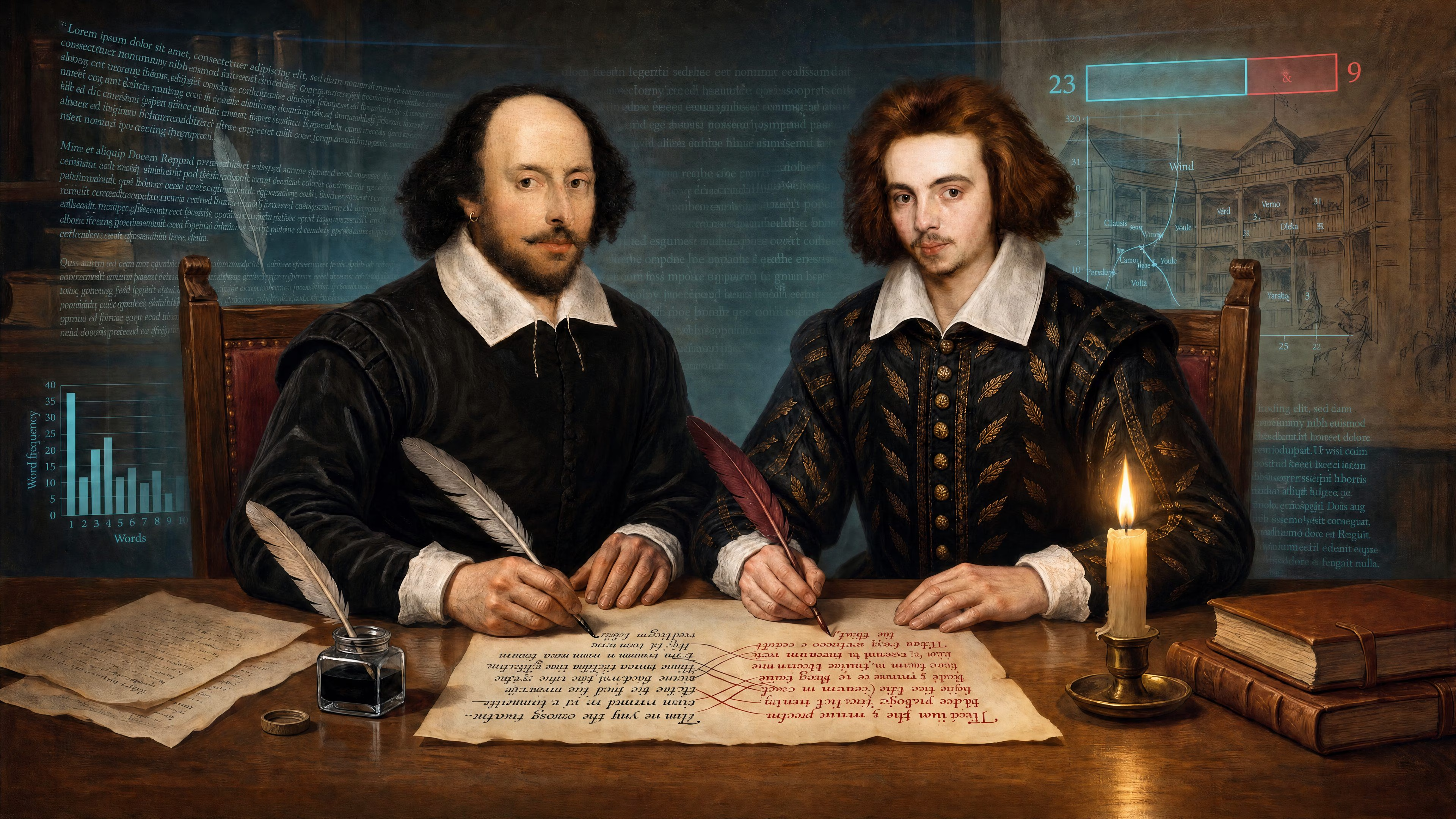
For centuries, literary scholars have regarded Shakespeare as a solitary genius and Christopher Marlowe as his historical rival, but a computer analysis using artificial intelligence has revealed that the two British writers collaborated to write the play “Edward III”. According to research, the main author would be Shakespeare, but part of the text would be by Marlowe. The study, which was reported by the Guardian, will be published in the magazine in November Shakespeare Quarterly.
Edward III, a historical drama centered on the battles of the English king against France, was published in 1596 without the author’s name (which was common at the time) and did not appear in the First Folio (1623), the first collection of the works of the Stratford-upon-Avon playwright.
For this reason, many scholars over the years have hypothesized that there were more than one authors. To verify this, researchers from the University of Kent Rory Loughnane and the University of Leeds Brett Greatley-Hirsch compared the play, divided into segments, with works of certain attribution by ten playwrights active between the late 1580s and mid-1590s. The method measures, for example, the frequency of words and how they combine.
According to Greatley-Hirsch, the evidence is compelling because it is not based on a single statistical test or a single verbal correspondence, but on multiple analyzes of different language features. In particular, in one of the tests it emerged that 23 segments were by Shakespeare, and 9 by Marlowe.
Shakespeare was credited with the scenes in which the king vainly woos a married countess, while Marlowe was credited with parts of the final battles (including the famous surrender of Calais).
Loughnane stated that this research proves the play’s authorship to Shakespeare and co-authorship to Marlowe “beyond reasonable doubt”, discrediting the simplistic theory that sees the two writers as enemies:
We have become accustomed to thinking of Marlowe and Shakespeare as rivals: two exceptional authors, born within weeks of each other, who established themselves in the same theatrical environment in the late 1580s and early 1590s. But we now know that their relationship was much more complex than that. They were not simply rivals or influencing each other.
But this would not be the only collaboration between the two, because a 2016 study by the New Oxford Shakespeare had also recognized Marlowe’s hand in the three plays of Henry VI. Unfortunately, the two writers worked together for a short time, because Marlowe died in 1593 at just 29 years old.
The Guardian University of Kent