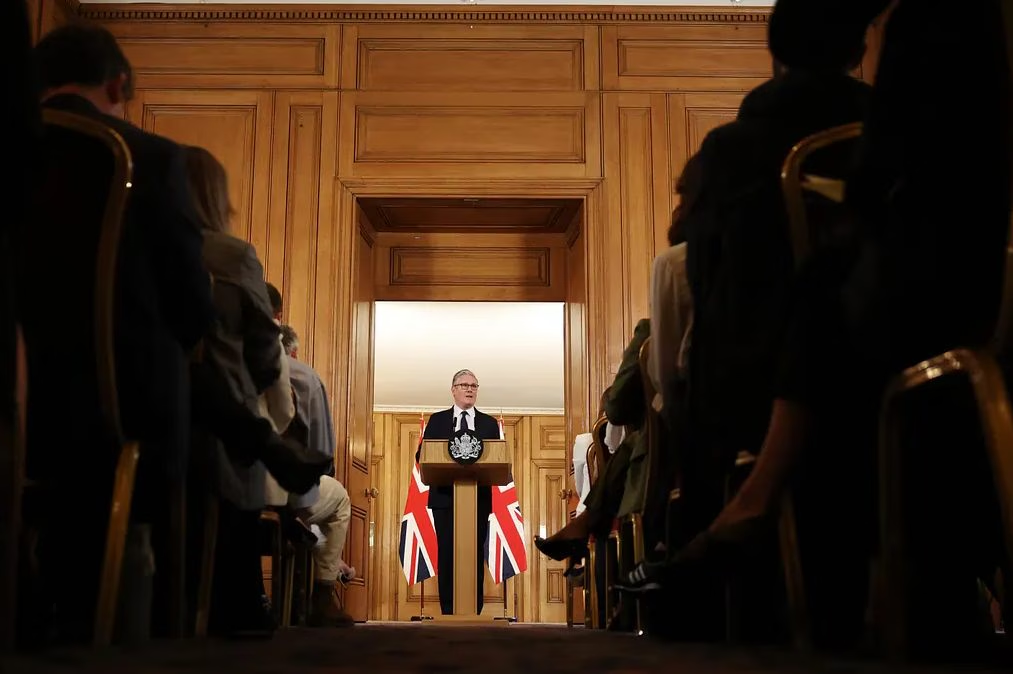
The British government has announced that, starting from spring 2027, the main social platforms will no longer be able to offer their services to anyone under 16. The announcement comes from Department for Science, Innovation and Technologywith British Prime Minister Keir Starmer and Technology Secretary Liz Kendall, and is the result of a public consultation involving over 116,000 people including parents, children and experts. As reported on the British government website, the objective is to protect minors from the possible dangers of the internet: the intention is to ban the use of social networks such as Snapchat, TikTok, YouTube, Instagram, Facebook and X.
One thing needs to be said straight away: the UK is not starting from scratch. In the same press release, the government declares that it intends to follow the same model already adopted by Australia, the first country in the world to have introduced a similar measure. And he is not the only one looking in that direction: in recent months several European governments have put similar proposals on the table, with different thresholds and timescales. Let’s see what the British plan actually provides and how it fits into this global framework.
What does the UK plan actually involve?
The measure concerns what the government defines as “user-to-user” platforms: services designed for social interaction, which allow you to publish content and which are based on recommendation algorithms. This category includes Snapchat, TikTok, YouTube, Instagram, Facebook and
The provision, however, goes beyond the simple ban on registration. Starmer’s government will also introduce restrictions on some functions considered particularly risky, such as live streaming and the possibility for strangers to contact minors directly: these functions will be deactivated by default not only for under 16s, but also for 17 year olds, to avoid a too abrupt “jump” when they turn 16. The restrictions will also extend to gaming sites. On the artificial intelligence front, “companion” chatbots with romantic or sexual roleplay functions will have to set a minimum age of 18.
In terms of timing, the government aims to bring the new rules to Parliament by Christmas, using the powers already provided by the Children’s Wellbeing and Schools Act to act through secondary legislation without having to wait for an ad hoc law. The first rules could therefore come into force as early as spring 2027. A key task has been entrusted to Ofcom, the British communications authority, which will have to carry out a rapid study on which age verification systems are really effective and present an enforcement strategy.
From Australia to Europe: who has already taken (or is about to take) the same step
The reference to Australia is not accidental. The “Online Safety Amendment (Social Media Minimum Age) Act 2024” came into force on 10 December 2025 and requires platforms to take “reasonable measures” to prevent anyone under 16 from creating or maintaining an account. According to the eSafety Commissioner, the Australian authority that oversees the implementation of the law, the platforms affected include Facebook, Instagram, Snapchat, TikTok, X, YouTube, Threads, Twitch, Reddit and Kick, as well as other services who have self-assessed themselves as falling within the obligation. Fines for systematic violations can reach up to 50 million Australian dollars. For age verification, eSafety has indicated a “cascade” approach (multiple successive checks, not just one) and explicitly excludes the use of government identity documents. It is precisely on this point – the real effectiveness of age verification systems – that the United Kingdom says it wants to “learn from the Australian experience”, introducing checks defined as “highly effective”.
At the European level, the picture is even more fragmented. On 26 November 2025, the European Parliament approved a non-binding resolution calling for the minimum age for access to social networks, video sharing platforms and artificial intelligence-based “companions” to be set at 16, with an exception between 13 and 16 in the case of parental consent. The resolution, passed with 483 votes in favour, 92 against and 86 abstentions, also calls for stricter rules on Digital Services Act and the default deactivation of features such as infinite scrolling or autoplay for minors.
On a national level, France is the most advanced European country: at the end of January 2026 the Assemblée Nationale approved at first reading a bill that prohibits access to social media by minors under the age of 15, with the declared aim of having it come into force from September 2026 for new accounts and to extend verification to existing accounts by the end of the year – the text has yet to pass the Senate. Similar thresholds (between 14 and 16 years) are also under discussion in Spain, Denmark, Greece, Austria and Norway, while in Italy a proposal that would set the limit at 15 years has been stalled in the Senate since 2024, although discussions resumed in April 2026.
An element that connects all these attempts is precisely the technical issue of age verification: without a reliable system, any age threshold risks remaining on paper. It is no coincidence that the European Commission is working on an age verification app common to the 27 member states, to be tested in some countries including Italy. It is probably on this basis, rather than on the exact number chosen by each government, that we will understand whether measures like the one announced by the United Kingdom will really work.