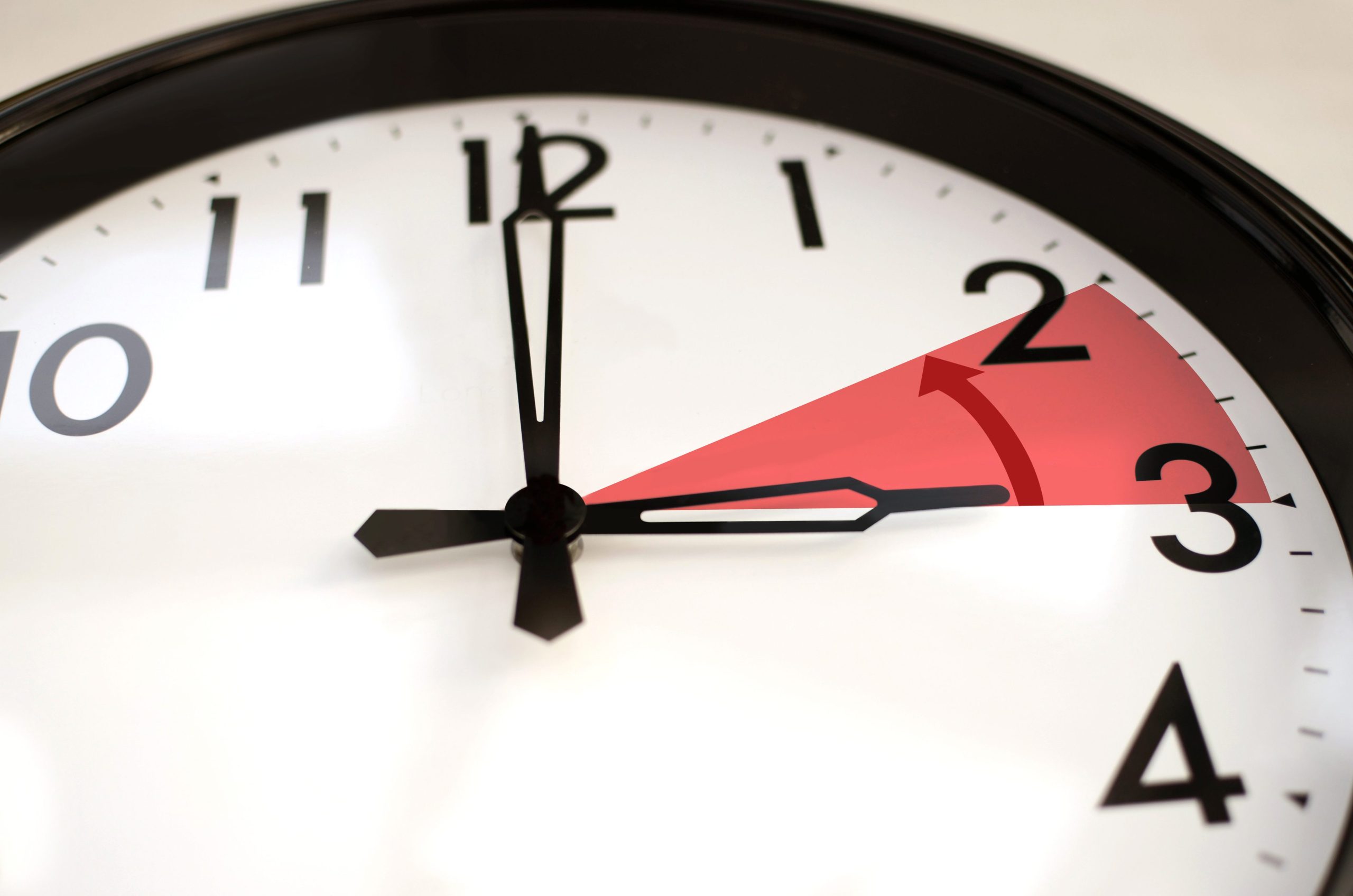
In Italy, the change of time is approaching with the return to solar time: on the night between Saturday 25th and Sunday 26th October 2025, the hands of the clocks will move one hour back, with 03:00 becoming 02:00. In this way, in addition to sleeping an extra hour, we will gain an hour of light in the early morning, but we will lose an hour of light in the late afternoon.
The time change, in reality, will come into force at the same time throughout the European Union: solar time is so defined because it follows the apparent motion of the Sun, placing midday (i.e. 12) around the moment in which the Sun reaches the highest point in the sky. This is in fact “natural” time, allowing you to take advantage of natural lighting in the early hours of the morning: in Italy the alternation with summer time (during which time shifts forward by one hour) was experimented for the first time in 1916, but has been officially in force since 1966.
The debate on the possible elimination of the time change is still open today: the European Parliament has been discussing it since 2018 and in recent days the Spanish Prime Minister Pedro Sánchez said he wanted to propose to the EU the definitive abolition of the alternation starting from 2026.
Standard time returns on October 26, 2025: hands moved back 60 minutes
Like every year, the transition from summer time to standard time is set for the last Sunday of October, which in 2025 is equivalent to October 26th. In particular, the time change is expected in all EU countries at 1:00 UTC (coordinated universal time, i.e. the Greenwich Mean Time zone), which in Italy corresponds to 3:00 in the morning.
On Sunday 27 October, therefore, the hands will be moved back an hour, transforming 3:00 into 2:00: the return to solar time will bring forward the times of sunrise and sunset by 60 minutes, giving us an extra hour of light in the early morning, but taking away one in the evening.
In reality, many clocks, such as those on our smartphones or computers, will update automatically without any need for intervention on our part. Analog clocks, on the other hand, will have to be manually set back one hour.
When daylight saving time will return next year: date and time
Standard time will remain in effect until the last Sunday of March: on 29 March 2026 summer time will then return and the hands will move forward by one hour, with 02:00 at night becoming 03:00.
This alternation of the time, which is still discussed at a European level today, was tested for the first time in Italy in 1916, with the aim of guaranteeing greater energy savings during the First World War. After 50 years of uncertainty, in 1966 the entry into force of summer time became official with Law n.1144. Then, in 1996, the time change was adopted throughout the rest of the European Union with the application of a common calendar.









