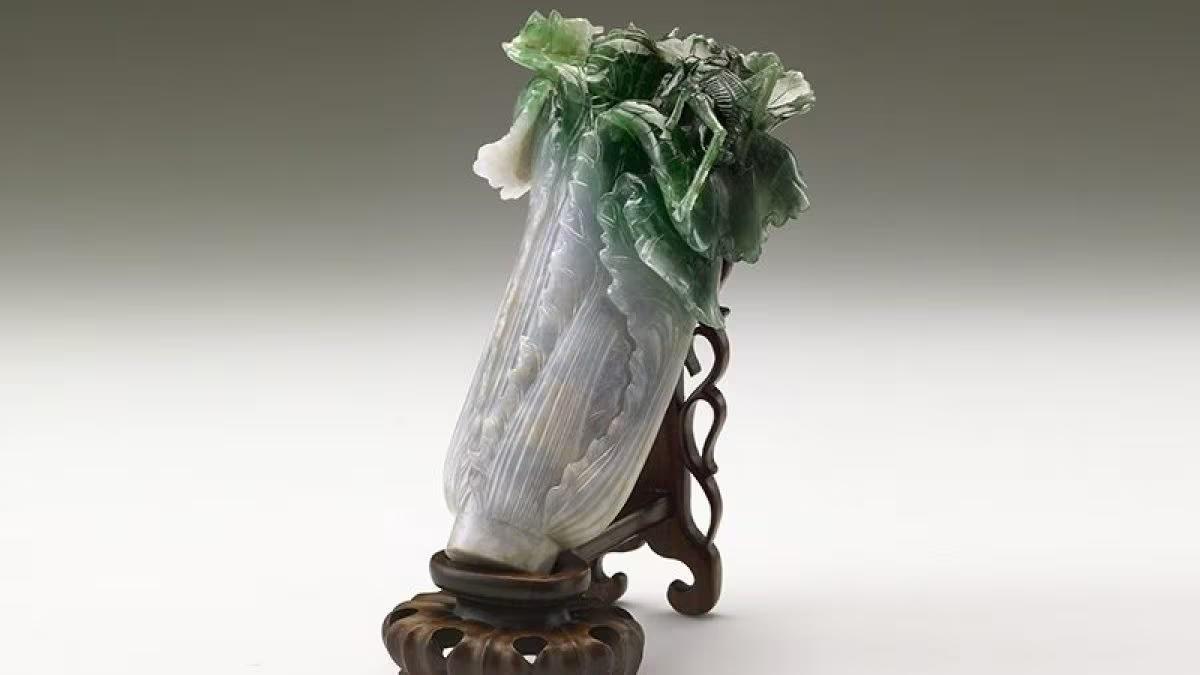
It often happens that museums, despite hosting varied and rich collections, become famous for one work of art in particular: Botticelli’s Venus at the Uffizi Galleries, the Mona Lisa at the Louvre and the Rosetta Stone at the British Museum alone attract hordes of visitors from all over the world. Even more unusual artefacts can attract attention: this is the case of the National Palace Museum in Taipei, where the absolute protagonist is a Chinese cabbage sculpted in white and green jadeite, just 18 cm high, which portrays the vegetable with astonishing realism. Hidden among its leaves are also a green grasshopper and a locust. Considered a “national treasure” of Taiwan, this sculpture comes from the Forbidden City and combines symbolism, technical skill and a good dose of marketing that have turned it into a true celebrity.
The Jadeite Cabbage, like much of the National Palace Museum’s collection, is an imperial relic from Beijing’s Forbidden City, transferred to Taiwan during the Chinese Civil War. Exhibited for the first time since 1928, it was moved to its current location upon its opening in 1965.
It is not the only artifact dedicated to Chinese cabbage: at the Palace Museum in Beijing and at the Museum of Tianjin there are others carved in jade, and even the Taipei museum preserves two others. The subject, therefore, is not enough to explain the fame of this little cabbage. Hsu Ya-hwei, professor of art history at National Taiwan University, attributes part of its charm to the natural colors of jadeite and the sensitivity of the sculptor, capable of making the light vibrate on the leaves. However, scholars point out that the quality of the work is in line with many jade sculptures from the Qing Dynasty. What conquers the public, perhaps, is a set of details: the delicacy of the workmanship, the story it brings with it and that immediate familiarity that makes the visitor feel part of a larger story.
This rare piece, likely part of a dowry given to China’s Guangxu Emperor by a consort in the 1880s, has long been associated with female purity, fertility and abundance. A supposition, accompanied by the belief that the locust and the green grasshopper represented children, which, although not historically ascertained, nevertheless captured the imagination of visitors.
Then there is a more earthly aspect: marketing. In 1968, just three years after the opening of the museum, the Taiwanese postal service chose the small cabbage as the subject of a stamp, printed in millions of copies and ended up in the hands of half the country. From then on his image continued to circulate, accompanied by an increasingly affectionate story. Other famous pieces in the museum also recall the world of cuisine – the “Meat Stone”, a jasper that looks like bacon, and the Mao Kung Ting, an ancient cooking vessel covered in inscriptions – and the guides enjoyed bringing them together in a playful trio nicknamed “pork stew with pickled cabbage”.
Wang Shao-chun, a former researcher in the museum’s antiquities division, said in the pages of the internal magazine that the secret of cabbage could be its simplicity. The image of such a familiar vegetable, he says, creates an immediate bridge with everyday life, making even the imperial court, which we often perceive as distant and impalpable, closer. It is perhaps in this balance between humility and history, between everyday cuisine and dynastic splendor, that the formula that transformed a jadeite cabbage into a small celebrity is hidden.