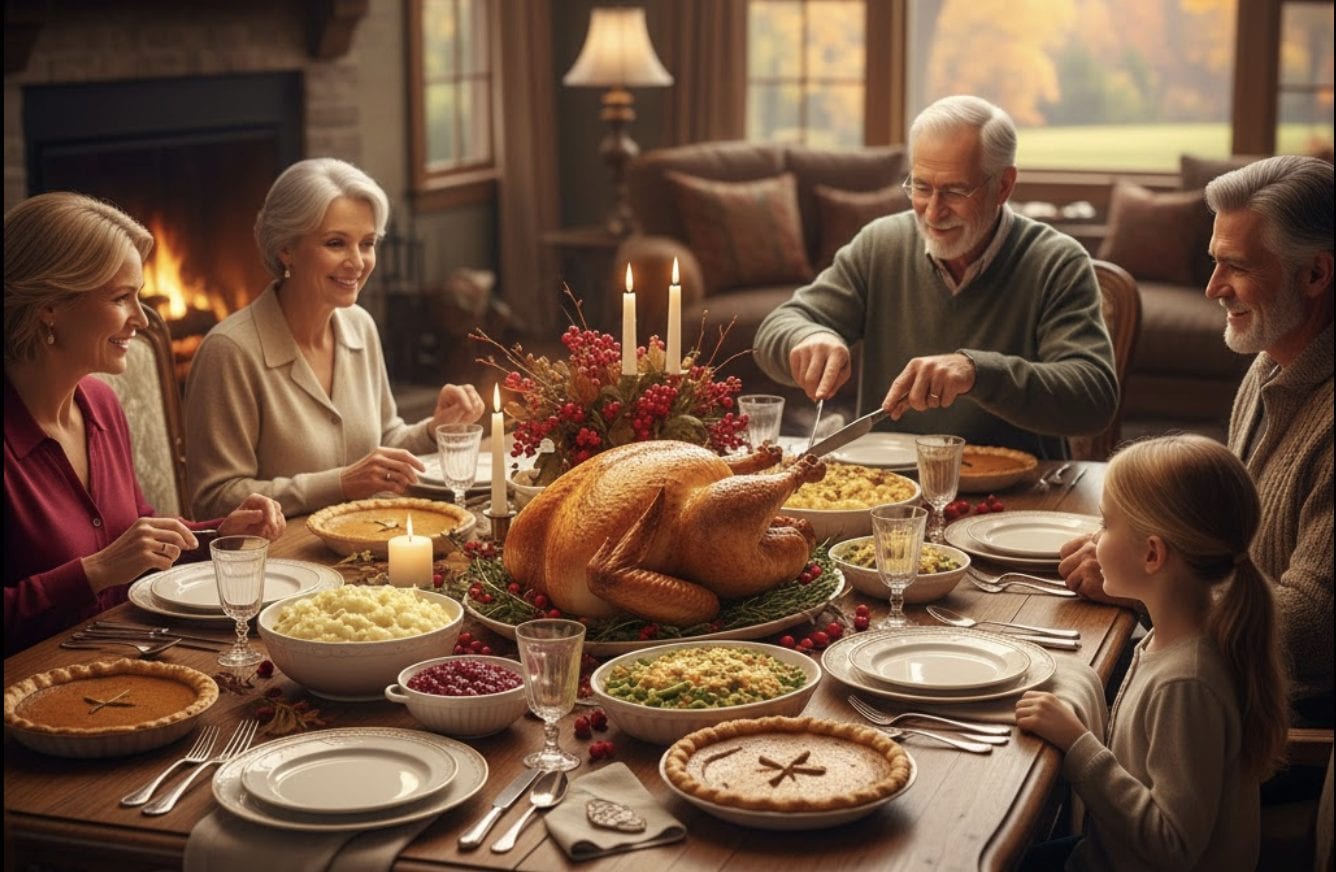
Today, Thursday 27 November 2025, we celebrate Thanksgiving Day, a holiday that in America has been celebrated every year since 1621, the year in which the Pilgrim Fathers celebrated together with the Wampanoag tribe their brotherhood and the prosperity of the harvest obtained thanks to the collaboration of the Native Americans.
But the date of this celebration changes every year, because Thanksgiving falls on the fourth Thursday of November. Also celebrated in Canada, the Caribbean, Liberia and – less officially – also in Brazil and the Philippines, Thanksgiving is deeply felt in the USA for its meaning: giving thanks for what life gives, gathering around a table with family and friends and eating the traditional stuffed turkey.
The history of Thanksgiving Day, a symbol of alliance between English settlers and Native Americans
The history of Thanksgiving Day begins in 1621: the previous year, in 1620, the Pilgrim Fathers, who left England aboard the Mayflower, arrived on the coasts of Massachusetts and founded the colony of Plymouth.
Here, thanks to the collaboration of the Native American Wampanoag tribe, they learned to grow corn, fish and hunt turkeys, typical animals of that region, and thus ensured their survival and prosperity. Precisely in 1621 the English colonists and the Indian tribe celebrated with a lunch thanks for the first abundant harvest and their mutual help.
In the following years, this anniversary continued to be celebrated until, during the American Civil War (1861-1865), the writer and activist Sarah Josepha Hale insisted on making the day a national holiday, in order to unite souls in such bloody years – just as happened with Mother’s Day – and, in 1863, Lincoln proclaimed Thanksgiving a national holiday. In 1941, President Franklin Delano Roosevelt definitively set the date as the fourth Thursday in November.
Why do we eat turkey on Thanksgiving Day?
Among the traditions of this day there is first and foremost the stuffed turkey: this animal is eaten because it is a symbol of the alliance between the Wampanoag tribe and the Pilgrim Fathers, as a tribute to the celebratory lunch of 1621.
This inevitable dish is based on a turkey that has been gutted and stuffed with a filling made of stale bread or rice, then seasoned with celery, carrot, onion, sweetened with cranberries and walnuts, to which you can add bacon, sausage and aromatic herbs. The turkey is cooked in the oven for at least 3 or 4 hours, and is brushed constantly to give it a perfect and crunchy browning: the recipe for preparing the turkey is, for those who take Thanksgiving seriously, a real “family secret” that is handed down from generation to generation.
Before serving it, in addition to the cranberry sauce, gravy is added to the turkey, a hot, thick and tasty sauce obtained from the juices released by the turkey during cooking which is thickened with a roux (mixture of melted butter and flour) and often flavored with broth, herbs and spices. To complete the dish there is the classic side dish of mashed potatoes and pumpkin pie, a pumpkin pie that is eaten at the end of the meal.
The parade and football games: other Thanksgiving traditions
In addition to lunch, every year since 1924 – with some exceptions – on Thanksgiving Day there is the traditional Macy’s department store parade, an advertising event that has become a real show (lasting three hours) broadcast on television throughout the USA.
But not only that: since 1934, every year – also in this case, with some exceptions – a football game has also been played on Thanksgiving morning in the city of Detroit, Michigan. The tradition was born from the idea of the owner of the Detroit Lions, who decided to have his team play against the Chicago Bears during Thanksgiving. The idea was so successful that it made the Lions game a real anniversary to which, from the 1960s, the afternoon game of the Dallas Cowboys was also added.
The Thanksgiving holiday in Italy
Although Thanksgiving Day is not a traditional holiday in our culture, it is celebrated in some places that have contact with American culture, such as universities, restaurants and associations. The concept of “giving thanks” is obviously very dear in our country too, which is why this holiday is taken as a starting point to celebrate and celebrate at home too.
Given the depth of the values of Thanksgiving, its essence is also shared in Italy: although there is no direct connection, since 1974, the Italian Episcopal Conference has invited people to celebrate “Thanksgiving Day” on the second Sunday of November, as a moment to thank God for the good received and valorise the gifts of the earth.









