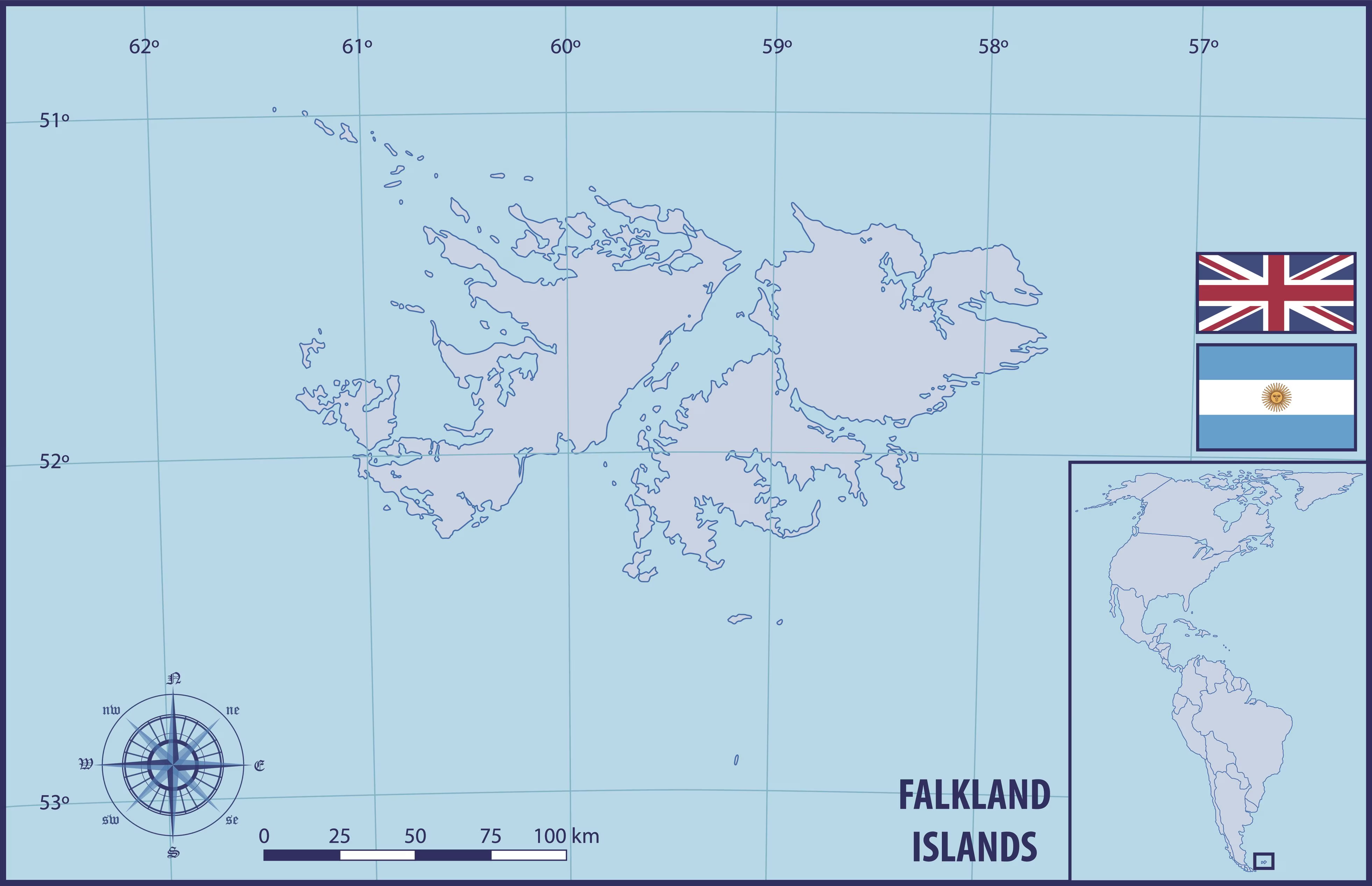
The Falklands/Malvinas War was fought in 1982 (April 2-June 14) between the UK and Argentina. The armed conflict broke out when Argentina, governed by a bloody military dictatorship, invaded and occupied the Falkland Islands (called Malvinas in Spanish-speaking countries), located in the South Atlantic, not far from the Argentine coast. The archipelago, in reality, has belonged to the United Kingdom since 1833: the war, which began on 2 April 1982 with the Argentine invasion, lasted just over two months and cost the lives of over 900 people, ending with the British victory.
After the defeat, Argentina no longer tried to occupy the islands by force, but continued to claim its right to annex the islands, which had now become a national symbol of anti-colonial claims.
The Falkland Islands/Malvinas
The Falkland/Malvinas Islands are an archipelago in the South Atlantic, located east of the Argentine coast. The archipelago is made up of two major islands and around two hundred smaller islands. Inside it lives a population of around 3,500 inhabitants, most of whom are of British origin and are concentrated in the capital, Port Stanley. The islands are administered as a British Overseas Territory, which also includes other South Atlantic islands: South Georgia and the South Sandwich Islands (uninhabited or inhabited only by military base personnel). The Falklands are called Malvinas by Argentines and in all Spanish-speaking countries.
The islands, discovered by Europeans since the 16th century, were occupied for the first time in 1764 by the French, who ceded them to Spain a few years later. Between the 18th and 19th centuries they were the subject of a dispute between the United Kingdom and the Spanish empire, which controlled much of Latin America. When Spain lost its colonies, Argentina, having become independent, claimed control of the archipelago, which however was occupied by British forces in 1833.
The United Kingdom, in fact, wanted to maintain control over the islands due to their strategic importance and to use them as a base for whale fishing. Since then, the United Kingdom has always controlled the archipelago and settled its military and citizens there. Argentina, for its part, has never stopped claiming the right to possess the islands, arguing that the British occupation is a form of anachronistic colonialism.
Why there was war: the Argentine occupation
In 1982 the government of Buenos Aires made its most decisive attempt to conquer the islands, occupying them by force, to reunite those territories with the motherland. At that time, the South American country was governed by a military junta, which came to power in 1976 and was responsible for atrocious crimes against the population. In the 1980s the junta had lost the consensus of the population and its leader, Leopoldo Galtieri, thought he could recover it with a military undertaking.
Galtieri was aware that Argentina’s armed forces were no match for those of the United Kingdom, but he believed that the British government would not react with force. Already in 1976, Argentina had occupied some islands of the Sandwich archipelago and the United Kingdom had passively suffered the occupation. Furthermore, the military junta hoped that the United States, its allies, would take its side.
Thus it was that on 2 April 1982 the Argentine troops landed in the Falkland/Malvinas Islands and occupied them without the small military garrison present being able to offer resistance. Argentine forces also conquered the South Sandwiches (where they encountered greater resistance) and South Georgia.
Immediately after the occupation, the Argentines imposed some changes: they renamed the archipelago Islas Malvinas and the capital Puerto Argentino; They also imposed driving on the right, instead of on the left as in the United Kingdom. The population, largely of English origin, did not like the Argentine occupation, but they had no way to oppose it.
The British response: the conflict and the English victory
The government of the United Kingdom, led by Margaret Thatcher, decided to regain control over the islands by force. The decision was motivated not only by strategic interest, but also by the fact that surrendering the territory without reacting would have constituted a humiliation and a loss of prestige on a global level. Therefore, the British armed forces set up an expeditionary force, with two aircraft carriers, numerous warships, more than one hundred aircraft and approximately 30,000 soldiers.
On the international level, the reactions Argentina had hoped for did not take place. The United States remained formally neutral and provided intelligence information to the United Kingdom. European countries also supported the British, while the Soviet Union wanted to side with Argentina, whose support, however, was rejected by the Buenos Aires dictatorship.
The war itself began on 20 April, when the first British units arrived in the area. In the following days, British forces retook South Georgia and conducted air and naval operations near the Falklands/Malvinas. On May 21, after a month of operations, British troops landed at San Carlos, East Falkland Island, and began to advance towards Port Stanley.
Despite fierce resistance from the Argentines, British soldiers occupied the capital on 14 June. The war was effectively over: on 20 June, after simple diplomatic pressure, the Argentine base in the Southern Sandwiches, occupied in 1976, also surrendered.
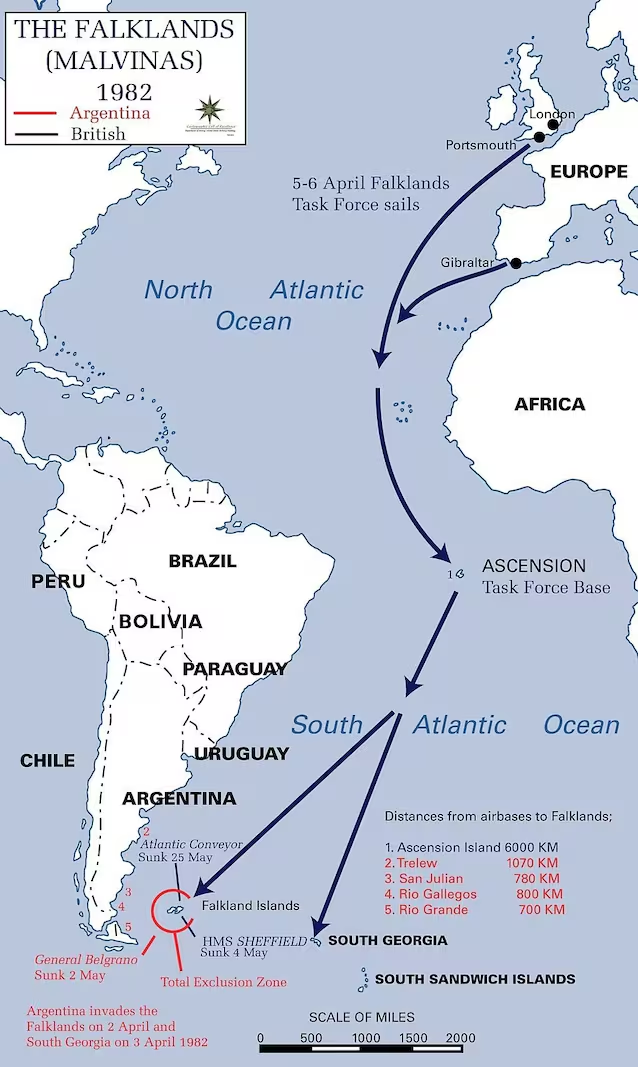
Overall, the war had caused 907 casualties: 649 Argentines, 255 British and 3 Falkland civilians.
The consequences of the war
The defeat contributed to eroding consensus for the Argentine dictatorship. Galtieri resigned in June 1982 and just over a year later, democratic elections were held in October 1983: the bloody military regime was finally over.
In the United Kingdom, Margaret Thatcher’s position was strengthened. At a diplomatic level, the Falklands/Malvinas’ membership of the British monarchy was no longer questioned and in 1990 Argentina and the United Kingdom re-established normal diplomatic relations. In the Latin American country, however, interest in the Malvinas has never waned, to the point that the topic is often brought up during occasions of national interest, such as the 2026 Football World Cup.