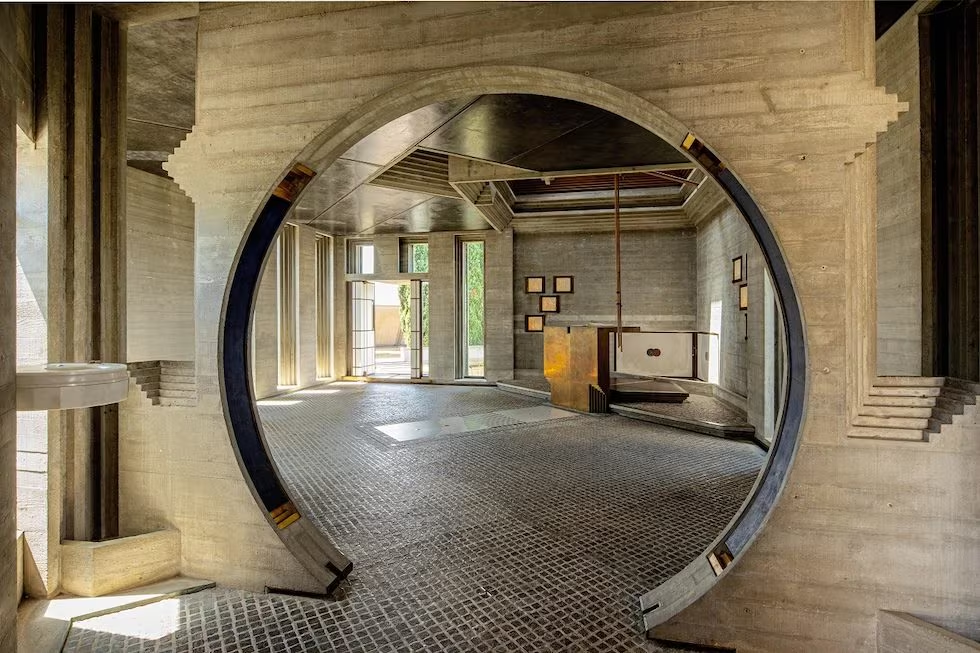
The movie “The cities of the plains” by Francesco Sossai, who recently won eight statuettes at the David di Donatello, a film award now in its 71st edition, includes scenes shot at the Brion Memorial, designed by architect Carlo Scarpa in the province of Treviso, in San Vito d’Altivole, a hamlet of Altivole.
The Memorial, also known as the Brion Tomb and now managed by the FAI, had already been chosen as a set by Denis Villeneuve for the film Dune – Part Two. In Sossai’s film it is not just a set design, but one of the protagonists, among the symbols of the Venetian landscape at the center of the narrative.
The tomb designed by Scarpa is not the only artist’s tomb in Italy that is worth a visit: throughout the country there is a heritage of monumental cemeteries and author’s tombs, designed by the greatest names in architecture and sculpture (from Aldo Rossi to Mario Botta, from Arnaldo Pomodoro to Leonardo Ricci) who have been able to transform pain into an aesthetic and spiritual experience capable of lasting over time.
- 1The Brion Memorial in San Vito d’Altivole, Treviso
- 2The ossuary of the S. Cataldo cemetery, Modena
- 3Cemetery of the island of San Michele, Venice
- 4The tomb of Federico Fellini and Giulietta Masina, Rimini
- 5Galli Tomb in Sant’Ilario, Genoa
- 6Veritti Tomb, Udine
- 7Neri Pozza Tomb, Vicenza
- 8The newsstands of the Monumental Cemetery, Milan
The Brion Memorial in San Vito d’Altivole, Treviso
In the Treviso countryside, this complex is considered one of the masterpieces of twentieth-century architecture, with its modernist style full of oriental, Venetian and Byzantine influences. It was commissioned in 1969 by Onorina Tomasin-Brion to honor her husband Giuseppe Brion, founder of the historic Brionvega designer electronic equipment company and is today an asset protected by the FAI.
Entrusted to Carlo Scarpa (who today rests right there, in a tomb designed by his son Tobia, on the border with the cemetery), the memorial is a 2,200 square meter park that blends reinforced concrete, water paths, Japanese gardens and Islamic references. You enter through the famous “propylaea”, characterized by two intertwined circles that symbolize conjugal love. It is a place designed to offer an experience of serenity and according to a famous phrase attributed to Scarpa himself: “Children play, dogs run: all cemeteries should be made like this”.
The ossuary of the cemetery of S. Cataldo, Modena
In 1971 the Municipality of Modena announced a national competition to expand Cesare Costa’s nineteenth-century cemetery, built between 1858 and 1876 in neoclassical forms. The winners were Aldo Rossi and Gianni Braghieri, with a project entitled The blue of the sky, quote from the novel by the French philosopher Georges Bataille (Le Bleu du ciel) to the color of the triangular roofs of the perimeter, designed to dialogue with the sky of the Emilian plain. Rossi conceived the cemetery as a true “city of the dead”: a place where “the private relationship with death returns to being a civil relationship with the institution”.
The visual fulcrum of the complex is the large cube of the ossuary: a reinforced concrete building completely hollow inside, painted brick red, pierced by square windows without frames. They are simple cuts in the wall: light entering the house of the dead, which Rossi himself described as “an unfinished and abandoned house, analogous to death”. Inaugurated in 1984, with the realization of just over a third of the original project, the cemetery remained a deliberately open work for decades. It was also the photographer Luigi Ghirri who made it famous throughout the world, who the previous year produced a series of shots that are now iconic: the red cube emerging from a car window, the empty windows framing patches of sky, the silent mass in the Po Valley.
Cemetery on the island of San Michele, Venice
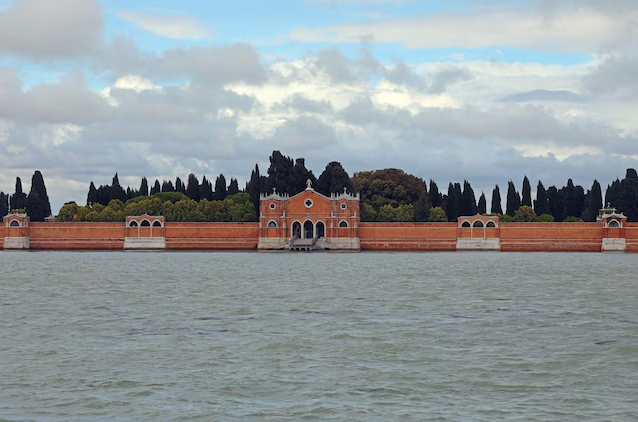
Located on the island of San Michele, between Venice and Murano, it is one of the most particular cemeteries in Italy, made suggestive by its isolated location in the Venetian lagoon. Its modern history begins at the beginning of the 19th century, following the Edict of Saint-Cloud issued by Napoleon in 1804, which imposed the creation of cemeteries outside of inhabited centres. The entrance is dominated by Mauro Codussi’s Renaissance church, but it is the modern extension that catches the eye of architecture enthusiasts. Designed by David Chipperfield, winner of the 1998 international competition, between 2007 and 2017, the contemporary intervention integrates the historic red brick walls and the internal courtyards clad in black basalt stone, creating a contrast that dialogues with the surrounding water. It hosts famous people and numerous testimonies of history and art, including Igor Stravinsky, Sergei Diaghilev, Ezra Pound and the Nobel Prize winner Iosif Brodsky.
The tomb of Federico Fellini and Giulietta Masina, Rimini
We are in the monumental cemetery of the Celle area, in Rimini. It is a place that Federico Fellini would have defined as “less gloomy”, thanks to the joyful presence of the train that passes nearby. Here rest the famous director, his actress wife Giulietta Masina (who died five months after her husband, on 23 March 1994) and their son Pierfederico, who died a few days after his birth in 1945.
The area was designed in 1994 by architect Pierluigi Cerri, with a radical choice: reducing every compositional element to a minimum. Dominating the scene is the large bronze sculpture commissioned by the Municipality of Rimini to the sculptor Arnaldo Pomodoro: “The large bow: homage to Federico Fellini”, a double triangle of polished bronze four meters high, planted in the ground with the vertex facing downwards, which seems to emerge from a body of water. Pomodoro was inspired by the nautical themes of two of the director’s films, Amarcord (1973), set in Rimini, e And the ship goes (1983). The sculpture is positioned near the entrance to the cemetery, so as to be visible even when the gate is closed.
Galli Tomb in Sant’Ilario, Genoa
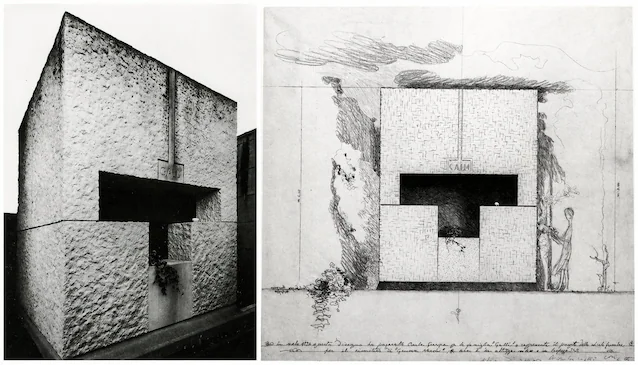
We are in Liguria, in Genoa, in the suggestive cemetery of Sant’Ilario Alto which overlooks Nervi, with a spectacular view of the sea. The cemetery is built on terraced floors along the steep Ligurian coast, with a row of funerary monuments inscribed in lots of equal size: the Galli Tomb is located in the highest part, near the large central staircase. It also bears the signature of Carlo Scarpa and was completed posthumously (1976-1981) based on his drawings by architects Mattia Pastorino and Giuseppe Tommasi. In 1976, following the premature death of her son Antonio, his mother Angela Galli Dossena contacted Scarpa, whose work she had admired at the Brion Memorial. At first the architect refused, then accepted.
The sudden death of the architect in 1978 interrupted the work still in the planning phase: it was the Genoese architect Mattia Pastorino who brought the work to completion together with Giuseppe Tommasi in 1981, faithfully following the 25 autograph drawings preserved today in Palazzo Spinola, home of the National Gallery of Liguria in Genoa. The result is a parallelepiped in white Vicenza stone worked with a burin, placed on a black granite base. On the main front, the volume is engraved by two grooves, one vertical and one horizontal, which create a shaped cut T.
Veritti Tomb, Udine
At the Monumental Cemetery of Udine, in its oldest part, there is one of the most discussed works of post-war Italian architecture. The Veritti Tomb was designed between 1950 and 1951 by Angelo Masieri, a young Friulian architect who was a student and close collaborator of Carlo Scarpa, for the Veritti family, to whom he was related. It was his last work: on June 28, 1952, Masieri died in a car accident in Pennsylvania, at just thirty years old. It was Scarpa, his mentor and friend, who completed the tomb based on the numerous preparatory sketches that the young man had left.
The building looks like a simple rectangular enclosure in Botticino marble, almost an uncovered cube. It is accessed via a crescent-shaped gate made of muntz metal (an alloy of copper and zinc dear to Scarpa). Half the space is open-air; in the center of the cobblestone flooring there is a marble slab which gives access to the crypt. The internal walls of the niches are covered in irregular red marble slabs. The altar, in pink stone, protrudes from a cut in the wall and the crypt is partially covered by a large oxidized bronze disk.
Neri Pozza Tomb, Vicenza
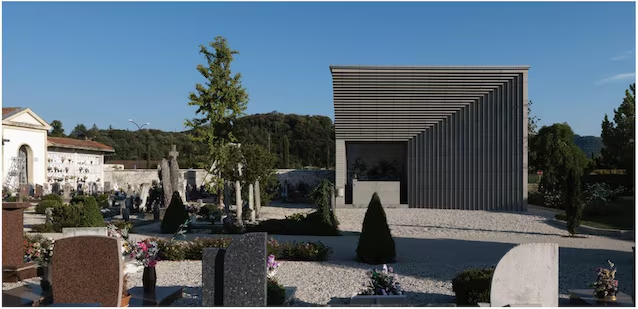
In the Longara cemetery, on the northern end of the western wing intended for the family chapels, stands one of the most singular funerary interventions in contemporary Italian architecture: the funerary monument that Mario Botta, the Ticino architect known for the Cathedral of the Resurrection of Évry and for a poetics based on brick, stone and pure geometric volumes, created between 2005 and 2009 for the Venetian intellectual Neri Pozza and his wife Lea Quaretti. Sculptor, engraver, partisan, writer (his Trial for heresy won the Campiello Prize in 1970), Pozza was also a publisher: in 1946 he founded the publishing house in Venice that bears his name and which published, among others, Montale, Gadda, Buzzati, Cardarelli and the first novel by Goffredo Parise.
The chapel that Botta designed for them is a parallelepiped in exposed brick whose main façade, oriented to the north-west, is modeled by two inclined planes which slope down in a regular groove towards the centre, where the passage opens within which the two twin sarcophagi rest. It is the same concave compositional figure that Botta had already used for the portal of the Cathedral of Évry, in France: a perspective focus that attracts the gaze and concentrates it towards the most important point, that of death and memory. On the south-west front there is a glass door covered in stone. Inside, the light enters zenithal through a circular hole. To the left of the tomb, there is a small sculpture in polished bronze, created in 1979 by the Vicenza sculptor Nereo Quagliato, which portrays Neri Pozza himself.
The newsstands of the Monumental Cemetery of Milan
Inaugurated in 1866 to respond to the Napoleonic Edict of Saint-Cloud and the new bourgeois individualism, the Monumental Cemetery of Milan is an open-air museum. Walking through its avenues you cross the entire history of Italian art, including sculptures by Lucio Fontana, Adolfo Wildt, Giacomo Manzù and Giò Pomodoro. In the Famedio (and in its crypt), the temple of the city’s fame, people of capital importance rest or are inscribed: from Alessandro Manzoni to Dario Fo, from Alda Merini to Carla Fracci, passing through the artist Walter Chiari and the great composer Amilcare Ponchielli. Among the most incredible private tombs we find:
- Bernocchi newsstand. Work of the architect Alessandro Minali and the sculptor Giannino Castiglioni, it was erected in memory of Camilla Nava Bernocchi (1879-1930) and the senator Antonio Bernocchi (1859-1930). The monument is a colossal structure with a square base, on which stands a truncated cone tower covered by a spiral of sculptural panels that narrate the Passion of Christ and the Via Crucis.
- Campari newsstand. Famous for the almost life-size bronze reproduction of the Last Supper. Giannino Castiglioni’s work is striking for the dramatic realism of the figures of the apostles.
- Körner newsstand. Work by the architect Giulio Ulisse Arata and the sculptor of “light” Adolfo Wildt, it was carried out in 1929. The structure in Ligurian conglomerate recalls the Mausoleum of Theodoric. The sculptural group with the title is grafted onto the imposing bronze portal Affection in pain.
- Toscanini newsstand. It is here that the conductor Arturo Toscanini rests. The aedicule was built between 1909 and 1911 by the Piedmontese sculptor Leonardo Bistolfi to commemorate the last born of the master Giorgio Toscanini, who died prematurely.