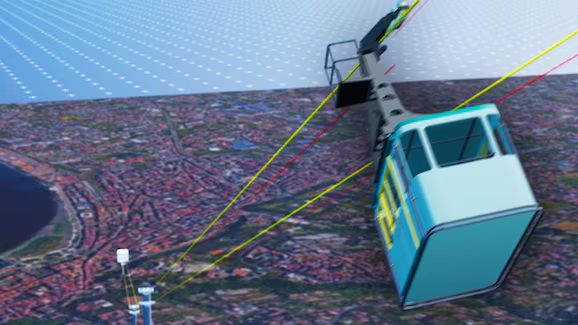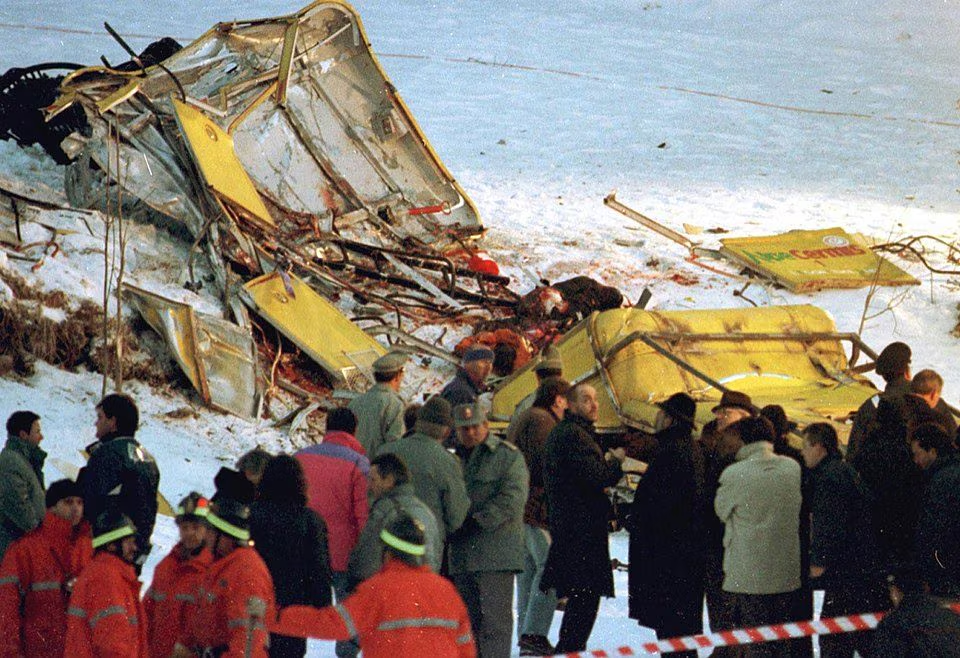
The Cermis cable car accident, a disaster that occurred 28 years ago in Val di Fiemme (Trentino-Alto Adige) but still alive in the memory of Italian society, was caused by a US military plane that collided with a ski lift on Alpe Cermis: at 3.13 pm on 3 February 1998, the US EA-6B Prowler aircraft, taking off from the Aviano base (in Friuli-Venezia Giulia), severed a cable of the Cermis cable car, hitting it at an estimated speed of around 833 km/h, causing the cabin to plummet to a height of 108 meters and causing the death of all 20 people on board.
That same cable car had already been involved in a first accident in 1976, which caused 42 victims: on that occasion, however, one of the cabins detached from the cable that supported it, ending up crashing to the ground.
After 28 years, we retrace the history of this tragedy, for which it is still believed that no justice has been served: the pilots responsible, in fact, were convicted exclusively of obstruction of justice after destroying the video of the flight.
The dynamics of the Cermis cable car accident
According to what was ascertained by the Parliamentary Commission of Inquiry, the US military mission – called “Easy 01” – had been planned as a low-altitude training flight. The crew consisted of four Marine officers: pilot Richard Ashby, navigator Joseph Schweitzer and electronic warfare systems officers Chandler and Seagraves.
The aircraft, a Grumman EA-6B Prowler, took off at 2.36pm from the NATO base of Aviano, in Friuli-Venezia Giulia: the objective was to simulate tactical navigation procedures.
However, according to the reconstruction of the dynamics of the accident, the flight conduct adopted was “radically different from current regulations”. In fact, the Commission of Inquiry found that for the area in question, national provisions and NATO agreements imposed a minimum flight height of 2,000 feet (about 600 meters). Despite this, the technical reports obtained demonstrated that the plane, at the moment of impact, was at a drastically lower altitude, estimated at around 360 feet (110 meters above the ground).
Among other things, the plane, which came from Val di Fassa and was heading south-west along Val di Fiemme, was traveling at a speed well above the limits allowed for that type of maneuver, proceeding at around 450 knots (833 km/h).
At 3.12pm, the aircraft crashed into a cable supporting the Cermis cable car: according to official documents, the pilot, in an attempt to pass under the cables or not having seen them at all due to the high speed and prohibitive altitude, impacted with the right wing and the tail fin against the carrying and hauling cables of the cable car.
The clear shearing of the cable caused the immediate fall of the cabin, which fell for approximately 108 meters and then crashed to the ground. From the Commission’s findings, it emerges that there was no technical problem with the aircraft before the impact: the tragedy was the direct result of a voluntary maneuver conducted in violation of the basic safety rules established for the exercises.
The investigations into the massacre and the diplomatic clash with the United States
The investigations following the disaster were immediately a source of tension, despite the formal collaboration between the Italian and US authorities. Among the various problems was that of the destruction of visual evidence: the plane, in fact, was equipped with an internal video camera intended to record the training and pointed outwards through the fairing. Precisely this recording would have constituted a sort of “visual black box” of the accident, offering irrefutable proof of the altitude, speed and behavior of the pilots in the moments preceding the impact. That videotape, however, was never viewed by the investigators because it was destroyed.
In his confession, Captain Joseph Schweitzer admitted to having stolen the original cassette from the aircraft immediately after the emergency landing at Aviano, replacing the tape containing the footage of the flight and then destroying the original.
This action to suppress the tests was motivated in the following years by the fear that the images (which would have confirmed the reckless maneuvers and shown the amused smiles of the pilots) could inflame Italian public opinion. The Commission of Inquiry underlined how this act deprived the prosecution of a fundamental piece of evidence, transforming a technical investigation into a battle of expert opinions and indirect testimonies.
The trial and acquittal of the pilots
Under the London Convention on the Status of NATO Forces, jurisdiction over the case was given to the United States. The trial, which was held at the Marine base at Camp Lejeune, North Carolina, ended with a sentence that, even today, is considered unjust.
Pilot Richard Ashby and navigator Joseph Schweitzer were charged with multiple manslaughter and manslaughter. Their defensive line was based on two main arguments: the alleged inadequacy of the aeronautical maps provided to the crew, which according to the defense did not clearly indicate the presence of the cable car, and a hypothetical malfunction of the radar altimeter which would have misled the pilots about the real altitude.
Although the Italian Commission of Inquiry had provided overwhelming evidence on the violation of the minimum altitudes (highlighting how, regardless of the presence of a cable car, flying at that altitude was illegal) and on the perfect visibility of the obstacles on a day with clear skies, the American military jury issued a verdict of acquittal on all charges relating to the massacre. Ashby and Schweitzer were found guilty of obstruction of justice and conduct unbecoming an officer after the destruction of the video material.
The sentence, however, was limited to expulsion from the Marine Corps: Ashby was sentenced to a prison term of just 6 months (serving only 4), without any direct conviction for the deaths of the twenty Cermis victims.