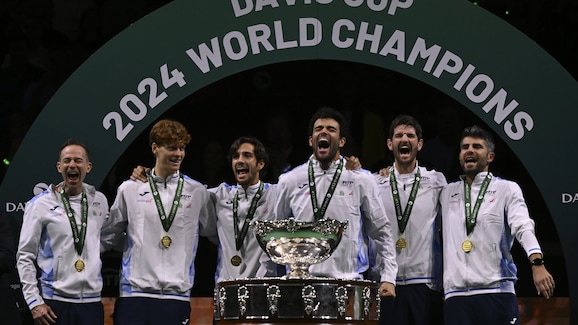
For over a century, tennis players from all over the world have been competing for the greatest sporting trophy of all: a shiny and imposing silver cup, which Italians affectionately call “the silver salad bowl“. Behind that curious shape – which recalls a bowl ready to serve a giant salad – lies the history of the Davis Cup, born from the passion and intuition of a 21-year-old American. Since then the cup has grown together with its myth: from the initial 30 cm and 7 kg, today it is 110 cm high and weighs over 100 kg, even bringing with it a small error, which has remained there as a sign of its fascinating history.
The Davis Cup trophy project was born from a student dream
It all begins in 1900 at Harvard, when an American student named Dwight Filley Davis decides to test the best tennis players in the world. To do this, it not only proposes an international team competition, between the United States and Great Britain: it also designs the trophy. Davis commissioned the cup from a silversmith in Boston, LA Shreve, Crump & Lowpaying out of his own pocket around 1,000 dollars at the time (a figure that today would be equivalent to more than 35,000 euros). The idea is simple and brilliant: a majestic trophy, which represents the union and rivalry between nations. Thus was born International Lawn Tennis Challengewhich was later renamed in his honor Davis Cup.
The shape of the bowl is already recognizable: a large basin of sterling silver — an alloy of 92.5% pure silver and 7.5% other metals, usually copper — polished to a mirror-like appearance. Inside, the surface is covered with a layer of burnished gold, to avoid oxidation and give warmer reflections under the light. Davis, who probably didn’t imagine the global success of his tournament, inadvertently creates an immortal symbol.
Why it is called a salad bowl: what it is and how much the trophy is worth
Looking at it up close, “the salad bowl” it is not only a piece of history, but also a small masterpiece of goldsmith’s art. Its shape — similar to a paraboloid — is designed to reflect light uniformly. It’s also why the Davis Cup shines so brightly in the television spotlight: the curvature and polish act like a diffuse mirror.
But why is it called “silver salad bowl“? The nickname comes from the wide and shallow shape of the trophy, and from the floral motifs that decorate its surface, making it similar to a large table salad bowl. The expression, born as journalistic irony, soon entered the common language of Italian fans and journalists, establishing itself as one of the most iconic nicknames in the history of sport.
Since 2010, the maintenance of the trophy has been carried out by Thomas Lyte, the famous London goldsmith’s shop which also deals with the restoration of the FA Cup football and the Rugby World Cup trophy. According to estimates from the same laboratory, if the Davis Cup were to be made from scratch today, its value would exceed 200,000 pounds (around 230,000 euros), including precious materials and hundreds of hours of artisan work.
A trophy that changes and grows like a family tree
If you look at the trophy today, it looks like a tower of stacked cups, almost a totem of world tennis. But it was originally just over 30 centimeters tall and weighed about 7 kg. Over the years, the Davis Cup has literally grown along with its history, turning into a symbol that bears the name of each generation of champions. From 1921 onwards, due to lack of space in which to engrave the names of the winners, a silver tray was added (the “Hello”), then a first mahogany base in 1933. From there, two more were added, transforming the trophy into a sort of centuries-old tree that grows along with its history.
Today the complete Davis Cup, with all its bases, measures 110 centimeters in height and over 1 meter in diameter. It weighs more than 100 kg: lifting it all is almost impossible, and in fact only the upper part is shown during the awards ceremony.
The biggest cup of all (with a small mistake)
Considered the largest sporting cup in the world, the Davis Cup does not disappoint expectations: it exceeds any other trophy in size and weight: the FIFA World Cup weighs 6 kg; the Wimbledon trophy, 3.5 kg; even hockey’s Stanley Cup, considered one of the most massive, comes in at “only” 15 kg. THE’salad bowlhowever, with its over 100 kg and its tiered structure, it is a true sculpture symbol of world tennis.
Yet, even monuments have their imperfections. When Italy, winner of the last two editions of the “Tennis World Cup”, won its first Davis Cup in 1976, reporters noticed a curious detail: the original trophy was mistakenly engraved with “four natches” instead of “four matches”. The error was never corrected and remained as a sort of involuntary signature, a small scar that reminds us how even the most majestic symbols are born from human hands.
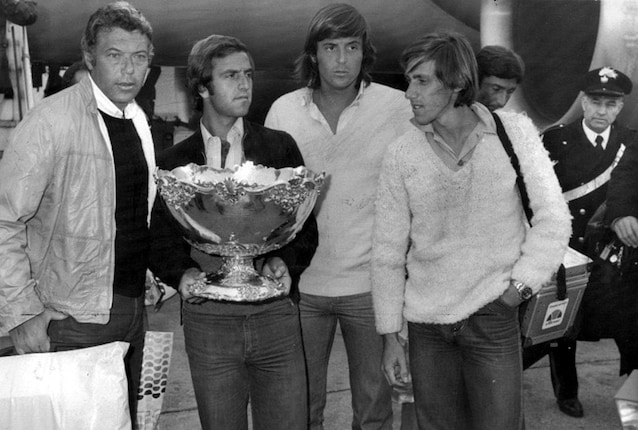
Today the trophy does not live closed in a museum: it constantly travels around the world, participating in the Davis Cup Trophy Tour. It has passed through dozens of countries and cities where it is displayed as a modern relic. In a sense, it is a silver time machine, chronicling 125 years of world tennis history.