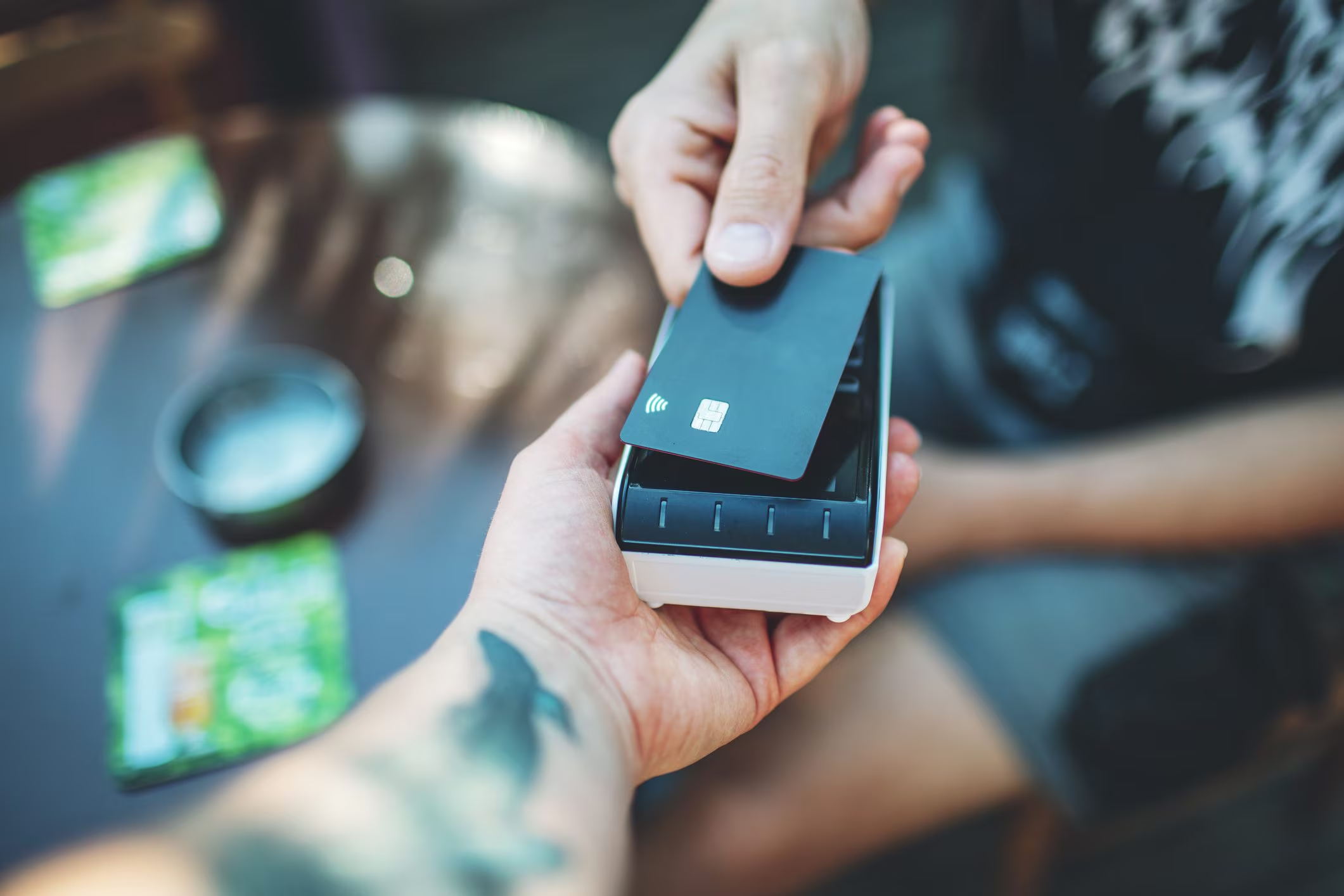
Try to imagine the scene for a moment: you are in front of the computer, in a forum of enthusiasts, you are experimenting with a new digital currency that does not yet have any market price and you decide to propose a very simple exchange: two pizzas in exchange for 10,000 Bitcoin, the cryptocurrency protagonist of this story. No bank, no intermediary, no credit card. Just an online message and a direct agreement between two parties. At the time it all might have seemed like a curious idea, almost a “game” between geeks. On May 22, 2010, 15 years later, those 10,000 Bitcoins are now equivalent to over 1 billion dollars! And this is precisely where the story becomes interesting: not because someone could have “gotten rich” thanks to two pizzas, but because that gesture marked the moment in which Bitcoin became a currency of exchange in all respects.
When Bitcoin was born: January 3, 2009
The history of Bitcoin officially begins on January 3, 2009, when the first block of code, called the “genesis block”, was inserted into its blockchain. This block is attributed to an individual (or group) known by the pseudonym Satoshi Nakamoto, a figure still shrouded in mystery today. A few months earlier Nakamoto had published a whitepaper. The nine-page technical document described the operation of a decentralized electronic payment system that did not require a central banking authority to function.
On January 12, 2009, the mysterious Nakamoto sent 10 bitcoins to Hal Finney, a developer and early proponent of the cryptocurrency. This was also a significant transaction, but it was still an exchange within the programming community. In fact, at the beginning, Bitcoin did not have a defined value: digital coins were exchanged to test the system or as a form of thanks in online forums. Nobody thought about possible investments in Bitcoin, and certainly nobody imagined that in the future a single Bitcoin could reach very high values (for the record, at the time we are writing this article 1 Bitcoin is equivalent to 110,077 dollars).
The story behind the two pizzas purchased for 10,000 Bitcoin
A turning point came on May 22, 2010, when Laszlo Hanyecz, a developer from Florida, posted a very simple request on the Bitcoin Talk forum: he wanted to have two large pizzas delivered to his home and offered 10,000 Bitcoins in exchange. He explained that his goal was not to save time or money, but to see if it was possible to purchase a real good by paying in Bitcoin, just as one could do with a “traditional” currency. A British user accepted the proposal, ordered two large pizzas from an American chain, paying about 25 dollars, and received in exchange the 10,000 Bitcoins offered by Hanyecz, which at the time were worth about 41 dollars.
With this transaction, Bitcoin effectively left the theoretical environment and demonstrated that it can function as a real means of exchange. It didn’t matter how much Bitcoin was worth then, nor what value it might have in the future: what mattered was that an economic agreement had been successfully completed.
In the following years, the value of Bitcoin began to rise. Nine months after the purchase of the two pizzas, the cryptocurrency reached parity with the dollar: suddenly, the value of the dinner purchased in Bitcoin by Hanyecz amounted to a whopping $10,000. In 2015, five years later, the same amount was approximately $2.4 million. And updating the value to current prices, the 10,000 Bitcoins would be worth more than $1 billion.
Since then, May 22 has been celebrated as Bitcoin Pizza Day, an anniversary that the cryptocurrency community observes by ordering pizza in memory of the first documented commercial transaction.
How Bitcoin is seen today
Meanwhile, Bitcoin has experienced a profound social transformation. The first communities were made up of pioneers fascinated by the idea of an economic system independent of banks. Subsequently, programmers interested in the technical structure of the blockchain were added and then investors attracted by the growth of the price. Over time, even traditional financial institutions have started to treat Bitcoin as an asset, that is, a real form of investment. Thus, a technology created to propose an alternative model ended up entering the economic system it aimed to reform.
And what does Hanyecz, the pizza man, say today about the purchase he made on May 22, 2010? In an interview given to New York Timessaid:
At the time, Bitcoin had no value, so the idea of exchanging it for a pizza was incredibly appealing. No one could have imagined that they would have such great success.
For the record, in addition to the 10,000 Bitcoins used to purchase two pizzas, Mr. Hanyecz owned others, which he decided to sell later when their price approached $1, earning around $4,000.