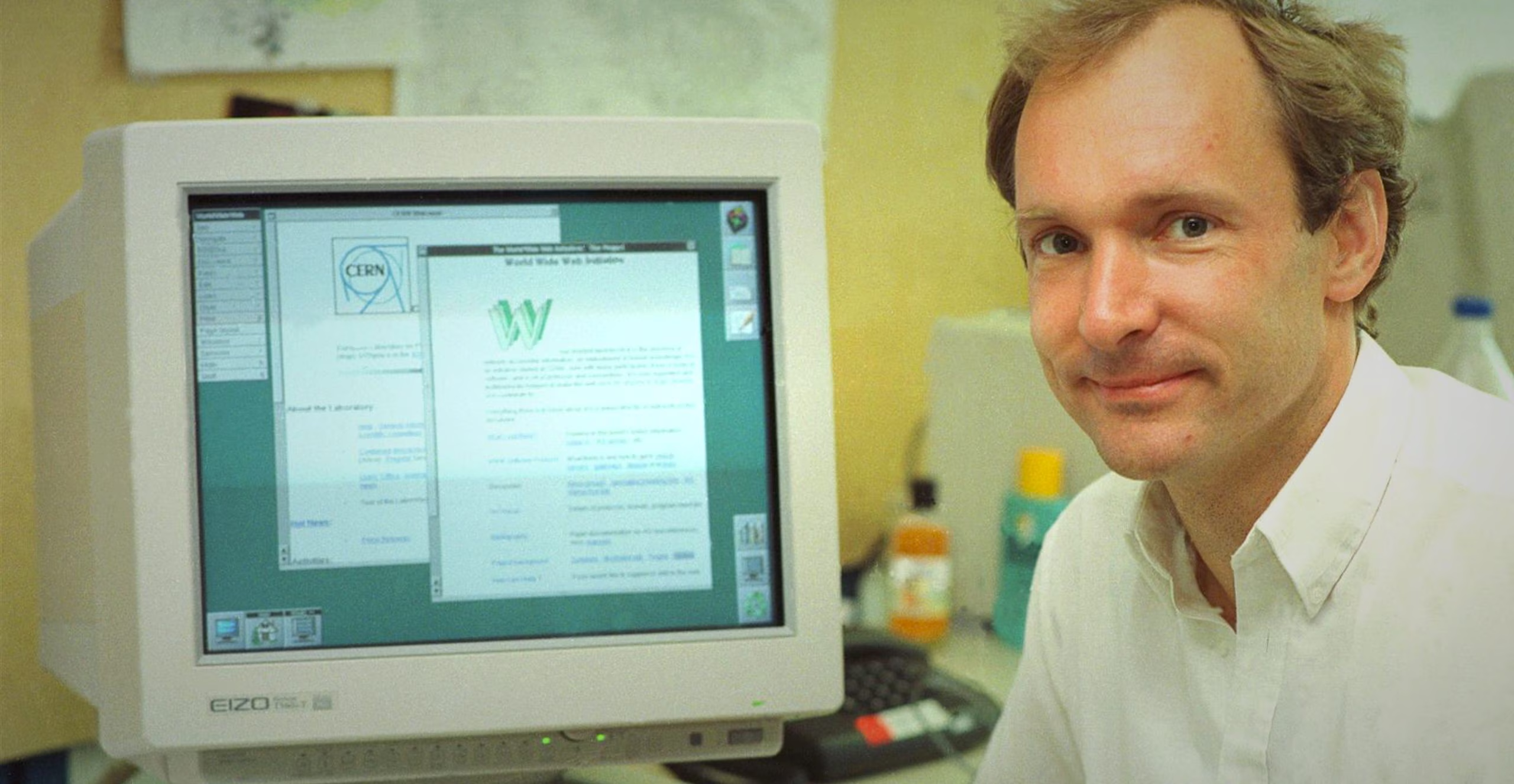
On December 20, 1990, inside the corridors of CERN in Geneva, Switzerland, Tim Berners-Lee turned on the “engines” of the first website in history, an event that would radically change the way we live, work, communicate and inform ourselves, although at that moment almost no one had noticed it, including the British scientist himself. In this article we will explore the genesis of the World Wide Web, distinguishing it from the physical infrastructure of the Internet that already existed, and we will analyze the three fundamental technologies invented by Berners-Lee which still today, after three and a half decades, constitute the “backbone” of online navigation: HTML to structure the contents, the URL to uniquely locate them and the HTTP protocol to transfer them from the server to our device. We will tell you how that first site, reachable at http://info.cern.ch (still online), was actually a “meta-document”, that is, an instruction manual on how to use the Web itself, devoid of captivating graphics but rich in a revolutionary vision based on hypertext. We will also analyze the technological context of the time, dominated by systems incompatible with each other, and how CERN’s decision, taken in 1993, to make this technology royalty free represented the real catalyst for the global explosion of the phenomenon, leading to the birth of the first graphical browsers such as Mosaic and the era of electronic commerce.
How December 20, 1990 changed the world of information
To understand the “seismic” significance of what happened on December 20, 1990, we must immerse ourselves in the digital atmosphere that reigned at the end of the 1980s, a period in which the Internet already existed but appeared very different from the “welcoming” space we are used to today. It was essentially a set of networks used almost exclusively by academics, military personnel and researchers, where access to information was an obstacle course requiring specialist technical skills. Let’s imagine a vast and complex research institution like CERN, where thousands of scientists from all over the world produced an immense amount of data; the main problem was that this information remained trapped in what we could define as a sort of digital Tower of Babel. The data resided on different computers, from IBM mainframes to Macintosh systems, each with its own file formats and proprietary protocols, making exchanging information a logistical nightmare: to read a colleague’s work, you often had to physically access the same terminal as them or own the same software.
There were certainly precursors who attempted to bring order to this chaos, such as ARPANET, the US military project that served as the backbone of the network, or Usenet, a worldwide network of interconnected servers born in the United States and which was used by users mainly to discuss various topics. None of these systems, however, offered a complete solution for document consultation. Perhaps the most intelligent attempt in this respect was represented by Gopher, developed by the University of Minnesota, which organized files in a hierarchy of structured menus, allowing navigation between different servers, but it still lacked that element of fluidity that would later define the Web. It is in this fragmented scenario that the vision of Tim Berners-Lee came into play, a British computer scientist who had understood how the true value of CERN did not lie only in the data from particle accelerators, but in the connections between people. Already in 1989 he had presented a proposal entitled “Information Management”, a technical document that his supervisor, Mike Sendall, called «vague, but exciting», fortunately giving the green light to the project.
Berners-Lee’s brilliant intuition
Berners-Lee’s brilliant intuition was not to invent the connection between texts, a concept already theorized by thinkers such as Vannevar Bush decades earlier, but to apply the idea of hypertext to a global computer network. Between September and December 1990, he wrote the code that would create an entire ecosystem based on three fundamental pillars that we still use today. The first is HTML (HyperText Markup Language), a markup language (and not complex programming), which was used to create the skeleton of the pages through simple “tags” to define titles, paragraphs and links. The second is the URL (Uniform Resource Locator), the solution to the addressing problem, which provided a unique and consistent method for finding any Web resource, avoiding the chaos of incompatible formats. The third pillar is HTTP (Hypertext Transfer Protocol), the invisible engine that manages the dialogue between the client, i.e. our browser, and the server that hosts the data, through a continuous cycle of requests and responses.
All this software was developed and run on a very particular machine: a NeXT computer. This workstation, created by the company founded by Steve Jobs after his departure from Apple, was equipped with advanced tools that allowed Berners-Lee to quickly create the first browser in history, called WorldWideWeb (later renamed Nexus). A fascinating feature of that first browser, which we have lost over time, was its bidirectional nature: it was not just a tool for viewing pages, but also an editor that allowed users to edit content and create new links directly, embodying a vision of the Web as an equal collaborative tool. That single black cube marked NeXT also served as the first Web server in history, so much so that it bore a hand-written sticker: «This machine is a server. DO NOT POWER IT DOWN!!», or “This machine is a server. DO NOT TURN OFF!!”), since turning it off would have meant, literally, turning off the entire World Wide Web.
When the site http://info.cern.ch finally became operational on 20 December 1990, it was initially accessible only to CERN’s internal network. The site had (and still has) a decidedly spartan layout: white background, black text and blue links. That’s it!. The content was self-referential, that is, it explained what the project itself was, how to create pages and how to search for information. But the real revolution lay in the function of the hyperlink, which destroyed the linearity of traditional reading: with a click you could jump from one concept to another, even if the information resided on computers thousands of kilometers away, mimicking the associative functioning of the human brain.
On April 30, 1993, the Web entered the public domain
In all this it must be said that the Web remained a niche tool for physicists until two crucial events occurred. The first was CERN’s far-sighted decision on April 30, 1993, to place World Wide Web technology in the public domain and royalty-free, preventing any single company from controlling it and inviting anyone to build on it. The second was the arrival of browsers accessible to the general public, such as Mosaic, developed in 1993 by NCSA (National Center for Supercomputing Applications) from the University of Illinois. Mosaic was the first to display images within text and not in separate windows, transforming the Web from a text archive to a visually appealing multimedia experience.









