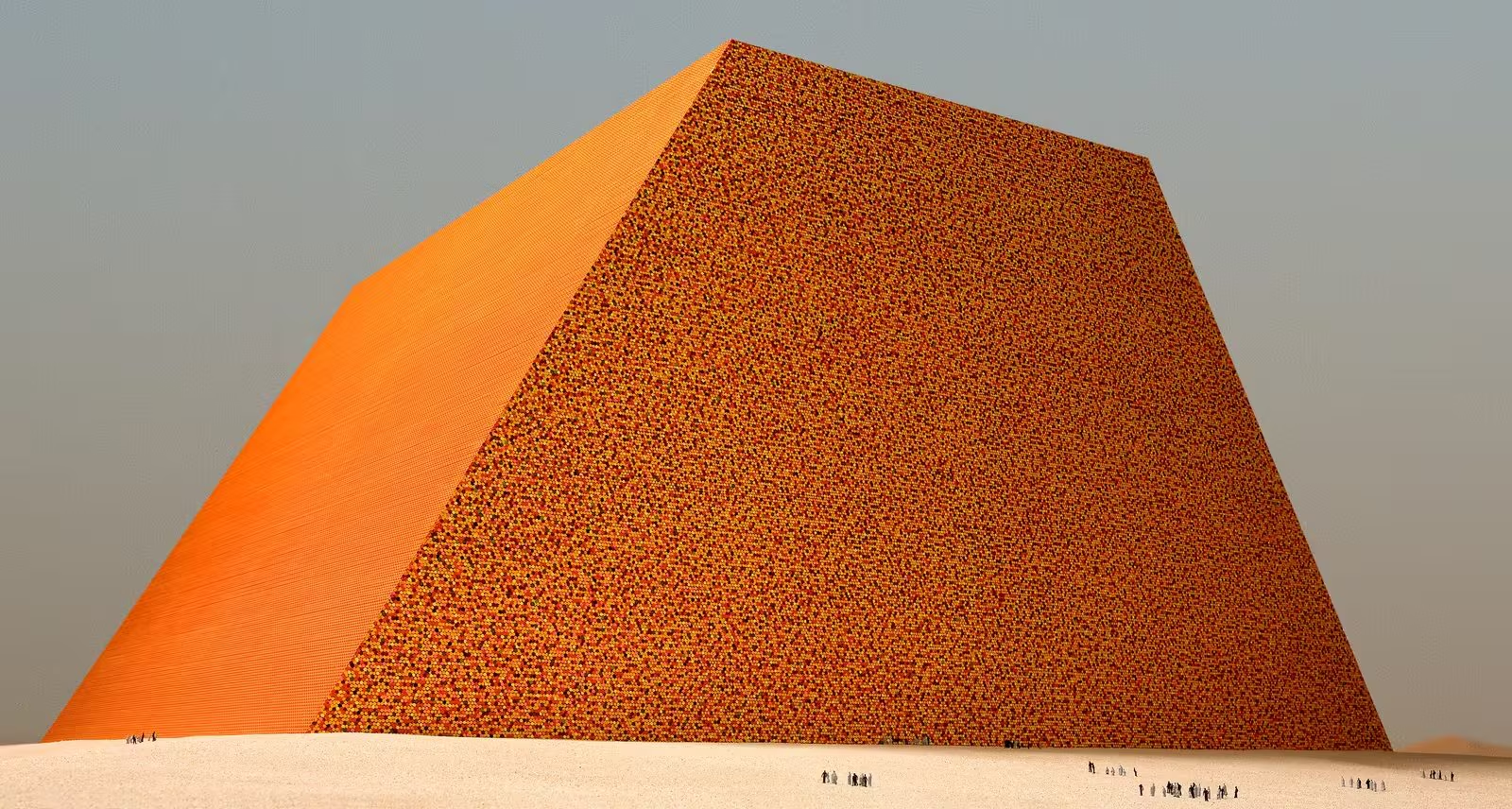
The Mastabadesigned by the great artists Christo and Jeanne-Claude, was supposed to be the largest sculpture in the world in terms of volume. Made up of 410 thousand colored barrels, 150 meters high and 300 to 225 meters wide, it was conceived between 1977 and 1979 by the pair of artists (in life and work) as their “only permanent work”. It was supposed to be built in the desert of Abu Dhabi, the capital of the United Arab Emirates. In the meantime, both artists have passed away and the project – with great technical difficulties – has stalled several times, even though in 2018 a temporary copy was exhibited floating on London’s Serpentine Lake. Now, due to the war in Iran and the resulting instability in the area, it may never be realized.
Who are Christo and Jeanne-Claude
Christo (1935–2020) and Jeanne-Claude (1935–2009) were throughout the second half of the twentieth century, and still are, among the most famous artists in the world: what made them famous were their ambitious large-scale works of art, which aspired to détournement (in Italian “diversion” or “deviation”). This term is used in the sense given to it by the situationist movement of the 1960s, according to which the artists’ duty would be to modify the perception of space and its contexts as a political gesture.
For this reason, the artists themselves maintain, that they have always “created many works in the city, in urban and rural environments, but never in deserted places, and always on sites already prepared and used by man, managed by man for man”.
Together the two artists created government buildings and bridges, coasts and valleys, parks and lakes. These large installations – so large that they belong to the category of “environmental” works, like our Cretto di Gibellina created by Alberto Burri – in fact had a particularity: they altered the physical form and visual appearance of the places for a short period of time, before returning them to their original state.
These operations proved to be very long (especially due to the numerous permits needed to install them) and very expensive: Christo and Jeanne-Claude financed their production through the sale of preparatory drawings and related photographs. This creative material is actually much greater than the works created, precisely because of these technical difficulties: in total it is estimated that around fifty projects were never completed, but through the Christo and Jeanne-Claude Foundation they could one day see the light.
The great works of Christo and Jeanne-Claude
One of their first installations is Wrapped Coast, One Million Square Feet built in the late 1960s in Sydney’s Little Bay in Australia: the project was so massive that it was not possible to see it all from a single point of view. Working with a team of 110 installers and 15 climbers, Christo and Jeanne-Claude covered a two-and-a-half kilometer stretch of land along the South Pacific Ocean with white fabric.
The duo’s most famous work is probably Wrapped Reichstag made 1971–95 in Berlin. To create it, the two wrapped up the iconic Berlin parliament, recalling its troubled history (it had been set on fire in 1933 during Nazism and almost completely destroyed during the Second World War).
In 1972-76 the large one was built in California Running Fence: a gigantic structure 48 kilometers long (from Route 101 to the ocean) and 5.5 meters high, made up of over 2,000 white nylon fabric panels supported by steel cables and poles.
The great one is always from the Seventies ValleyCurtaina colossal orange wall (almost half a kilometer long) that divided a Colorado valley in two, allowing cars to pass underneath: this project, unfortunately, lasted only 28 hours before a very strong wind forced the artists to take it down. Documentary filmmakers Albert and David Maysles filmed the installation of the work and included it in a short film which was also nominated for an Oscar.
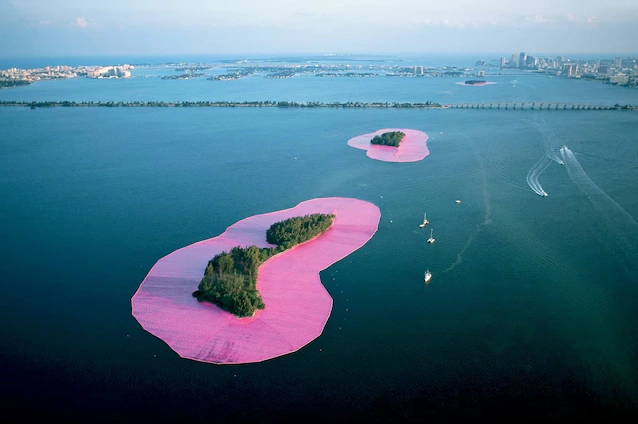
For the legendary Surrounded Islands of 1980-83 (literally “surrounded islands”) 603,000 square meters of fabric were used. The installation surrounded the islets in Biscayne Bay, Miami, in an homage to Claude Monet’s water lily paintings.
It also opened in the 1980s The Pont Neuf Wrapped: they covered the century-old bridge that crosses the Seine with an orange fabric, also covering the surrounding sidewalks and part of the Île de la Cité embankment.
The Gates is one of the most photographed works of public art ever installed in New York: the installation, which covered all of Central Park and was composed of 7,503 “gates”, rectangular wooden arches topped with orange awning fabric. According to New York City officials, due to the massive tourism it had generated, the work had brought as much as 80 million dollars into the city’s coffers.
In the following decade Christo and Jeanne-Claude then covered trees: despite the apparent simplicity of making Wrapped Trees (1997-98) took several tries. The two initially tried wrapping trees at the Saint Louis Art Museum in Missouri, then along the Champs-Élysées in Paris, but never got permission. Eventually the Fondation Beyeler in Switzerland stepped up.
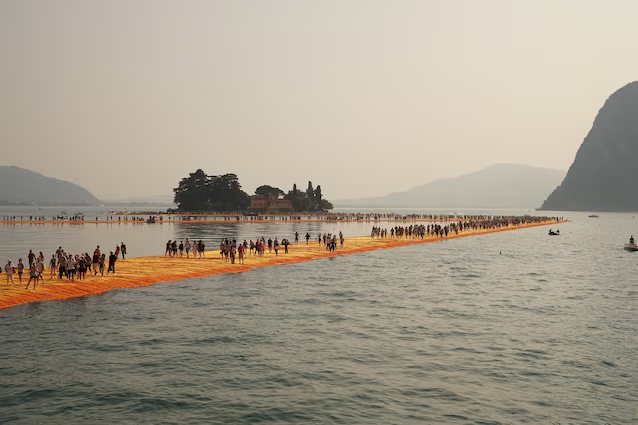
Then there’s the famous one The Floating Piers from 2014–16 on Lake Iseo, Italy. The process is similar to that of the works that preceded it: a large pier-like structure was installed on the lake, making large sections of it normally inaccessible on foot.
Started in the 1960s but completed only in 2021, there is then The Arc de Triomphe Wrapped: A bureaucratic dispute prevented the opera’s debut for decades, before its inauguration with great fanfare.
Finally there is the Mastabathe last work for which Christo had made all the aesthetic and practical decisions, and which he could now skip. It was a very significant work for him:
The mastaba is an extraordinary shape – for me, more beautiful than the pyramid, because the pyramid has four inclined sides, while the mastaba has two inclined and the other two vertical. It offers a different perception of height from different angles and perspectives… It is a movement, an explosion of strength. When you stand sideways and look at the diagonal walls, you have the feeling that the entire structure is about to explode. It is, above all, the result of a balance of forces.
For many of these works – especially the older ones – there were a series of protests and protests due to the inconvenience caused and discussions regarding the real artistic value of the installations. In more recent times, however, their works have often been welcomed with great favor and visited by hundreds of thousands of people.