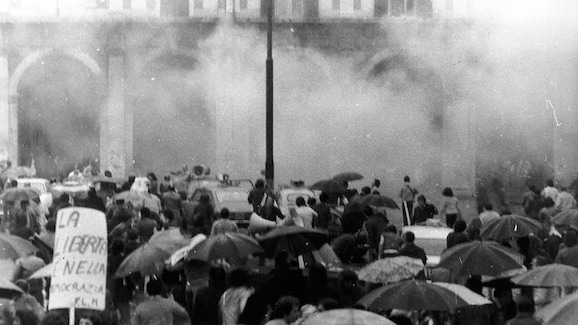
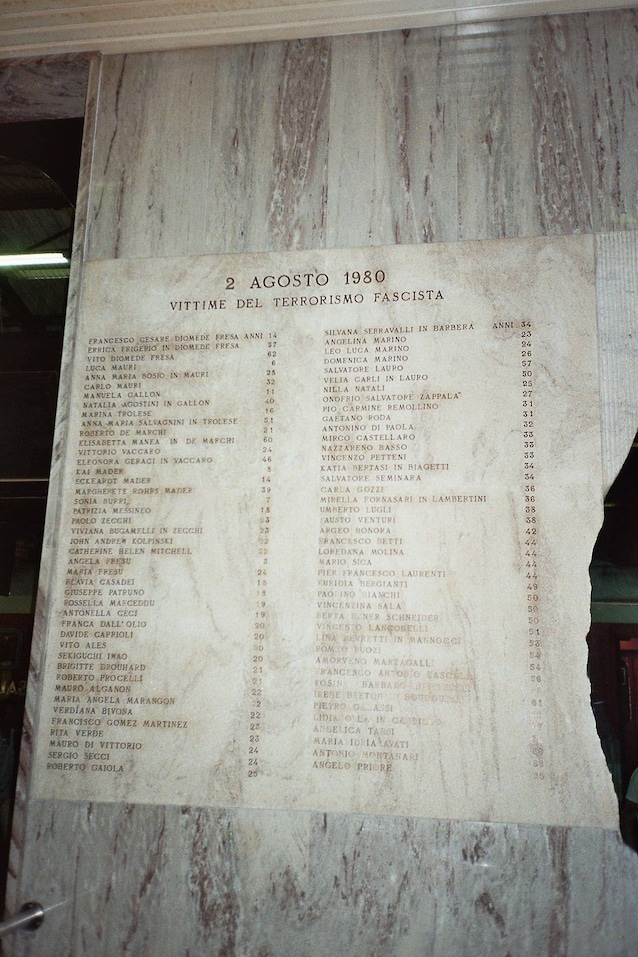
The massacre of the Bologna station is a fascist attack made on Saturday 2 August 1980. The explosion of a bomb placed in the waiting room caused 85 deaths and over 200 injured. The attack, which took place at 10:25 am – the time that the station watch still marks today – was the most serious episode of the strategy of tension, that is, the attempt to destabilize democratic institutions to encourage the establishment of a fascist dictatorship, put in place by far -right groups and “deviated” sectors of the state systems between the late 1960s and the beginning of the 1980s. According to the results of the processes, material executors of the Bologna massacre were the neo -fascists of the group of revolutionary armed nuclei, while the principals were the Grand Master and some affiliates of the deviated Masonic Loggia propaganda Due (P2), among which they also appeared belonging to the state apparatuses. The processes, however, did not make complete clarity and on the events of 2 August 1980 and many points remain dark.
The strategy of voltage
The Bologna massacre ranks in the context of the strategy of tension, of which it constituted the culmination. The strategy consisted in creating dynamite attacks to destabilize the country and make the democratic institutions appear unable to preserve the order, thus favoring the establishment of a dictatorship. The strategy of tension was put in place by neo -fascist subversive groups, including the revolutionary armed nuclei (Nar), with the support of deviated sectors of the state apparatuses, such as the secret services and the police. The massacres began in 1969 with the massacre in Piazza Fontana, in Milan, and continued with numerous attacks in the 70s, including the massacre of Piazza della Loggia in Brescia, and in the first half of the 1980s.
The last episode of the tension strategy is generally considered the 1984 rapid train massacre, but some analysts consider the strategy with the 1980s massacre in 1980. The total number of victims of the tension strategy amounts to a few hundreds, but it is impossible to define the exact number. What is certain is that democracy proved stronger than fascism and the institutions of the Republic were not overturned.
What happened that August 2, 1980 at 10.25
The Bologna massacre took place on August 2, 1980: terrorists deposited in the second -class appearance room a bomb made up of chopped and nitroglycerin, hidden in a suitcase. The station was crowded with travelers who started or returned from summer holidays. The explosion took place at 10.25 and devastated not only the appearance room, but also the in front of the taxi parking, the canopy of the first track, a parking train. The dead were 85 and over 200 injured: the most serious massacre in Italy since the end of the Second World War. The station clock remained stopped on the explosion time.
Rescue, given the high number of deaths and injuries, proved to be difficult, but began immediately. Patients in hospitals were also used to transport private cars, taxis and even scheduled buses. Bus 37, which was used as a sort of mobile first aid, became one of the symbols of the massacre. The funeral of the victims were celebrated on August 6 in the Basilica of San Petronio (but many families made private funerals), in the presence of the highest authorities of the state and a crowd of 100,000 people, who protested against fascist terrorism and insistently asked for the defense of democratic values.
Who committed the Bologna massacre? Between judicial truths and sidetracks
After the massacre, the investigators followed several slopes, including one that traced back to terrorist groups linked to the Libyan leader Gaddafi, but the fascist matrix of the attack emerged. Over the years, several processes have been celebrated to ascertain responsibilities. As material executors were accused of some exponents of the Nar, more specifically, in 1995 Giuseppe Valerio Fioravanti and Francesca Mambro were definitively sentenced, who had been in prison since 1981 and 1982 respectively (today they have been free). Fioravanti and Mambro have been sentenced to other processes also for various murders, of which they have admitted responsibility, but have always denied being the executors of the Bologna massacre. In recent years, other right -wing terrorists have also been sentenced as authors of the massacre: Luigi Ciavardini in 2007, Gilberto Cavallini in 2020, Paolo Bellini in 2025.
The principals and organizers have never been identified with certainty. However, it is considered certain that the managers belonged to the P2 loggia, a subversive group of Freemasonry aimed at establishing a dictatorship. According to the judgments of the Assize Court of Bologna, they are considered principals and financiers of the Licio Gelli massacre, head of the Loggia P2, Mario Tedeschi, journalist and former senator of the Italian social movement, Federico Umberto d’Amato, the official of the secret services, Mario Ortolani, banker and company manager. The complete truth about the Bologna massacre, however, has not yet emerged: all the principals, the decision -making process, the real reasons of the massacre are not known with certainty.
Over the years, moreover, numerous attempts have been put in place to divert the investigation. Some secrets of the secret services tried to accredit an international track by finding a suitcase containing explosive on a train in 1981 and creating a false dossier to accuse the massacre of foreign terrorists. The association of family members of the victims, then established in 1981, continues to ask insistently that full light on events be made.