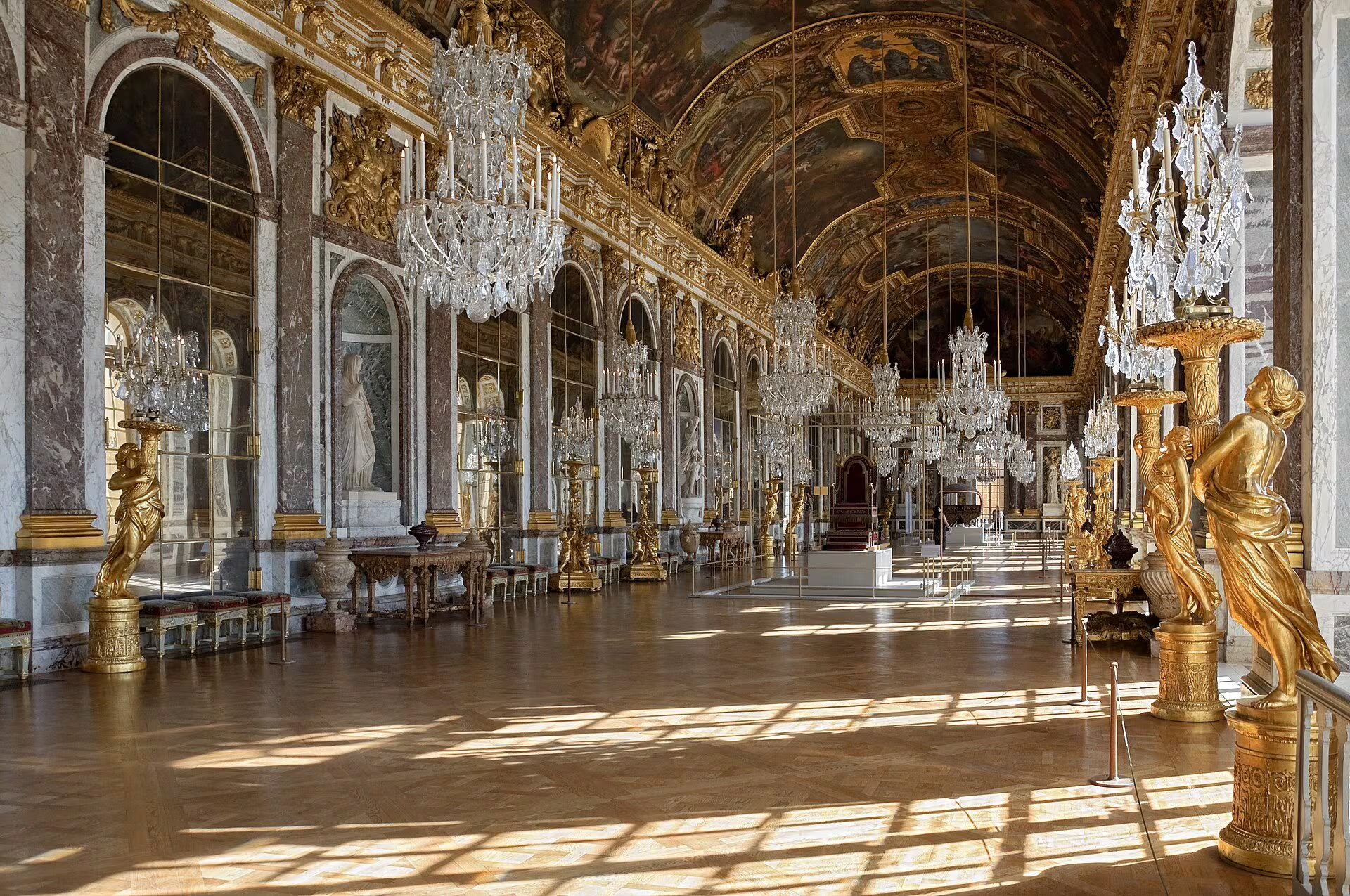
There palace of Versaillesmagnificent palace seat of the French monarchy from 1682 to 1789, the year in which the Revolution eliminated absolutism, is the symbol par excellence ofAncien Régime. This is how, during the 18th century, they were built, openly inspired by Versailles, the palace of Caserta in Italy, the Herrenchiemsee palace in Germany, near Munich, the Peterhof Palace in Russia and and the Sanssouci Palacein Potsdam, near Berlin. They cannot be defined as exact copies, but as tributes, marvelous palaces wanted by European sovereigns precisely for this purpose keep up with the greatest monarchy of the momentthe French one.
If in ancient times it enchanted sovereigns from all over Europe, who aspired to similar palaces, or even to surpass the French magnificence, today the French palace still enchants visitors from all over the world, so much so that in China, in Changsha, another reproduction was created a few years ago by the will of a billionaire.
- 1The Royal Palace of Caserta, an Italian wonder
- 2Herrenchiemsee Castle in Germany, almost exact copy
- 3Peterhof Palace in Russia
- 4Sanssouci Palace in Potsdam, near Berlin
- 5The modern reproduction of the Palace of Versailles in China
The Royal Palace of Caserta, an Italian wonder
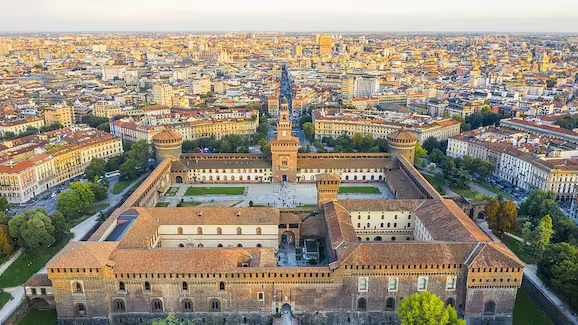
There palace of Casertain Campania, defined throughout the world as the “Italian Versailles“, was commissioned in 1752 by Charles of Bourbon and designed byNeapolitan architect Luigi Vanvitelli. The palace was commissioned by King Charles with a declared reference to Versailles, even if the “local” palace has a neoclassical style, while Versailles is more baroque.
Furthermore, King Charles’ intent was not to just build a magnificent palace where the monarchy could show off its wealth, but he wanted contribute to the development of the city and the surrounding area: he then built the Carolino Aqueduct, which supplies both the tanks and fountains of the Royal Park, as well as the city of Caserta and the village of San Leucio.
The Royal Palace of Caserta is famous for its magnificence and large extension: although Versailles is larger in terms of floor space, the park of the Royal Palace of Caserta is larger and more spectacular.
Herrenchiemsee Castle in Germany, almost exact copy
Commissioned by King Ludwig II of Bavariawho also had Neuschwanstein Castle built which inspired Disney’s castle, the Herrenchiemsee palace it was built in 1878 on the island of Lake Chiemsee, near Munich.
The sovereign’s intent was precisely to create a place similar to the magnificent French palace by which he was fascinated: a few years earlier he had gone to France, but had not managed to visit Versailles due to the sudden death of an uncle, an event which had forced Ludwig to return early.
He therefore wanted to build a similar castlea true architectural hymn to pomp and magnificence: thearchitect Georg Dollmannwho was entrusted with the task, had to study the exact plan of Versailles, including some rooms in Ludwig’s palace that no longer existed in the French palace. Even the park, designed by court gardener and landscaper Carl von Effner, followed the model of Versailles: when Ludwig died in 1886, the palace was not yet completed.
The end result was one palace very similar to Versaillesa real tribute, even if not an exact copy: today the Herrenchiemsee palace is part of the UNESCO world heritage siteand can be visited on a day trip from Munich.
Peterhof Palace in Russia
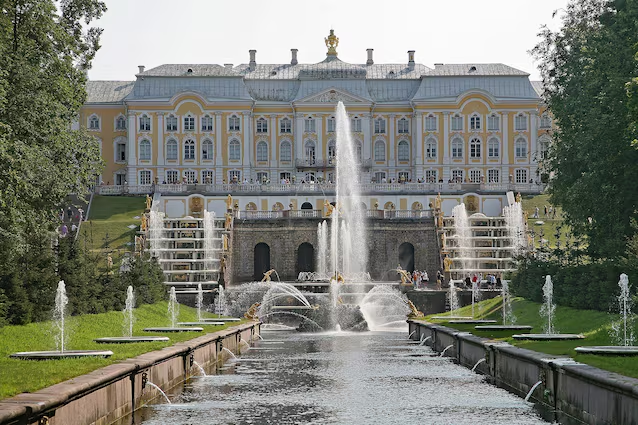
The Peterhof Palace is known as the “Russian Versailles“: it is not an exact copy, but an ambitious reinterpretation desired by the Tsar Peter the Great in the early 1700s. The Tsar, after seeing Versailles, even wanted to surpass the palace of the kings of France, creating something even more spectacular.
The Tsar, in fact, was enchanted by the French palace and its gardens of Villa d’Estein Tivoli, near Rome: he then commissioned the project to a French architectJean-Baptiste Alexandre Le Blond, and a ItalianBartolomeo Rastrelli, with the specific intention of celebrating the rise of Russia in Europe.
The main difference with the palace of Versailles is that, while the palace of the Sun King used an artificial system to make its fountains and splendid hydraulic games work, the Peterhof waterfall system exploits only the natural height difference. The park extends for 2.5 km: here there are more than 150 fountains and four large waterfalls, all fed by gravity from the springs of the surrounding hills, from which the water is conveyed into a 96 km long canal system.
Almost totally destroyed by the Nazis in World War II, the Peterhof complex has been rebuilt, too UNESCO heritage.
Sanssouci Palace in Potsdam, near Berlin
The Sanssouci Palacein Potsdam, west of Berlin, is defined as “the Prussian Versailles”: Sanssouci, literally “without worries” in French, takes its inspiration from Versailles, and was commissioned by Frederick the Great, king of Prussia, in the mid-1700s.
The king wanted a place where escape from the chaotic life of Berlinand commissioned the architect Georg Wenzeslaus von Knobelsdorff for this Rococo palace, smaller in size than Versailles, a true jewel surrounded by greenery.
Unlike Versailles, Sanssouci was not in fact an institutional place, but a personal refuge, where the sovereign could cultivate music, philosophy and cultural dialogue precisely, “without worries”.
Sanssouci is too UNESCO heritageand is considered one of the greatest examples of Rococo architecture in Europe.
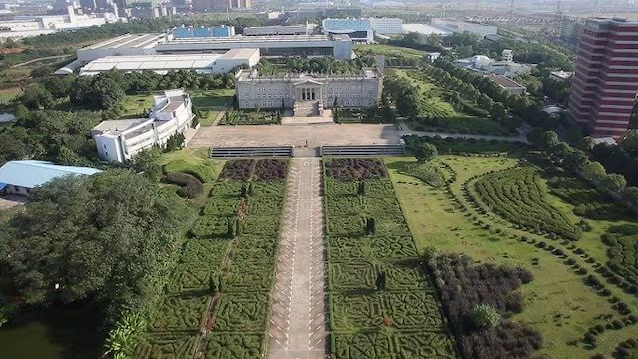
The modern reproduction of the Palace of Versailles in China
Not only European sovereigns, but also Chinese entrepreneurs have been fascinated by the Palace of Versailles: in particular a multi-billionaire, Zhang Yue, who in the outskirts of Changsha, the capital of Hunan, in central-southern China (where Mao Zedong lived as a young man!), had an enormous pyramid built, 130 meters high, and a faithful replica of the palace.
The entrepreneur lives in “BROAD Town”, where BROAD Air Conditioning is also based, a company he manages and which has allowed him to make his fortune: after the production of boilers he moved on to the sale of industrial air conditioning systems and, again, to construction. With the profits, the millionaire has realized two dreams: owning a pyramid like the pharaohs of ancient Egypt and walking through the sumptuous corridors of an iconic palace like that of Versailles.