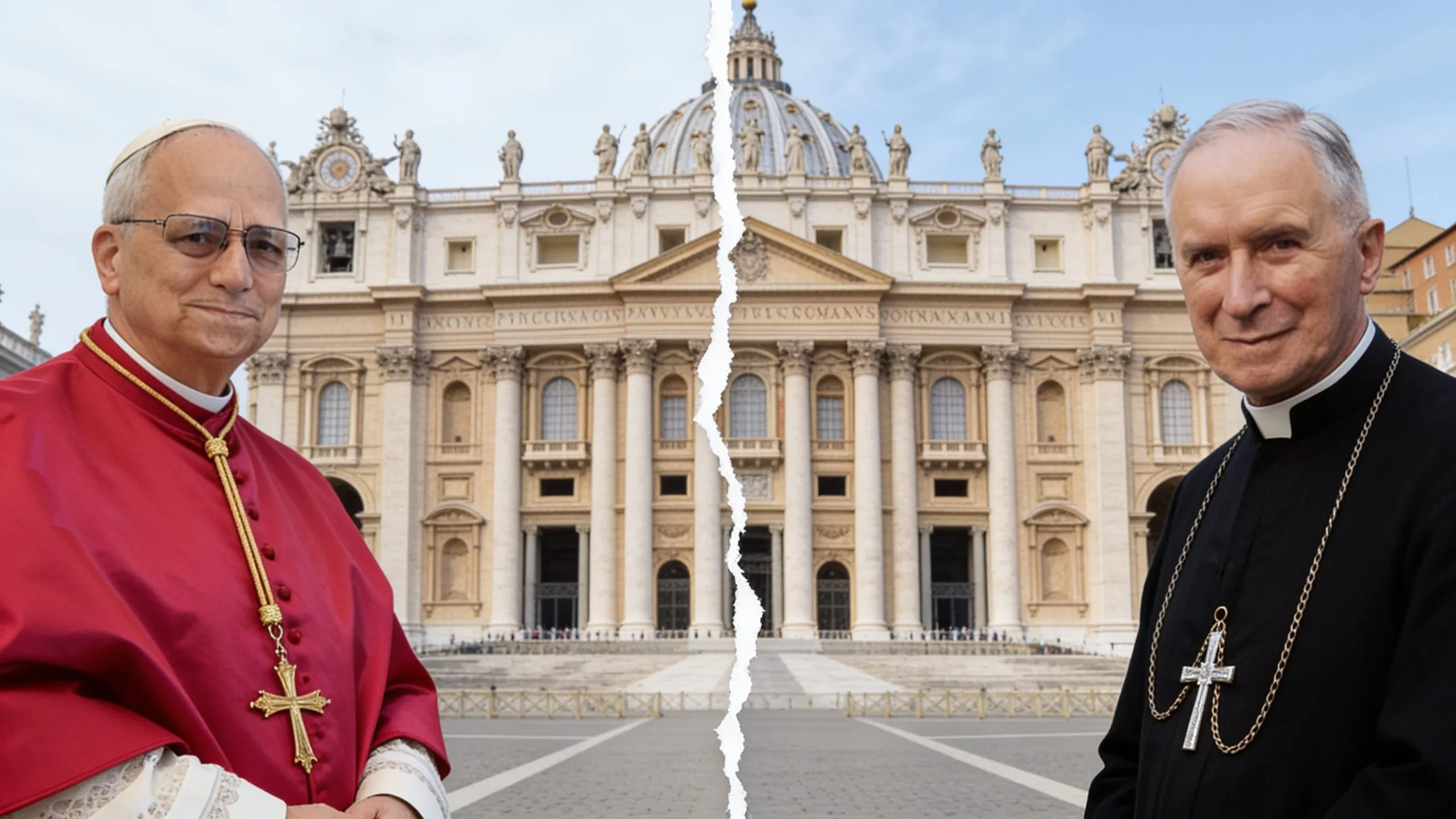
In the last few hours we have returned to talking about a possible schism, that of the priestly Society of Saint Pius “I beg you and ask you with all my heart: retrace your steps”, wrote Leo XIV to the superior general of the Fraternity. It is not the first time that the Church and the Lefebvrians have confronted each other: the Fraternity has in fact already caused a schism in 1988, partially resolved, and now risks making the separation more acute if, as announced, it ordains new bishops without the Pope’s authorization.
But what is a schism? It is the separation of a group of believers from a religious community. It can occur due to organizational, disciplinary, doctrinal or other differences. The term refers above all to Christianity, which in its history has undergone numerous schisms, some of which have never returned and still determine the presence of different Christian confessions today. The Eastern Schism, the Protestant Reformation and the Anglican Schism are the most important. Instead, the Western Schism, which divided Christianity in the 14th and 15th centuries, has been definitively overcome.
What is a schism
Schism is the separation of a group of believers from a religious community, usually due to disagreements over authority, organization, discipline, or fundamental doctrines. In a broader sense, the term sometimes indicates a division within an organization, party, or movement. The most frequent use of the word schism concerns Christianity, since divisions that have developed in other religions, such as that between Sunnis and Shiites in Islam, are generally not defined as schisms.
The Christian religion, since its origins, has undergone numerous schisms. One of the first was the Nestorian schism, which occurred in the 5th century for doctrinal reasons: the followers of Nestorius, bishop of Constantinople, believed that the two natures of Jesus, the human and the divine, were completely separate and that consequently Mary could not have the title of “mother of God”. Other schisms took place in the following decades and centuries. The most important were four, three of which were never recomposed.
The first took place in 1054 between the Catholic and Orthodox Churches
The Great Schism, or Eastern Schism, took place in 1054 and sanctioned the definitive separation of the Catholic Church from the Orthodox one, that is, of Rome and Constantinople. The schism was the conclusion of a long period of conflicts, due to various doctrinal and political issues, but above all linked to the pre-eminence that the bishop of Rome, i.e. the Pope, had acquired over the entire Christian world. The Church of Constantinople did not recognize such superiority. In 1054 the definitive rupture came, which resulted in the mutual excommunications of Pope Leo IX and the Patriarch of Constantinople Michael I Cerulario.
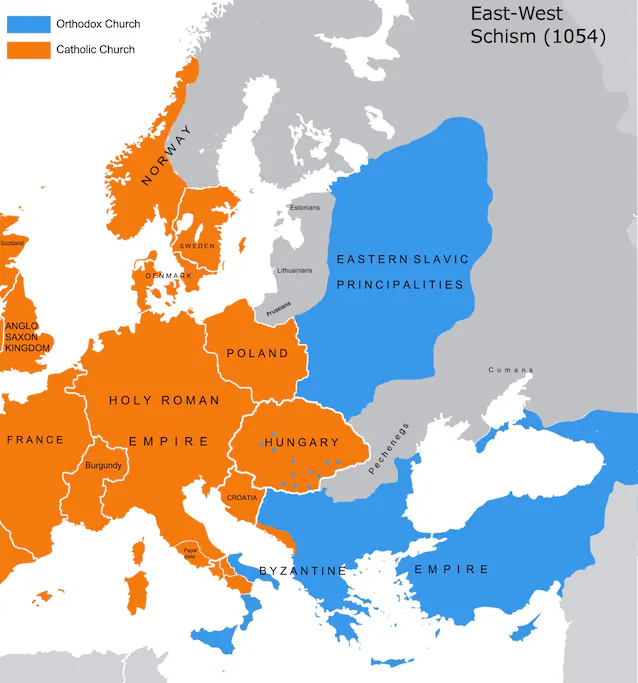
Despite attempts at reconciliation, the schism has never been healed and even today the Orthodox Church, predominant in Eastern Europe, is separated from the Catholic Church and, with its approximately 250 million faithful, is the third largest Christian confession in the world after Catholicism and Protestantism.
The Western Schism between 1378 and 1417
The Western Schism was the division of the Catholic Church into two great “obediences” between 1378 and 1417. The schism originated from the fact that in 1378 the papal seat – transferred to Avignon in 1309 – was brought back to Rome by decision of Gregory XI. The following year the pope died and the election of his successor, Urban VI, was not accepted by some cardinals, who elected another pontiff, Clement VII, who brought the seat back to Avignon. Therefore, two popes found themselves coexisting, one in Rome and one in Avignon. Christianity split and European monarchies sided with one or the other pontiff for political reasons.
In 1409 the Council of Pisa attempted to resolve the crisis, but ended up creating a third pope. The schism ended in 1417 with the Council of Constance, which deposed the contenders and elected a single pontiff, Martin V.
The birth of the Protestant Reformation in 1517
The Protestant Schism, better known as the Reformation, was the separation of the Reformed confessions from the Catholic Church. The Reformation began in 1517, when the German Augustinian monk Martin Luther published his 95 theses, harshly criticizing the Catholic Church, in particular for the sale of indulgences. Luther’s ideas spread rapidly, thanks to the press and the support of some German princes. The Reformation led to the birth of new Christian confessions, such as Lutheranism and Calvinism, and to a profound religious division, which continues to this day.
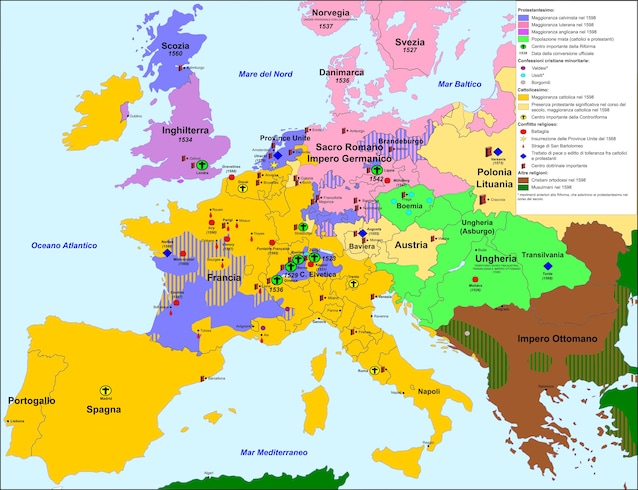
Protestantism is now widespread in central-northern Europe and other continents. The various Protestant currents have around 900 million faithful.
The separation of the English church with King Henry VIII
The Anglican Schism is the separation of the English Church, which recognizes the King of England and not the Pope as its highest authority. The schism occurred in the 16th century when King Henry VIII of England broke relations with the Catholic Church due to the pope’s refusal to annul his marriage to Catherine of Aragon. With the Act of Supremacy of 1534, Henry proclaimed himself head of the Anglican Church. The confession is still separated from Rome today and recognizes some elements of Protestant doctrine and others of Catholic doctrine. The Anglican faithful number around 80 million.
The Society of Saint Pius
The case of Lefebvrian priests is different. The separation dates back to recent times, that is, to the period following the Second Vatican Council, which, as we know, in the 1960s profoundly renewed the Church, introducing the recitation of the mass in the national languages instead of Latin and making the ecclesiastical institution more adequate to modernity.
The most conservative priests aligned themselves against the innovations, including the French bishop Marcel Lefebvre (1905-1991). In 1970 Lefebvre founded a community, the Priestly Fraternity of Saint Pius Having come into conflict with the Vatican, the prelate was excommunicated latae sentiae (i.e. automatically) in 1988, when, without authorization from the Holy See, he ordained four bishops, who were in turn excommunicated. Thus began the schism, which continued after Lefebvre’s death in 1991. The excommunication was revoked in 2009 by Benedict XVI, who thus put an end to the schism, but the Society did not return to full communion with Rome.
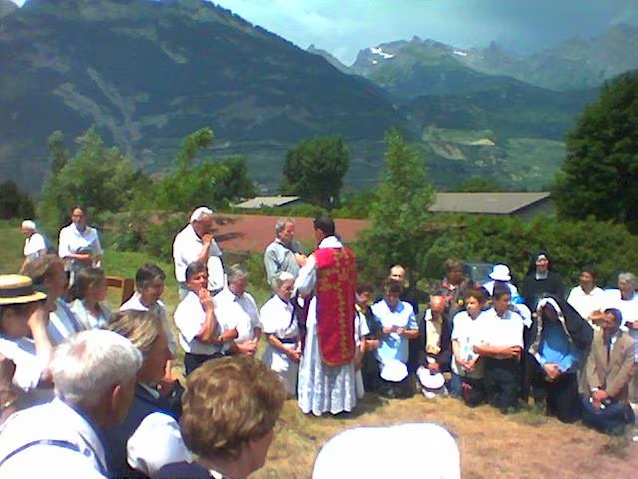
If, as announced, the Society ordains other bishops, it will face a new excommunication latae sentiae and the schism will begin again. The excommunication, therefore, will take effect immediately. Today the Lefebvrians number around 700 priests and several hundred thousand faithful, spread across various countries, with a prevalence in France and Switzerland.