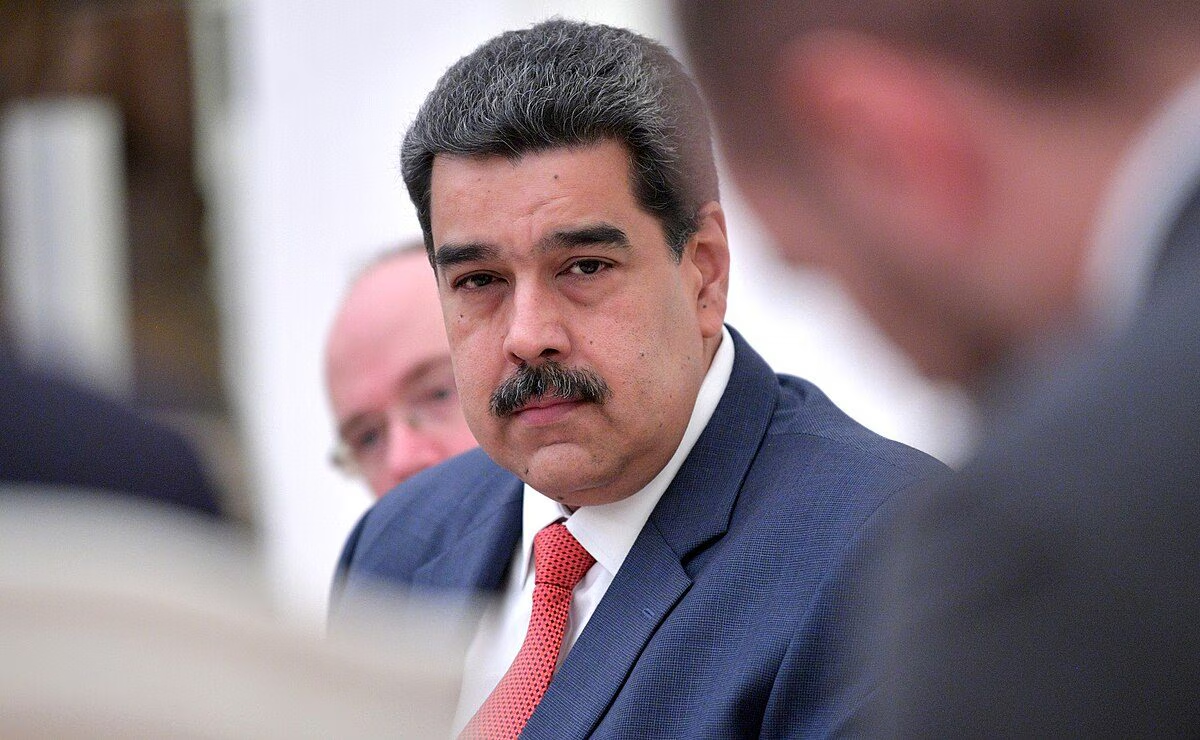
The President Nicolás Maduro he was captured together with his wife by Delta Forcethe main one US Army special unit, following numerous air raids on the capital Caracas that hit the military base of Fuerte Tiuna and other military objectives. After the US attack, the Venezuelan government declared a state of emergency.
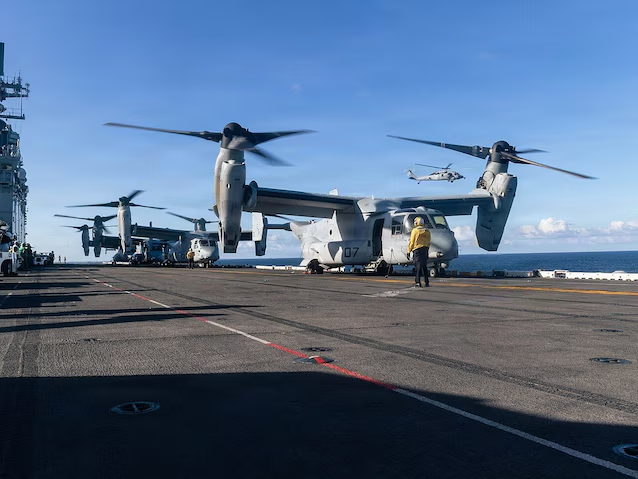
Strong tensions had already been going on for months between Venezuela and the United States, with US President Donald Trump accusing the Venezuelan government of Nicolás Maduro of encouraging the illegal entry of drugs into US territory and which led to the birth of Southern Spear (Southern Spear), the military operation launched by United States in November 2025 with the aim of combating drug trafficking and terrorist groups in Latin America and the Caribbean.
What President Nicolás Maduro risks
There are currently no details regarding where Nicolàs Maduro was taken with his wife, nor what his conditions are. The vice president of the Venezuelan government Delcy Rodriguez asked for proof of his being alive. But what does the Venezuelan President risk?
The US government has declared that Nicolás Maduro will be subjected to trial in US territory (the probable charges will be of drug trafficking and narco-terrorism). Already in 2020, during the first term of the Trump administration, Maduro had been accused in the Southern District of New York of “narcoterrorism”, corruption and conspiracy to import cocaine and other narcotic substances into US territory. During his second term, President Trump then designated two Venezuelan drug trafficking gangs, Tren de Aragua and Cartel de los Soles, as Foreign Terrorist Organizations, and claimed that the latter was led by Maduro himself. The US State Department had announced a reward of $50 million in August 2025 to those who would provide information towards his arrest or conviction.
US Secretary of State Marco Rubio said:
Nicolás Maduro was arrested by US personnel to stand trial for criminal charges in the United States and that the military action was put in place to protect and defend those who executed the arrest warrant.
Maduro’s diplomatic immunity
A crucial point concerns the alleged diplomatic immunity of Nicolás Maduro. Although the Venezuelan President and his government are not recognized by the United States government, the diplomatic immunity normally enjoyed by Heads of State would not be lost.
According to customary international law, in fact, during his mandate a Head of State cannot be detained, arrested or captured by the forces of another State, regardless of the political recognition of the government in question.
The Heads of State can in fact enjoy absolute immunity which protects them from any proceedings abroad for any act they carry out in a private or official capacity during their mandate. Therefore, although the United States does not recognize Maduro as a legitimate president, this position does not eliminate the protection guaranteed by international law against the use of force on the Heads of State of sovereign countries by foreign states.
The limits to diplomatic immunity
There are indeed limits to which state representatives cannot benefit from diplomatic immunity:
- if a State expressly renounces the immunity of its representative
- if the mandate of a head of state, a head of government or a minister of foreign affairs ends, they no longer enjoy immunity for acts carried out in a private capacity
- some international tribunals, such as the International Criminal Court, the International Criminal Tribunal for the former Yugoslavia, the International Criminal Tribunal for Rwanda and the Special Tribunal for Lebanon, can judge the criminal responsibility of a state representative without taking into account any immunity
For more serious crimes such as genocide, crimes against humanity, war crimes, apartheid and torture there is still debate on the international level, but none of these cases seems to concern President Nicolás Maduro nor the accusations attributed to him by the US government.
Use of force and violation of the principle of sovereignty according to the UN Charter
According to the United Nations Charter, the use of force against the territorial integrity or political independence of any state is prohibited.
In fact, according to article 2.4, there cannot be unilateral armed interventions in foreign territory violating the principle of respect for sovereignty, unless the right to self-defense provided for in article 51 is invoked, subject to authorization by the Security Council. However, there must have been a previous armed attack or an imminent threat to the State in question.
According to these elements, therefore, the air attack and capture of the Venezuelan president would represent a violation of the principles of sovereignty and non-intervention.
International reactions
The governments of Russia, Iran and Cuba have strongly condemned the US military operation in Venezuela. The Moscow Foreign Ministry defined it “US armed aggression against Venezuela” while the Iranian Foreign Ministry a “violation of the national sovereignty and territorial integrity of Venezuela”. Even Cuba, a country that has always been a strong ally of Venezuela, has openly sided with Venezuela: Foreign Minister Bruno Rodríguez condemned the incident, speaking of a “criminal attack” of Washington and asking for the intervention of the international community.
While the European Union called for moderation, the European country that immediately expressed its opinion on the matter, calling for de-escalation and respect for the United Nations Charter, was Spain: the government of President Pedro Sanchez also offered its support in the mediation process.
As for the United States, numerous Democratic senators and parliamentarians have harshly criticized the legality of the operation, also due to the lack of consultation and approval by the US Congress.
However, Utah Republican Senator Mike Lee declared that the operation was carried out in accordance with Article II of the US Constitution, which in section 2 gives the President the powers of commander in chief of the army. The operation, according to Lee, was carried out to protect US personnel from “an actual or imminent attack” by Venezuela.
What could happen now: possible scenarios
As we follow the developments of the story, different scenarios emerge. First of all, the operation aimed to underline and highlight to powers such as China and Russia the role of the United States in America, demonstrating that, in the event of failure to respect diplomatic channels, the United States is willing to use force. A sort of revisitation of the principles of the Monroe Doctrine, the ideology enunciated by US President James Monroe in 1823 which was used to justify US military interventions in Latin American countries.
In this context of strong international instability and lack of further details, the scenarios could be the following: according to the Venezuelan Constitution, in the absence of the President, his deputy temporarily takes his place. It would therefore be Delcy Rodriguez who would replace President Maduro until new elections. In the meantime, a de-escalation could take place with the intervention of the United Nations, which could resolve the situation and lead to the release of the Venezuelan President. The second scenario could instead see the dissolution of Maduro’s government and the resignation of its senior leaders. The last scenario, the least desirable, is the military takeover of the country.









