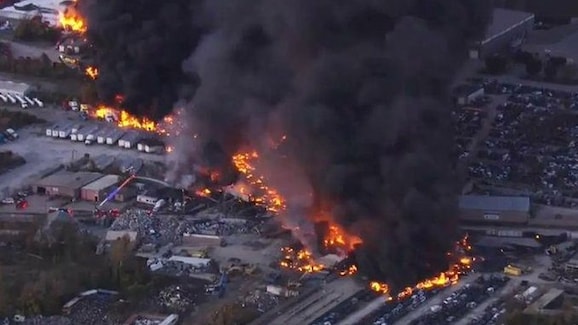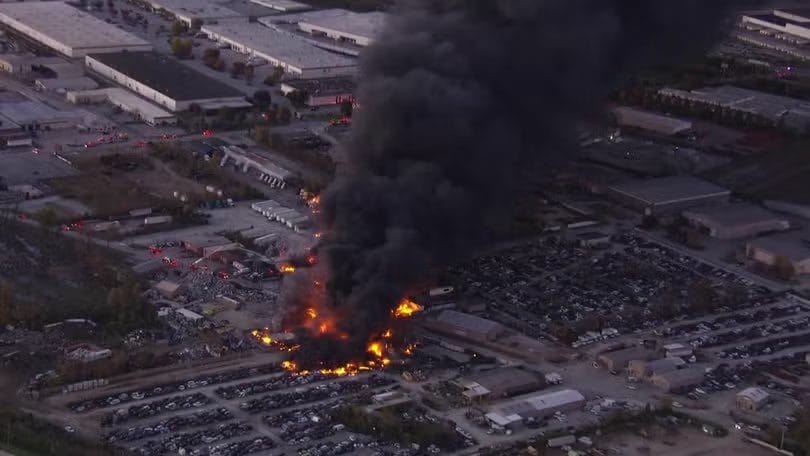
The death toll rises to 12 and the number of missing in the plane crash of UPS cargo flight 2976 which crashed yesterday on take-off from the Muhammad Ali airport in Louisville, Kentucky, causing a fire that spread for hundreds of metres. This was stated by the mayor of Louisville Craig Greenberg, while the National Transportation Safety Board (NTSB) began investigating the accident and confirmed in a press conference held recently that the black box of the aircraft – a McDonnell Douglas MD-11 – was recovered, which will help shed light on the dynamics of what happened. According to the statements of NTSB spokesperson Todd Inman, we know for sure that an engine of the plane detached from the wing during take-off (as also confirmed by the video that you can see above, which has been circulating a lot in the last few hours) and that, in correspondence with this event, flames broke out on the left wing of the aircraft.
The dynamics of the accident, although still to be clarified, closely resembles that of the most serious air accident in the history of the USA in terms of number of victims: the disaster of American Airlines Flight 191, which on 25 May 1979 caused the death of 273 people. The similarities are in fact truly remarkable: on that occasion a McDonnell Douglas DC-10 (on which the MD-11 model involved in the Louisville accident is based) saw the detachment of its left engine, a General Electric CF6-6D (which belongs to the same family as the engine detached in Kentucky), during take-off from O’Hare International Airport in Chicago.
The detachment damaged the left wing, in particular the front flaps, necessary to reduce the stall speed, but by now the plane had exceeded the speed limit above which take-off cannot be avoided. The inability to act on the flaps increased the stall speed to around 300 km/h, but the pilots – who could not rely on the various warning systems, damaged by the engine detachment – had reduced the plane’s speed to around 280 km/h. As a result, the left wing stalled, meaning it no longer had lift. This caused a significant yaw to the left and pitch downwards at an altitude of about 100 metres. Once the plane lost control, it crashed into a workshop 1400 meters beyond the end of the runway. The extremely violent impact caused the death of all 271 people on board as well as 2 people who were working in the hangar at the time.
In that case the NTSB found that the pylon connecting the wing to the engine was damaged, and that it was this damage that caused the separation of the engine. The damage was due to the adoption of an incorrect engine replacement procedure during maintenance of the aircraft two months before the accident.
Obviously we don’t know if the same thing also happened to the McDonnell Douglas MD-11 that crashed yesterday. The portal FlightRadar24 reports that the plane was grounded from October 3 to 18, giving rise to the hypothesis that it had undergone maintenance during that period. However, during yesterday’s press conference Inman stated that the NTSB has no confirmation of this. At the moment, therefore, all we have to do is wait for the preliminary report that the American control body is required to publish within 30 days of the date of the accident, in which the evidence ascertained by the initial analyzes is collected and an attempt is made to shed light on the exact dynamics of the accident. For an explanation of the causes, however, we will have to wait for the definitive report which is generally published approximately one year after the accident.