The Astronaut of Salamanca is a enigmatic statue found on a cathedral of the 1500s. It is an Oopart, that is, an “object placed out of place”: in most cases, they are modern artifacts present in ancient artistic depictions, such as the alleged bulbs carved on a temple of ancient Egypt, and even a astronaut on a tomb in a tomb of civilization Maya. Although the Oopart feeds unfounded alternative theories on the history of human civilization, their presence can be easily explained: these are almost always images that depict scenes other than those that appear at first sight. The astronaut of Salamanca, however, is a different case: on the cathedral of the Spanish city, built in the 16th century, the figure of a space traveler is really carved. How is it possible?
The most famous ooparts
Oopart, from the English acronym Out of Place Artifacts, “out of place artifacts” are objects created by the man placed in contexts in which they should not be. Generally, these are anachronistic objects, that is, modern artifacts present in artistic representations dating back to eras in which they would not have been existing.
The Ooparts are often at the origin of alternative historical narratives, such as the one according to which the land would have been visited in ancient times by an alien civilization. These are hypotheses without any scientific foundation. The Oopart, in fact, can easily explain: they are often different objects from what they seem, in other cases, are actually ancient objects, but their temporal location is explained without resorting to imaginative theories. Let’s see two examples.
Palenque’s astronaut
On a 5th century Mayan tomb. C. In Palenque, Mexico, on the sarcophagus lid there is a bas -relief that, with a little imagination, seems to depict a man in the act of maneuvering a spacecraft. The supporters of the theory of ancient astronauts, such as the Swiss writer Erich von Däniiken, believe that the figure is a proof of the validity of their thesis. It is, however, a Madorna error: in -depth studies have shown that the relief shows the transition of a high dignity from the world of the living to that of the dead. Nothing to do with space travel.
Dedera lamps
On a temple in Dendera, in Egypt, dating back to the 4th century BC. C., there are some bas -reliefs that seem to depict large bulbs (invented, as we know, only in the nineteenth century). According to supporters of alternative theories, the images would show large lamps connected to a generator. The Egyptians of the 4th century BC. C., consequently, knew electricity, evidently because an advanced civilization of alien origin had taught them. In reality, the explanation is very simple: the dedera reliefs depict an Egyptian myth, that of the primordial snake (the alleged filament of the light bulb) that is born inside a lotus flower (which would be the bulb of the light bulb).
The astronaut on the Cathedral of Salamanca
On the cathedral of Santa Maria dell’Assadio di Salamanca, built in the 16th century and known as Cateterral Nueva, the figure of an astronaut is carved.
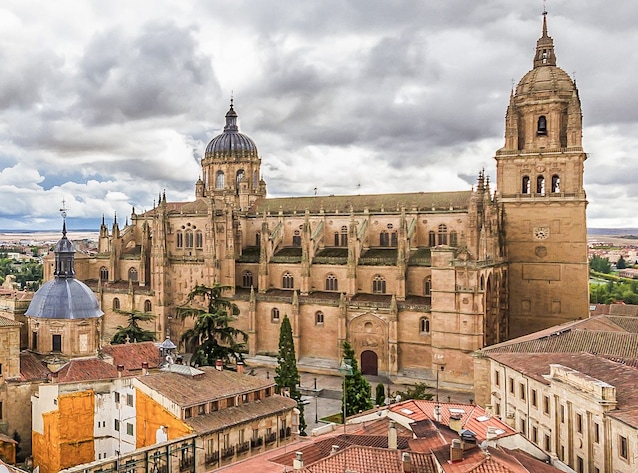
The relief is located on the western facade, near the Ramos Porta. And it is not, as in the case of Palenque, a figure that only with a good dose of imagination can a pilot of space vehicles be considered, but of a relief that unequivocally represents an astronaut, complete with a helmet and suit.
How is it possible? The explanation is very simple: the relief was carved in the twentieth century, when traveling in space were a reality. In the 1980s, in fact, it was decided to restore a portal, the Porta de Ramos and, in the points in which the original figures were damaged, modern depictions were added, such as that of the Iberian lynx, a species at risk of extinction, and that, precisely, of the astronaut, which served to symbolize the spatial era in which we live.
This is not the rest of a unique case: also in other cathedrals, modern sculptures have been added. One of the best known cases is that of the Milan Cathedral. Among the spiers, in the years of fascism, images of characters at the time were carved at the time, including Mussolini, Vittorio Emanuele III, Pius XI and even the first carnera boxer.