
Fascist architecture, like all the architectural languages desired and imposed by the regimes, developed during the twenty years of fascism with a symbolic, colossal, monumental and classic character also known as a littorio style. In the specific case of our country, already in 1925 Benito Mussolini openly declared the intention of transforming architecture into a regime tool (and propaganda): the new fascist Italy would have been heir to imperial Rome, and the new buildings, together with large and targeted urban interventions (from heavy editions and removal of the historical fabric, to the foundation of cities on the recounted plains), should have reflected its grandeur.
The characteristics of fascist architecture: classical monumentality and rationalism
Unlike Nazism in Germany, fascism exerts a discontinuous pressure on Italian architectural culture that allows several attitudes to enter and emerge during the twenty years (1922-1942). There are two main strands: the first is a variant of the neoclassical style, while the second is that of rationalism.
Neoclassical style
The first, which only from the second half of the thirties will become an official expression of Mussolinian politics, turns its gaze to the past, finding its roots in ancient architecture and Romanity (in this context, the archaeological excavations of the contemporary in Ostia, Portus and Rome highly engraved). The architectural forms, severe and symmetrical, therefore recover the most traditional busty elements (the wall, the archery, the column, the praise) and combine them with a massive use of travertine. The result is a variant of the neoclassical style, whose new simplified guise echoes the imperial era without replicating its sumptuousness: a language so monumental, but at the same time stereometric and unadorned.
The architect Marcello Piacentini will be his main interpreter and promoter, as a key figure in the urban planning commissions of the 1930s. In fact, it will play a decisive role in the drafting of the 1931 Rome General Regulatory Plan, and will coordinate the projects of the university city (for which it will carry out the famous palace of the rectorate) and of the 42, ambitious urban experiment conceived as the seat of the never -happened Universal Exhibition of 1942. To resume the classical monumentality of the Piacenza model, in the free to the autarchic principles, they are the buildings of the newborn neighborhood. Among these stands out the Palazzo della Civiltà Italiana (now Palazzo della Civiltà del Lavoro) by Giovanni Guerrini, Ernesto La Padula and Mario Romano: emblem of the Romanity renamed “Square Colosseum“.
Rationalism
The second strand, born on the wake of the avant -garde and the modern European movement, is affirmed in Italy with the name of rationalism. The attempt of this second current is to mediate the emerging characters of international architecture, such as functionalism, transparency, audacity and the use of new technologies (including reinforced concrete), with the evocative aestheticism of classical precedents already dear to the regime; Basically, he aimed to decline them in a national key. Rationalism will find space mainly in the Lombard environment, through group 7 (founded in Milan in 1927 by Luigi Figini, Guido Frette, Sebastiano Larco, Gino Pollini, Carlo Enrico Rava, Giuseppe Terragni and Adalberto Libera, and then dissolved in the Italian movement for Rational Architecture Miaor); among the pages of the magazines Casabella And Dial; And thanks to events such as the exhibitions of rational architecture and the three -year of Monza and Milan.
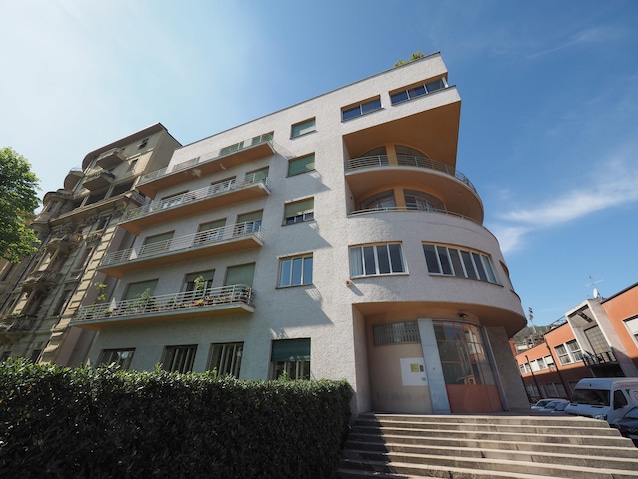
To provide a clear example of the synthesis developed in this context was Giuseppe Terragni, the undisputed protagonist of Italian rationalism and author in Como, from the mid -1920s to the mid -thirties, of seminal works, including the building for Novocomum homes, the asylum Sant’Elia and the house of the bundle. The latter, with its open grid facade in marble, the classic volumetric system and the traberate atrium, betrays the contradictory coexistence between the search for modern and continuity with the past. All too cold and abstract to be understood and arouse enthusiasm in the masses, the Casa del Fasce di Como is, unlike the others spread throughout the country, the most singular and surprising episode of fascist client to the modern Italian movement, as well as the most representative and well -known rationalist building.
As anticipated above, with the failure of Miar and the approach of Hitlerian Germany, starting from 1931 the regime will denote its ties with rationalism, choosing to identify, now at the dawn of the Second World War, with what will become the so -called state neoclassicism. Monumental, scenographic and very Roman, this precise architectural language is voted to spread ideals and transmit the myth and greatness of fascism.
The examples of fascist architecture
The regime was not limited to building buildings and houses of the bundle in each city, but found entire landscapes, urban and non -urban. According to the renewal plan for Rome, some roads should have been cut to connect the main monuments, representative of the distant and grandiose past of the city, with those that were intended to be built from scratch. Among the most drastic interventions, Piazza Augusto Imperatore (by Vittorio Ballio Morpurgo) and via della Conciliazione (by Marcello Piacentini and Attilio Spaccarelli), both built by demolishing vast areas built in order to provide, respectively, a monumental scenario to the mausoleum of Augustus and create a perspective axis in the direction of the Basilica of San Pietro, stand out.
Another imposing gutting of the twenty years was the one accomplished, always by Piacentini, for the construction of Piazza della Vittoria in Brescia. The model of this square, with Torrione and Portici, will be an important precedent for the urban planning of the five Lazio cities of the new Foundation built by the fascist government following the reclamation of the Pontine marshes: Littoria (today Latina), Sabaudia, Pontinia, Aprilia and Pomezia.










