
The so -called Dead Hand (translatable as a “dead hand”), according to numerous military experts, would allude to “System 15E601 Perimetr”, and with it we mean a sophisticated and potentially dangerous system of control and autonomous launch of the nuclear arsenal developed by the Soviet Union and still in use by the Russian Federation to ensure the persistence and effectiveness of its nuclear response in case an enemy was able to carry out a precise surprise attack that results in the beheading of the political and military vertices of the country thus interrupting the normal decisional chain. delegated to authorize a nuclear counterattack.
What is the “Dead Hand” and how it is composed today: what we know
Although it has been operational for 40 years, there are still many elements of the “Dead Hand” system that are surrounded by mystery. What we are sure is that it is activated by the interaction of a series of sensors specifically calibrated to find the traces of the nuclear attack in the environment. In the absence of manifest activities by the operational commands, “Dead Hand” proceeds to launch one or more rockets of the type 15p001. The characteristics of the rockets in and for themselves are not known even if most of the sources consider them variants for special uses of the ballistic missiles “Mr-Eur-100 Sotka”.
Unlike from the original ballistic missiles from which, however, instead of embarking multiple nuclear heads, the 15p001 rockets are equipped with a raised “15b99” which would be united to a powerful electromagnetic wave emitter which have the ability to remotely activate the launching systems of the Russian nuclear newspapers. After a certain period of time, that the different sources quantify in an interval between the few hours and a few days, and if along the chain of command and supervision there is no human intervention aimed at blocking the sequence of activation steps of the components of the “Dead Hand”, then the system goes into fully autonomous mode by proceeding with a massive launch of the nuclear arsenal towards the pre -established objectives.
Although, paradoxically, the ratio that undergoes the creation of the “Dead Hand” system would be to preserve peace by guaranteeing the Mad, the risk of entrusting an automatic system the ability to trigger the proverbial “apocalypse” should in itself revalue the rules of engagement according to which nuclear powers emit the guidelines that regulate the use of nuclear weapons.
The doctrine of mutual assured destruction
The term “mutual destruction insured” (acronym in English “Mad”) means that theory that underlies the so -called “balance of terror” which guaranteed that the competition existing between the two superpowers of the Cold War (USA and USSR) and members of the respective military alliances chaired by them, never resulted in a generalized conflict and without restrictions as it had happened during the first war. World.
Essential element of this doctrine is the existence of a so -called “triad of nuclear weapons of different classes and types” based on the ground, in heaven and on the sea that allows you to commit the opponent through an attack strategy (the so -called “first strike”) or retaliation (the so -called “second strike”) in the event that the scenario of the “nuclear war” is concretized. The existence of this triad makes the victory in the event of the outbreak of an absolutely impossible nuclear war and, as a consequence, acts as a deterrent towards a conflict that would be particularly destructive and most likely would lead to the learning of humanity.
The search for an autonomous launching system of the newspapers
The Mad theory was partially under discussion in the early 1980s when the Soviets realized that the new American ballistic missiles, launched by the ballistic launches with nuclear propulsion, Ugm-96 Trident I and UGM-133a Trident II (also called respectively “Trident C4” and “Trident D5”) were much faster Compared to the UGM-27 Polaris and UGM-79 Poseidon precedents. This meant that if a submarine ballistic launches with American nuclear propulsion had managed to approach the Soviet coasts dangerously, he could have launched a surprise attack potentially capable of decapitating Soviet leadership in a few minutes giving it a too scarce notice to launch a retaliation nuclear counterattack.
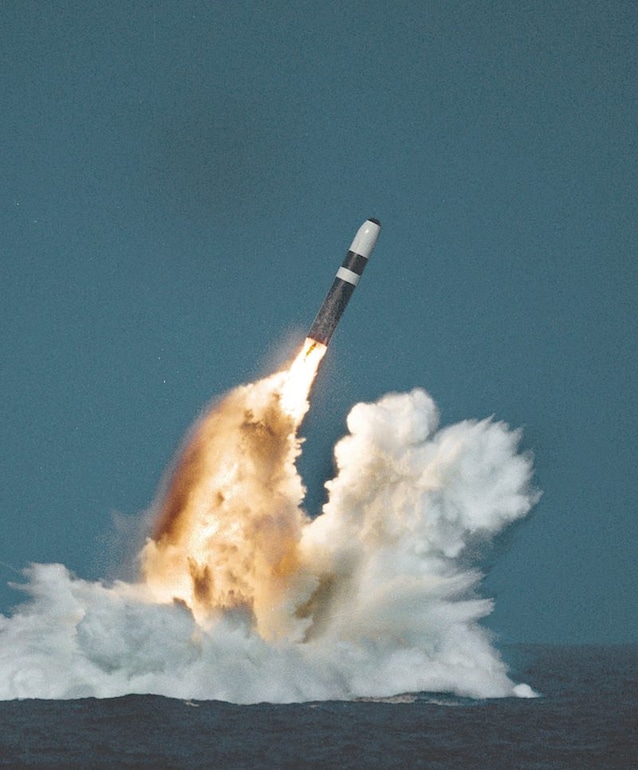
For this region, the Soviets worked hard, between the late 70s and the beginning of the 80s, to the creation of an autonomous command, control and launch system that could have continued to guarantee the Mad even in the new scenarios. The result of their efforts was the “system 15E601 perimetr”, also known with the nickname “Dead Hand” (the “dead hand”), which was finally declared operational in January 1985, although some of its components were not completely ready until 1986. In particular, the communication rockets associated with the “Dead Hand” system were tested a total of 7 times between 1979 and 1986 by obtaining 6 launches. 1 partially.










