Energy produced from renewable sources is increasing more and more, despite fossil fuels maintaining their dominance. According to what was reported in Global Electricity Review 2025, published by Ember, in 2024, more than 80 states generated more than 50% of their electricity from renewable sources, with 47 countries exceeding 75%.
Overall, the mix of wind and solar energy covered 15% of the world’s electricity needs, with solar energy confirmed as the fastest growing renewable source for the 20th consecutive year.
According to the report, in 2024 the low emission sources (renewables + nuclear) produced the 40% of global energy needs, with renewables alone accounting for approximately 32%.
Let’s see the top 5 countries in the world for renewable energy production, with a focus on solar, wind and hydroelectric energy.
China, global leader in renewable energy produced
China confirms itself as the leading country globally, producing more renewable energy than the other 4 countries in the ranking combined. According to the latest available data – and referring to the whole of 2024 – in China, 38% of the national energy mix was produced thanks to renewable sources. Specifically, the country has produced well 3,836 TWh of renewable energy – which would be enough to cover Milan’s current energy needs (homes, offices, industries and transport) for around 620 years -, of which 1,826 TWh (18.1% of the mix) coming from wind and solar and 1,356 TWh (13.5% of the mix) coming from hydroelectric.
Nonetheless, it must be said that coal still represents the primary source for energy production in China: in 2024, in fact, 58% of energy was produced thanks to coal, a clearly growing value compared to 2015, when it stopped at 45%.
United States, record growth
The United States ranks second in this global ranking. In 2024, the country experienced record growth in renewable energy production, surpassing coal for the first time in history thanks to the combination of wind and solar. In particular, clean energy production reached 1,839 TWh (equal to 42% of the national energy mix), the equivalent of Italian electricity consumption for 6 years. Of these, 757 TWh they were produced by wind and solar. Hydroelectricity, on the other hand, contributed approximately 236 TWh.
Brazil, one of the greenest energy mixes in the world
In third place is Brazil, which has one of the “greenest” energy mixes in the world, dominated by hydroelectric and with very rapid growth also in wind and solar energy. In 2024, 90% of the total mix was covered by renewable sources, with a total of 669 TWh produced. Of these, 56% were produced by hydroelectric sources, while 24.5% were covered by wind and solar.
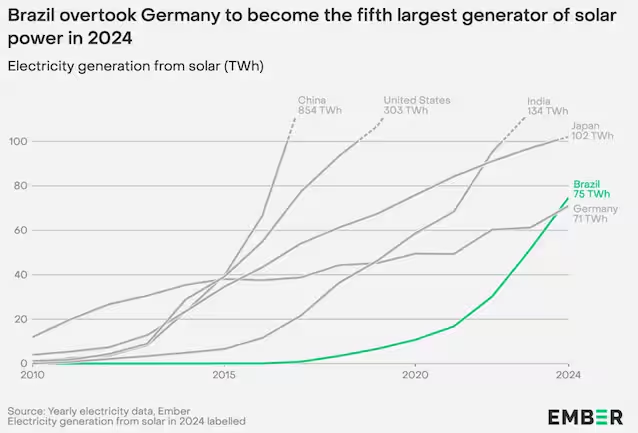
At the end of the year, Brazil overtook Germany as the 5th largest producer of solar energy in the world (75 TWh), preceded only by China, the USA, India and Japan.
India, mix between wind and solar
Fourth global position for India, which in 2024 became the world’s third largest producer of renewable energy from wind and solar. Overall, 22.5% of the energy mix was covered by renewables, for a total of 462 TWh produced. Over the last 5 years, India has almost doubled its energy production from wind and solar to 215 TWh.
Canada, hydroelectric is declining
Closing out this ranking is Canada, which continues to rely on its vast hydroelectric base, although growth in other renewables has been slower than the global average. In 2024, the country produced approx 455 TWh from renewable sources, of which almost 70% comes from hydroelectric.
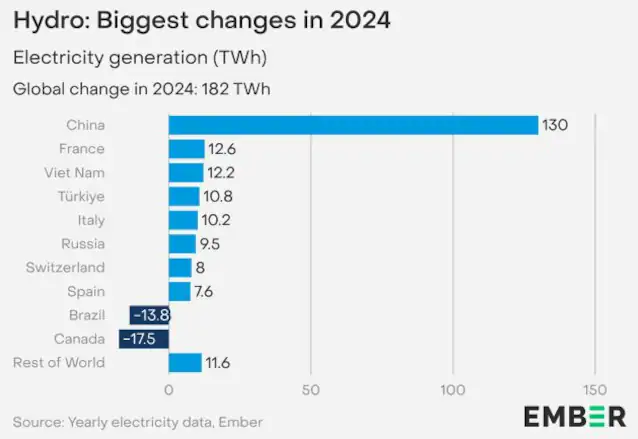
Although this is a considerable share, equivalent to the Italian electricity requirement for 1 year and 5 months, last year Canada suffered a decline, with -17.5 TWh of energy from hydroelectric sources produced less than the previous year.