
The Roma constitute one of the largest and at the same time most stigmatized ethnic minorities in Europe. Despite centuries of presence on the continent, their history, social practices and internal heterogeneity remain widely misunderstood.
But why do we call them Roma? Who are they and where do they come from?
The language used to name them, in particular the use of the term “gypsy”, is not neutral: it reflects power relations, processes of exclusion and a long tradition of external representations that have contributed to their marginalization.
Who are the Roma: historical and cultural heterogeneity
Linguistic, genetic and historical research agrees in placing the origin of the Roma in north-western India, from which they left between the 10th and 11th centuries. In fact, comparative linguistic studies show how the Romani language has structural and lexical affinities with Indo-Aryan languages such as Hindi and Punjabi.
The reasons for their migration cannot be traced back to a “vocation” to the movement, as is often thought, but to complex historical processes: conflicts, political pressures and territorial transformations. In their long journey across Asia and Europe, the Roma have inserted themselves into different contexts, adapting artisanal, musical and commercial knowledge to local economies.
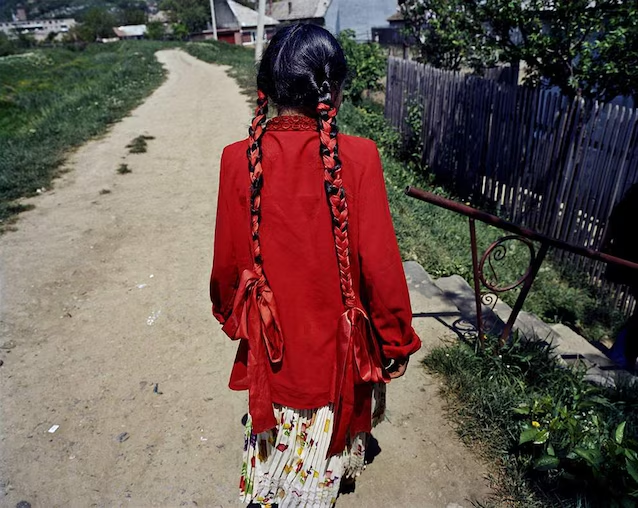
However, even speaking of “Roma” in the singular is reductive: there are numerous groups (Roma, Sinti, Kalé, Manouches, Caminanti) differentiated by migratory history, economic practices, religion and degree of sedentarization. The idea of a homogeneous people is in fact a true external construction, often functional to policies of control and categorization.
Where does the word “gypsy” come from and why is it highly discriminatory
The term “gypsy” probably comes from Greek athinganoiused in the Byzantine era to indicate a sect considered heretical and “untouchable”.
Over time, the term has lost its religious reference to take on a negative ethnic connotation. From a morphological and semantic point of view, “gypsy” has become an imposed heteronym, full of stigmatizing meanings: vagrancy, deviance, dirt, crime.
In linguistics and anthropology, the use of a term imposed from outside, especially when it is historically associated with discrimination, is considered problematic precisely because it contributes to naturalizing stigma and reproducing power hierarchies.
All this can be explained through the widespread use of stereotypes that surrounds the reputation of Roma populations. Stereotypes about Roma, in fact, are not simple individual prejudices, but social products sedimented over time.
The figure of the “gypsy” reflects in the minds of some characteristics such as: nomadic by nature, refractory to the rules of society, incapable of regulating himself, controlling himself or integrating into the culture of the nation in which he settles. Furthermore, contrary to widespread imagination, the vast majority of Roma today do not live in caravans.
Caravans and campers have become a media symbol of “Roma nomadism”, but they only represent a very minority reality. Historically, in fact, caravans have been used above all in contexts in which Roma, simply because they come from that ethnic group, were denied access to a home or ownership of land.
Where are the largest Roma communities located and what are their relationships with each other?
From a cultural and social point of view, Roma are characterized by a strong centrality of family and parental relationships, but this does not imply automatic recognition among all Roma as “relatives”.
Roma identity is plural and situated: ties of belonging are often based on the specific group (for example Vlax Roma, who differ from the Sinti or Lovara), on the language spoken, on local history and on actual kinship networks.
Today the largest Roma communities are found in Central-Eastern Europe and the Balkans, in particular Romania, Bulgaria, Hungary, Slovakia, Serbia and North Macedonia, but they have also been present for centuries in Spain, France, Italy and Germany. In many of these countries, Roma represent a historic minority, often permanently settled for generations in urban neighbourhoods, rural villages or informal suburbs.
EU legislation and recognitions on Roma
At the European Union level, Roma are recognized in policy documents as the largest ethnic minority on the continent (estimated at between 10 and 12 million in Europe) and are the subject of community policies to promote equality, inclusion and social participation.
The EU has a strategic framework for Roma equality until 2030, which aims to reduce inequalities in areas such as education, health, economic inclusion and discrimination (right to housing, work etc.).
There are also multilateral initiatives such asEuropean Alliance of Cities and Regions for Rome Inclusionwhich promotes local policies and networks between public authorities to counter anti-Gypsyism and promote civil rights.
Looking then at the specific Italian case, in our legal system, although the Roma are not officially recognized as a national or ethnic minority, there is a National Strategy for their inclusion (2021-2030) promoted by the Government and monitored by the European Commission, which includes objectives such as access to education, work and equal rights.