Today it seems normal to us: the referee puts his hand in his pocket, raises a colored card and the whole stadium instantly understands what is happening. But until fifty years ago, football was a mess of linguistic misunderstandings. The yellow and red cards did not arise from a deliberate decision by FIFA, but from a communication misunderstanding during the 1966 World Cup between the German referee Rudolf Kreitlein and an Argentine footballer and from an epiphany that the head of the referees commission Ken Aston had in the middle of London traffic. This innovation transformed a game of incomprehensible words into a universal visual language, borrowing logic from traffic lights.
The sending off that revolutionized football
It all began on 23 July 1966, during a World Cup quarter-final that to describe as “tense” would be an understatement: England against Argentina. There was crazy electricity on the pitch. The referee of the match was the German Rudolf Kreitlein, who however spoke neither English nor Spanish. In the 35th minute the unexpected happened: Kreitlein decided to expel the Argentine captain, Antonio Rattín, for protests. Despite not understanding Spanish, the referee interpreted Rattín’s attitude and facial expressions as offensive, considering them real insults to his authority.
The problem? Rattín didn’t understand German and the referee couldn’t explain himself. The Argentine captain refused to come out for eleven minutes, clamoring for an interpreter. In a gesture of defiance that went down in history, before leaving he sat down on the red carpet reserved for Queen Elizabeth II and wrinkled a small English flag.
But the confusion didn’t end there. In that same match, the English brothers Bobby and Jack Charlton were booked, but they only found out the following day by reading the newspapers, because they didn’t understand the referee’s gestures at the time. It was clear that the verbal system had failed.
In the stands, observing that communication disaster, was the Englishman Ken Aston, then head of the FIFA referees commission. Aston knew well what tension on the pitch meant: he had been the referee of the infamous 1962 “Battle of Santiago” between Chile and Italy, a match so violent that it required police intervention. That July evening at Wembley, Aston understood that something new was needed: a signal that needed no translation.
Intuition at the traffic lights on Kensington High Street
The solution came not during an official meeting, but while Aston was driving his car home. Standing at an intersection on Kensington High Street in London, he watched the traffic lights go from green to yellow and finally to red. He had the decisive intuition: if billions of people around the world associated yellow with caution and red with stop sign, why not bring that code to the football field? Yellow would have been the warning (“be careful”), red the definitive stop (“you’re out”).
When he returned home, he explained the idea to his wife Hilde, who with great practical sense went into another room and returned with two small colored cards cut out for the occasion, just the right size to fit in the breast pocket of a uniform. The idea was brilliant in its simplicity: the color eliminated the language barrier. A Russian player, a Brazilian referee and a Japanese fan would have understood the sanction at the exact same moment. Although the intuition dates back to 1966, FIFA waited until 1970 to test the system.
May 31, 1970, the day of the debut of cards in the world of football
The official debut took place at the 1970 World Cup in Mexico, chosen not by chance because they were the first to be broadcast in full color on television. The first yellow card in history was drawn on 31 May 1970 by the German referee Kurt Tschenscher during the inaugural Mexico-USSR match: the Soviet Kakhi Asatiani received it. A curiosity? In the entire ’70 World Cup not even a red card was drawn. To see the first “chromatic” expulsion we had to wait for Germany 1974, when the Chilean Carlos Caszely entered the annals for the wrong reason.
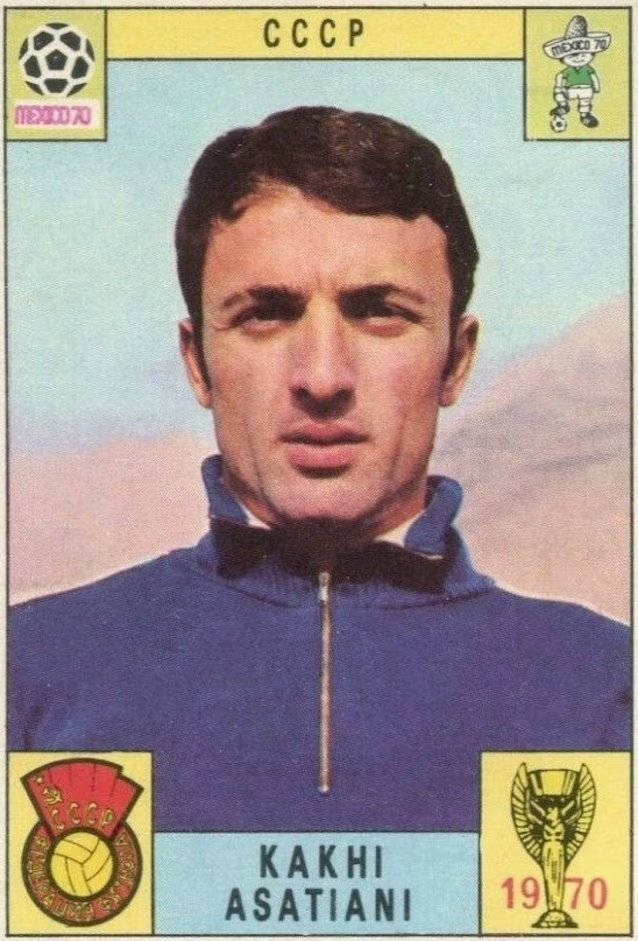
From that moment until today, the numbers on expulsions and yellow cards have reached astonishing figures. The world record for the greatest number of reds in a single match belongs to a match in the Argentine fifth division in 2011: the referee Damian Rubino, after a colossal brawl, sent off 36 people including players, reserves and technical staff. Another incredible case was Josip Šimunić’s Croatia-Australia match at the 2006 World Cup, who received three yellow cards in the same match before finally being sent off: a refereeing error that has remained in football history.