Palmiro Togliatti, born in Genoa in 1893 and died in Yalta, Crimea, in 1964, was a political manager, journalist and economist. He was the leader of the Italian Communist Party from 1926 to death. Exile in the Soviet Union during fascism, the turning point of Salerno promoted the turning point in Italy and played a leading role in the drafting of the Constitution and in the establishment of republican democracy. He collaborated strictly with Stalin, but in 1956 he showed himself in favor of the policy of decreased in the Soviet Union. He supported the thesis of the Italian street to socialism, which provided to establish society without classes with democratic means.
Togliatti Young: from birth to the foundation of the Communist Party
Palmiro Togliatti was born in Genoa on March 26, 1893 to a family of Piedmontese origin. The father was an accountant and the mother an elementary teacher. Palmiro was called because Palm Sunday was born. During childhood he moved to different cities due to his father’s work: Novara, Turin, Sondrio, Sassari. In 1911, after finishing the high schools, he participated in a competition for a scholarship and was the winner. Among the others awarded, there was a young Sardinian student: Antonio Gramsci. Thanks to the scholarship, Togliatti was able to enroll in the Faculty of Law of the University of Turin. In the same period he matured his political beliefs and in 1914 he took the socialist party card, but at the outbreak of the First World War he sided in favor of the intervention. In 1916 he was recalled to weapons.
At the end of the conflict, he resumed political activity in the Socialist Party and was part of the group of young intellectuals who published the newspaper “The New Order”, founded in Turin together with Gramsci, Umberto Terracini and Angelo Tasca. In January 1921 the group was among the promoters of the split of Livorno, from which the foundation of the Communist Party of Italy arose.
Exile during fascism: the USSR and Spain
At the advent of fascism, Togliatti embodied in the repression of black shirts and in the days of the march on Rome fortunately managed to escape an attack. In 1924 his private life also had a turning point: he married Rita Montagnana, party companion, from whom he will have the only son, Aldo. In the party, he sided in support of the Gramsci line, in conflict with the current more extremist led by Amadeo Bordiga. In 1926, when the fascist repression became more tight, he was arrested for a few months. In the same year he entered into contrast with Gramsci about the judgment on the Soviet Communist Party. The arrest of the Sardinian manager, which took place on November 8, 1926, prevented the diatribe from being clarified and meant that Togliatti, now exiled to Moscow, would actually take the leader of the party. In 1936 he became the main representative of the communist internaration in the Spanish civil war, who opposed the Republicans and Francoists. He returned to Moscow in 1939.
On the role of Togliatti in Russia they developed on controversy. The secretary, in fact, denounced some Italian communists not aligned with Stalinism to the Soviet authorities, causing their deportation to the gulags, but a part of the accusations addressed to him turned out to be false. More generally, the Italian manager had to accept Stalin’s decisions, although most likely on some issues it was disagreement, as on the idea of considering socialism an enemy movement like fascism, imposed from 1928 to 1935, and on the non -aggression pact with Nazi Germany of 1939.
Togliatti’s return to Italy: from the turning point of Salerno to the attack
In March 1944, after the fall of fascism, Togliatti was able to return to Italy. As soon as I arrived, I promoted the turning point of Salerno, that is, it established that the communists collaborated with the other parties, in the name of the unit of the anti -fascist forces. The PCI then entered the government team and from 1944 to 1946 Togliatti held the positions of Minister without wallets, vice -president of the Council and Minister of Grace and Justice. In this last guise, in 1946, he was the promoter of the amnesty for those who had stained himself with political and common crimes, thus “saving” numerous former fascists. In the same period it contributed significantly to the drafting of the Constitutional Charter.
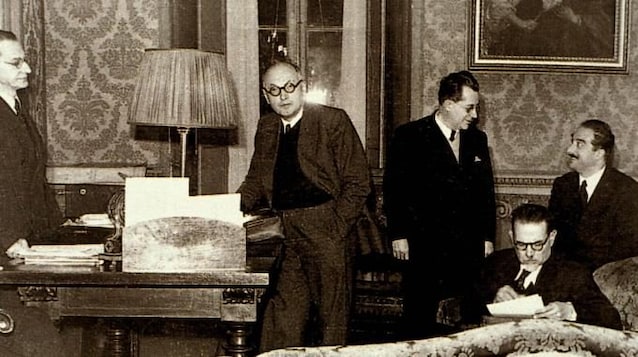
In 1946, when the Prime Minister, Alcide De Gasperi, at the request of the United States decided to end the experience of national unity and to establish a government without communists and socialists, Togliatti became an opposition leader. In the elections of April 18, 1948 he led the popular front, composed of the PCI and the socialist party, which was defeated by the Christian democracy. In the same period he tied sentimentally to the young companion Nilde Jotti and separated from his wife.
In Italy, the political climate was increasingly tense, due to the reflections of the Cold War. On July 14, 1948 Togliatti suffered an attack: a student, Antonio Pallante, shot him three pistol shots as he left the Chamber of Deputies. Seriously injured, Togliatti was operated on urgently and managed to survive. The attack unleashed a wave of protests, which brought the country, on the verge of a revolution, but from the hospital the same Togliatti invited demonstrators to calm. The secretary, in fact, was aware that the relationships of force were unfavorable to the communists, because Italy, for its geographical position, was linked to the United States, and believed that the socialist system could be established democraticly, according to the concept of progressive democracy, and not with the use of force.
The last years of Togliatti: the deterioration, the international role and death
Togliatti, as was inevitable, cultivated close relationships with the USSR and Stalin. In 1953, when the Soviet dictator died, he wrote that he had been a “giant of thought”. In 1956, however, he showed himself favorable to the deterioration, started by secretary of the Soviet Communist Party Nikita Kruscev and, better specified the concept of progressive democracy, presenting it as a Italian way to socialism in an perspective of realization of the communist project in accordance with the democratic dictates and with the Italian Constitution. In the same year, he declared himself in favor of the repression of the Hungarian rebellion, implemented by the Soviet Union.
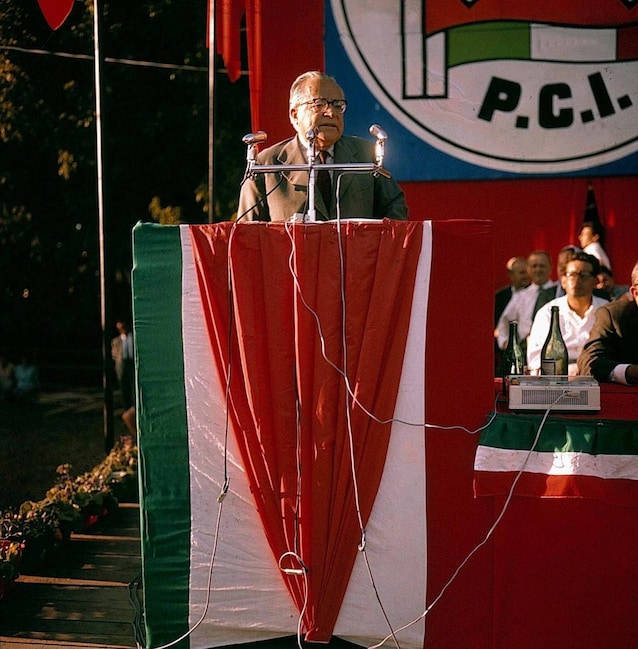
In the following years, Togliatti continued to lead the party and play a leading role in the international communist movement, also trying to mediate, without success, in the contrast that had developed between the Soviet Union and China. In 1964 he went to Yalta, Russia, for a short stay but on August 21 he was hit by cerebral bleeding and died. At the funeral, a million people took part in Rome on August 24. In the Soviet Union, it was decided to pay him homage to name him a city: Stavropol took on the name of Togliatti, who still preserves (not Togliattigrad, as he is sometimes called in Italy).