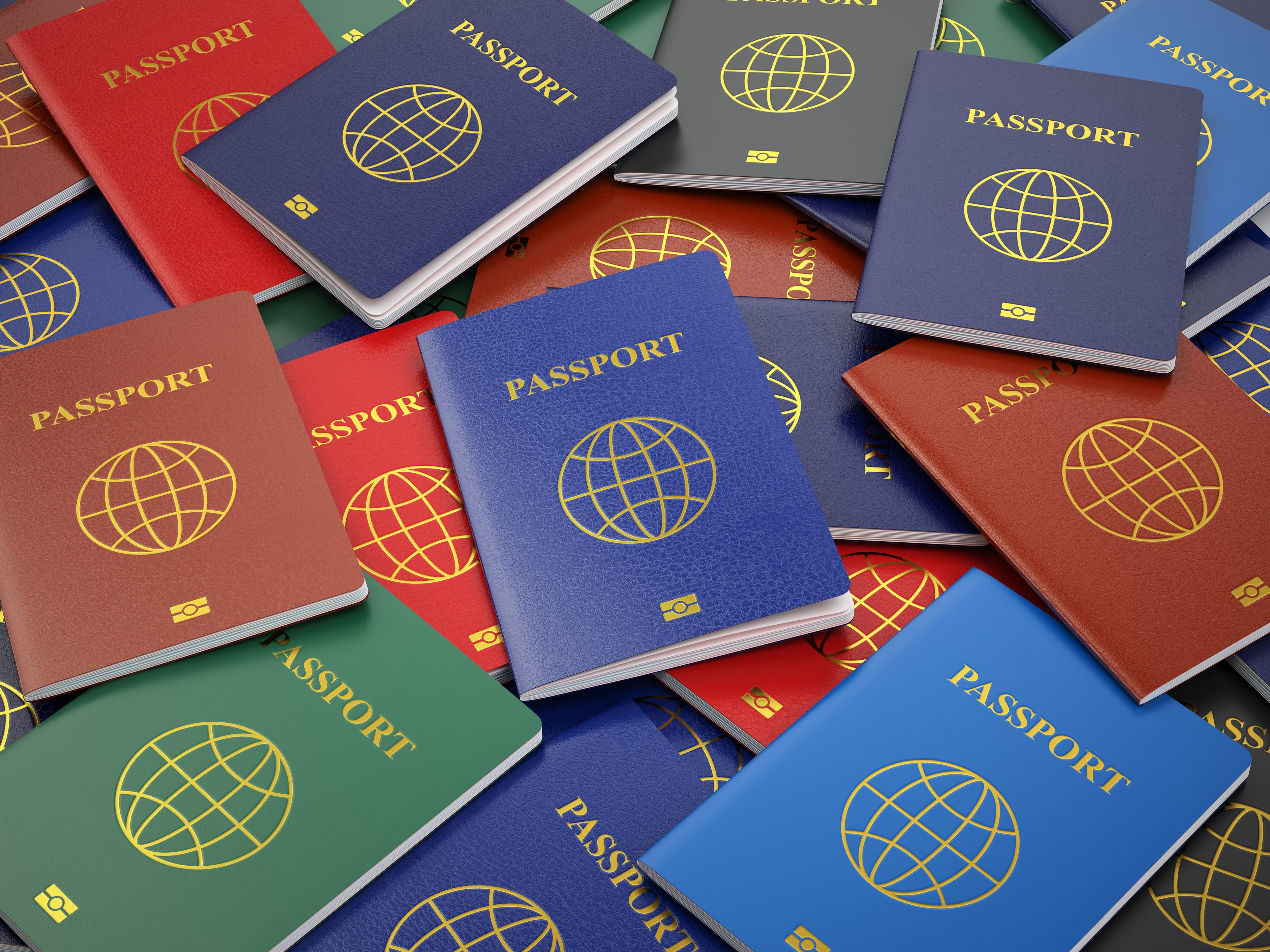
The color of passports is not an aesthetic choice nor a graphic whim: behind those burgundy, blue, green or black covers are hidden stories, identities, religions and even political alliances. There is no law that imposes a precise color: each state has followed traditions, religions and geopolitical strategies, to the point of creating four large color families that have now become standards. But the color of the passport is not just a technical choice or a simple bureaucratic detail. For millions of travellers, it is the first sign of recognition: it tells you at a glance where you come from, it says who you are in the world. That cover, which seems so anonymous, becomes one of the most visible emblems of national identity: thus Europe wears burgundy, the Americas blue, the Islamic world green and some diplomatic entities (or very rare nations) black.
What does the choice of color depend on: the factors
Currently, passports around the world are made in shades that tend to be dark to combat dirt that could ruin the cover. Behind every color selection there is a history of belonging and strategies. The passport, in fact, is also a tool with which States describe themselves and choose how they want to be seen outside their borders. A color can mark the distance or proximity to large geopolitical blocks, it can recall a religious tradition, evoke prestige, recall recent political battles or attempt a “change of appearance” in international perception. It is a small manifesto of one’s collective identity.
Passport colors and their meanings
Here are the colors used around the world:
- Dark red or burgundy: used in European Union countries and, more generally, those with a strong artistic and cultural past.
Blue: the American and Mercosur countries (Mercado Común del Surwhich brings together most of the South American nations), associated with the “new world”, have opted for this color. Even the United Kingdom, after Brexit, has returned to a blue passport to mark its distance from the European Union: before it was burgundy. - Green: widespread in many majority countries Islamicas it is considered a sacred tone in their religious tradition.
- Black: rarer, it is the color of diplomatic passports and of some nations such as New Zealand and some African countries, including Chad and Zambia.
Because the European passport is burgundy
The passport as we know it today was born from the need, after the Second World War, to standardize travel documents to facilitate checks and reduce fraud. A 1981 resolution of the Council of the European Communities defines a “uniform passport” for the member states: in this document it is declared that the color of the cover must be the “burgundy red” and, subsequently, the key is specified RAL 4004“burgundy-violet”.
But the Italian passport was officially born in 1967. Before this date there were travel documents and passes, but not real passports for all citizens. This is why comparing vintage passports is almost impossible: each office had its own layout and even different materials. Its design is regulated by the Ministerial Decree of 29 November 2005, within which it is established that our passport it must have the coat of arms of the Italian Republic and gold inscriptions on the cover. In the Italian Official Gazette all the information on the page features: there are many technical rules on microblades, materials, paper weights and even on how the document must react to UV light. Everything is designed to make counterfeiting as difficult as possible. Italy, in fact, is among the countries that have invested the most in security: colored and fluorescent threads, microtexts, special numbers and a polycarbonate page with biometric data make the passport a small concentration of technology, as explained in detail in the Official Journal. And there is also a touch of identity because for years, among the pages, a graphic motif dedicated to the Colosseum has appeared, chosen as a national cultural symbol according to European guidelines.
What are the technical standards established by ICAO: There is no color
The history of the passport, as we know it today, only began to take shape at the beginning of the twentieth century. In those years the world was changing rapidly: new political frontiers, more people on the move, international travel becoming more and more frequent. Already after the First World War, in 1920, the League of Nations wanted to impose the first international standardization for the issuing of passports. Today, the task of establishing technical standards for passports falls to the International Civil Aviation Organization (ICAO), a United Nations agency.
Among the current regulations, it is established that passports are made with foldable material that it does not crease, to avoid damage that could make the document illegible and therefore invalid; There are also provisions on watermark, symbols and graphics which make counterfeiting almost impossible; ink and paper must remain stable in temperatures between -1 and 50°C and remain readable in humidity conditions between 5 and 95%.
However, in the regulation there are no fixed rules for the color of the cover: each country can choose what it prefers, potentially even a different color than those used to date.









