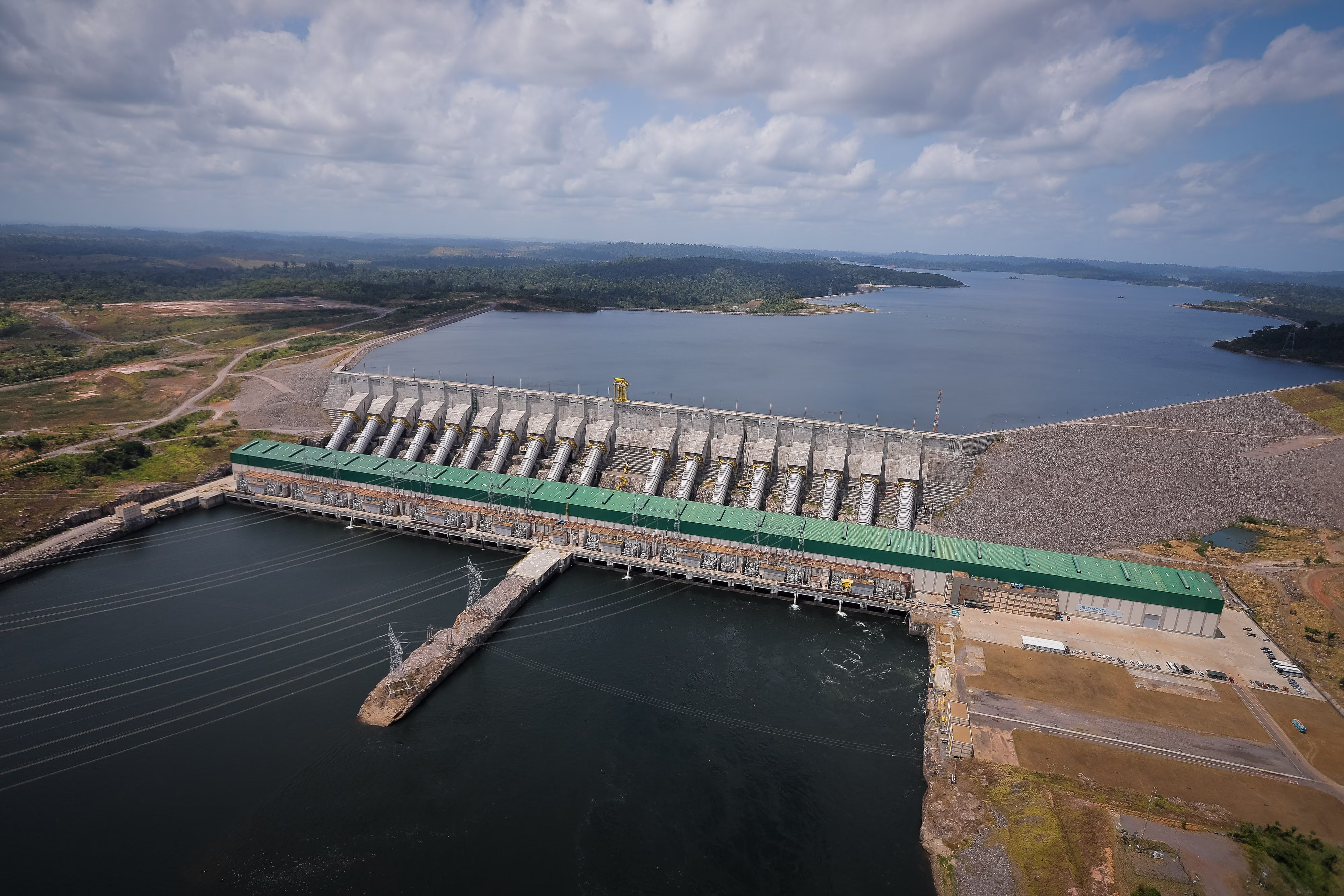
The Belo Monte Dam in Brazil, located along the Xingu River (one of the major tributaries of the Amazon), is one of the most ambitious infrastructure projects ever carried out in the country. Built between 2011 and 2016, it has a capacity of 11,233 megawatts and is the second largest hydroelectric plant in Brazil and the fifth in the world, preceded only by three large Chinese dams (the Three Gorges dam on the Yangtze river and the Baihetan and Xiluodu complexes on the Jinsha) and, indeed, by the Itaipu dam on the Paraná river, on the border with Paraguay.
The objective of the project is to contribute to the strengthening of the electricity grid on a national scale after the 2001 energy crisis, exploiting the great potential of the Xingu River basin. This objective, however, came at a very high cost for the river ecosystem, for the local indigenous populations and for the fauna. Thus, what should have been a great work, a symbol of progress, ended up at the center of heated controversy, remembered more for its controversies than for its scope.
The Belo Monte dam project in Brazil
With a main dam more than 90 meters high and a reservoir of 516 km2the Belo Monte complex produces enough energy for around 60 million people. However, to make its operation possible, it was necessary to intervene directly on the course of the Xingu river: a diversion work of great engineering interest, essential to convey the water towards the power plant, which has a total of 24 turbines. To this end, two imposing artificial canals were created, approximately 500 meters wide and 75 km long, which allow the plant to operate with an average output of 4,571 megawatts, an estimate which takes into account the natural seasonal variations in the river’s flow and which, however, is less than 30% of the installed capacity. This performance highlights a certain discrepancy between expectations and results, achieved through a project considered extremely controversial for its environmental and social impact.
The impact of the dam on indigenous peoples and the environment
The construction of the two diversion canals has had serious repercussions, in particular near the so-called Volta Grande, the bend of the Xingu river, where the flow of water has been drastically reduced: over 80% is in fact directed towards the power plant, leaving local communities with insufficient quantities to live and work.
Indigenous peoples such as the Kayapó, the Arara and the Juruna, who depend on the river for fishing, water supply and daily activities, suddenly found themselves with almost zero water availability – especially during the dry season – suffering very serious economic and social consequences for their communities. Faced with conditions that have become unsustainable, tens of thousands of people have been forced to abandon their homeland, migrating elsewhere in search of new means of subsistence.
On March 11, 2025, a preliminary ruling by the Supreme Federal Court (STF) established that the indigenous communities of the Volta Grande do Xingu should receive a share of the royalties generated by the hydroelectric plant; this right was recognized following a petition promoted by seven indigenous associations.