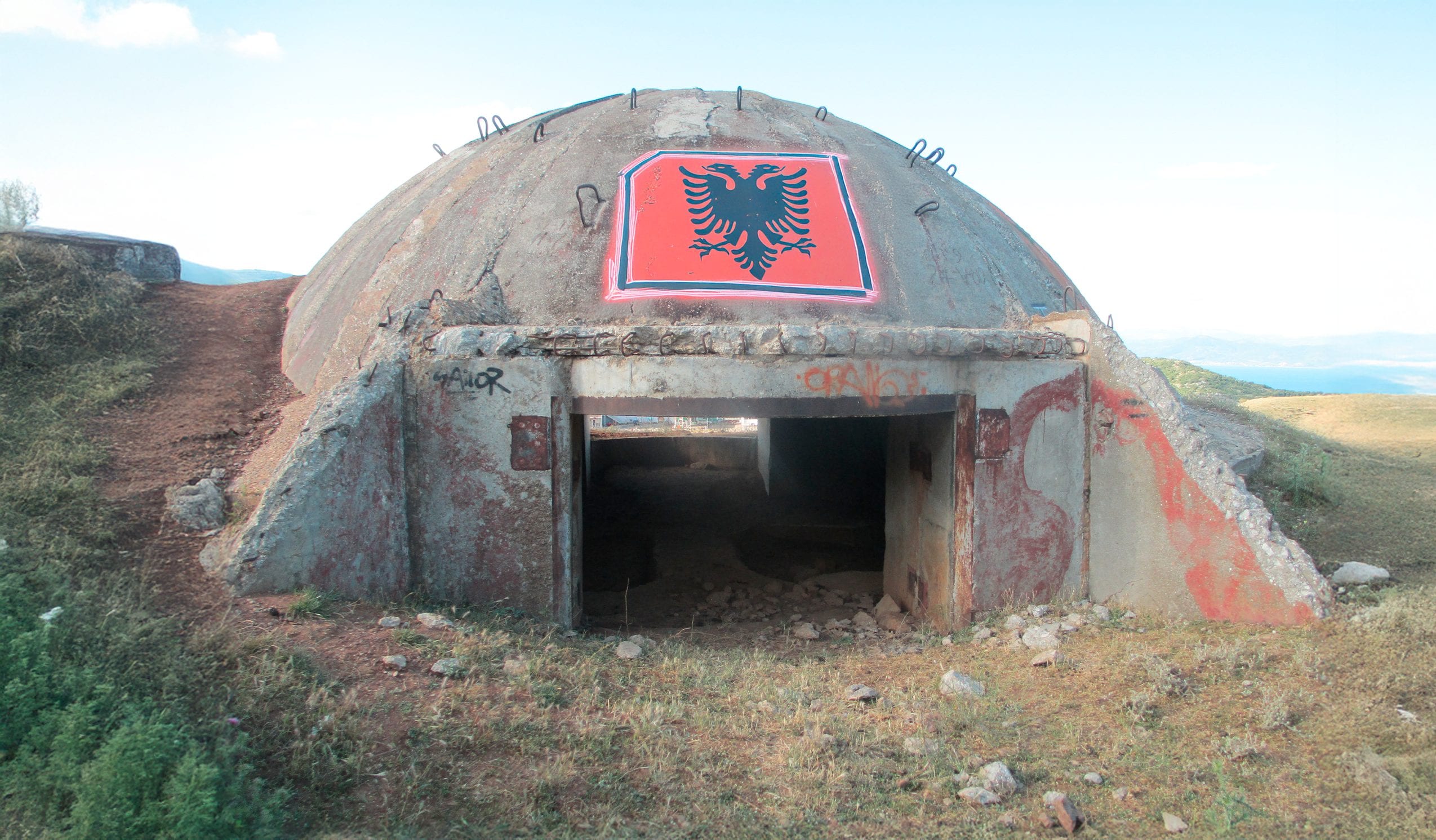
Perhaps not everyone knows it but in Albania today there are around 173,000 bunkers built in the country during the Cold War and today largely reused as museums, warehouses, restaurants or even tourist accommodation. Does it seem like a lot? Well, the original plan was to make around 750,000! But why was Albania so interested in these defense systems?
The history and purpose of Albanian bunkers
The Albanian bunkering program has its roots in the height of the Cold War. At the time the country was led by the communist leader Enver Hoxha who saw threats from all sides, given that to the south and west there were two NATO countries, namely Italy and Greece, while to the north there was Tito’s Yugoslavia. This sense of encirclement and growing paranoia pushed Hoxha to commission the military engineer Josif Zagali to create a network of bunkers capable of both hosting the population and the army in case of need, and providing an additional defensive line.
This caused the construction of concrete structures in every corner of the country, from the coasts to the mountains and from the cities to the countryside. It was an extremely widespread project and, in all likelihood, its secondary purpose was to assert the leader’s power and authority. The most often cited estimates speak of a total project of 750,000 bunkers but, to date, there is no concrete evidence of this value. Furthermore, the census of 173,371 bunkers mentioned at the beginning refers to data updated to 2014, so today this value could be slightly different.
In any case, however, we are talking about hundreds of thousands of defensive structures. But how were these bunkers created from a technical point of view?
The technical characteristics of the bunkers
The smaller bunkers, called Qender Zjarriwere made of reinforced concrete, with a wall thickness of approximately 60 centimetres. Each was prefabricated, had a dome shape with a diameter of 3 meters and the main objective was to resist artillery.

In addition to these there were also larger bunkers designed to house the army command centers called Pike Zjarri. These could reach a weight of 400 tons, with a wall thickness of approximately 1 meter and inside them not only were there multiple rooms but advanced ventilation systems were also installed.
Building structures of this type, however, entailed an extremely high cost: it is estimated that the construction of these 173 thousand bunkers alone consumed 20% of the country’s gross domestic product in those years, not to mention the fact that each bunker required a quantity of materials which, in another context, would have been sufficient to build a modest apartment.
Unlike what Hoxha would have expected, however, these structures were never used for their original purpose, with sporadic exceptions during the Kosovo War in the 1990s.
Today this network of bunkers is seen as tangible evidence of a cumbersome past. Some of these structures have been demolished, while others have been repurposed – such as the museum in Tirana Bunk’Art 1 And Bunk’Art 2 – even if most are in a state of abandonment and progressive degradation.









