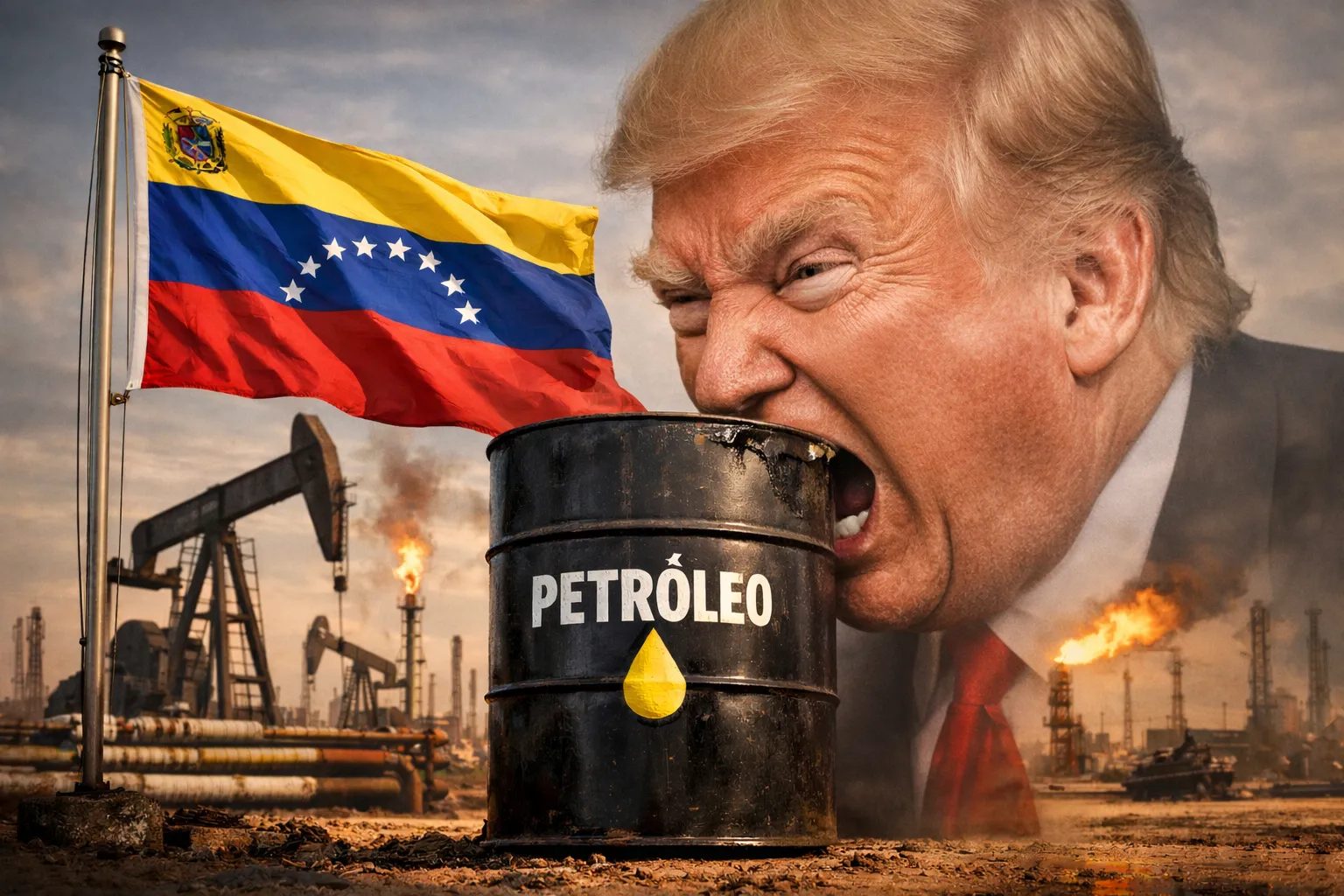
Donald Trump’s White House has made no secret of the fact that the main objective of the recent attack on Venezuela is the control of the South American country’s oil resources, which are the most abundant in the world with around 300 billion barrels. In this regard, the US administration has stated that Venezuela will deliver 30 to 50 million barrels of oil to the American government. The issue of Venezuelan oil, however, is much more complex than it might seem at first glance, involving geological and geopolitical factors so in reality these reserves are more on paper than in practice: the raw material is there, but the exodus of foreign oil companies after the nationalization desired by the then Venezuelan president Hugo Chávez caused a clear decrease in production. Part of the US plan would be to increase Venezuela’s oil production so that it can benefit economically.
Why Venezuela is so rich in oil
Venezuela is located in a tectonic context in which the Caribbean plate, colliding with the South American plate, created a mountain range that allowed the formation of an oil system. Between 120 and 90 million years ago, much of the north of the country was covered by warm, shallow seas, rich in plankton and other organisms that accumulated on the seabed, forming layers of sediment with abundant organic matter which over millions of years transformed into hydrocarbons and then oil. Tectonics did the rest: the interaction between the two plates created anticlines (we can understand them as folds in the earth’s crust) capable of accumulating the oil formed in porous rocks and trapping it in a boundary of impermeable rocks.
Where is oil found in Venezuela and what does “heavy” mean?
In Venezuela there are mainly two large oil areas: the Maracaibo Basin, to the west of the country, with deep deposits (even 5000 meters deep) of light oil. To the east, however, there is the Orinoco Belt, an enormous expanse hundreds of kilometers long that hosts colossal quantities of oil at relatively shallow depths, this time extra-heavy.
Light and heavy indicate the density and viscosity of the oil. Unlike the Middle East, Venezuela is rich in heavy oil: thick, viscous, rich in sulfur and impurities. This is because the interaction with water and bacteria has reduced the lighter fractions of the crude oil, leaving a heavier mixture.
Precisely because it is dense and viscous, heavy oil is much more difficult to extract, even if it is found at shallower depths: it is necessary to resort to high-pressure steam injections or solvents that thin the crude oil so that it can be extracted more easily. It takes a lot of energy and maintenance. For this reason the Orinoco belt has a recovery factor very low, that is, the percentage of oil that can be recovered: we are talking about 3-5%.
History of the Venezuelan oil industry and the “breakup” of 2007
Since the first decades of the twentieth century, Venezuela has seen great extraction activity, especially in the Maracaibo Basin, where oil is light. Production grew over the decades also thanks to the intervention of various foreign oil companies operating in the country. In the 1970s, over 3.5 million barrels per day were produced; PDVSA (Petróleos de Venezuela, SA), the Venezuelan state oil company, was founded in 1975 and became one of the most prestigious in the world thanks to its skills and technological resources.
The year of rupture was 2007, in which the then president of Venezuela Hugo Chávez nationalized oil production in the very rich Orinoco Belt, where foreign companies operated. With the Plena Soberanía Petrolera operation (“full oil sovereignty”), Chávez puts Western companies faced with an ultimatum: become minority shareholders or abandon mining. Without the operational skills, technologies and capital of foreign companies, PDVSA would not have been able to manage the complex and expensive extraction of extra-heavy oil in the Orinoco Belt on its own. Chávez thus decided that the operation of the joint ventures in the territory was allowed, but PDVSA would have had at least 60% of the shares and operational control of the extraction activity.
Some companies, such as ExxonMobil and ConocoPhillips, reject the deal and sue Venezuela for illegal expropriation. Other companies (Chevron, Repsol, Eni, Total, Statoil and BP) accept, but greatly reduce their activities and drastically reduce investments.
Symbolically and politically, this is a victory for Venezuela. But from a technical and industrial point of view, in hindsight, it is the beginning of a structural decline.
In fact, PDVSA lacks the expertise in extra-heavy oil extraction acquired over the decades by Exxon and Conoco. At the same time, the remaining companies stop investing capital because trust in the political and contractual framework is now compromised.
The result is that maintenance drops, systems degrade and production slowly but surely begins to collapse. Over time, from around three million barrels a day in those years, it dropped to less than one million. Without a solid industrial system, without a supply chain that works from start to finish, even the largest reserve on the planet remains just an untapped potential.
What is needed to increase Venezuela’s production
Having said that, we come to today, with Trump getting his hands on Venezuela. At this point, what will happen? Will the big American teams return? If they do, it will probably be with interest.
The problem is that to increase oil production from the Orinoco area we need to invest a lot in technologies, modern infrastructures, know-howhighly specialized staff. According to the authors of a report drawn up in 2021, entitled “The future of Venezuela’s oil industry”, total investments of tens of billions of dollars would be needed to bring the production potential of Venezuelan oil back into operation, distributed in two main phases.
In the first phase it would be necessary to invest between 7 and 9 billion dollars over 2–3 years to bring production back to pre-2017 levels, i.e. around 2 million barrels per day. The second phase, following the initial recovery, would instead require 20 billion dollars per year for another 2–3 years. These would be investments intended primarily for the development of deposits offshore and projects onshore underdeveloped, which would take 4–5 years to translate into actual new production.
Again according to the report, if these investments were made adequately and continuously, Venezuela could sustain a production of around 2.5 million barrels per day for the next 20–30 years.