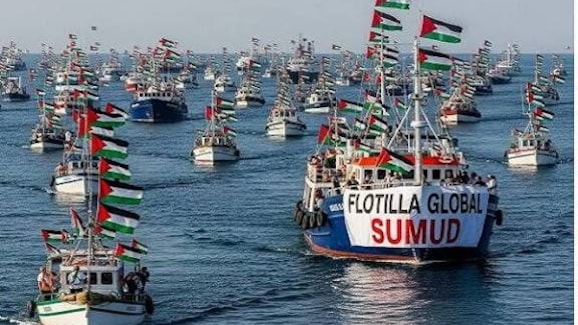
The Israeli military forces have bought and blocked all 47 boats of the humanitarian mission Global Sumud Flotilla while they were in international waters headed towards the Gaza Strip. According to international law, the blocking of boats and the arrest of activists on board can be configured as an illegal action in violation of the United Nations Convention on the right of the sea. Let’s examine the individual reasons.
The sinking took place in international waters
The first question is related to the fact that the interception of the Flotilla took place in international waters. Article 87 of the United Nations Convention on the Law of the Sea (UNCLOS) establishes as a fundamental principle of the Upper Sea that of freedom of navigation, according to which the ships of all states enjoy the right to navigate without restrictions. Furthermore, art.97 of the same agreement sanctions that:
In the event of ABONDO or any other navigation accident in the Upper Sea, which implies the criminal or disciplinary liability of the ship’s commander or any other crew member, criminal or disciplinary actions cannot be taken against such people, if not by the jurisdictional or administrative authorities of the flag or state of which such people have citizenship.

The Global Sumud Flotilla was a mission for humanitarian purposes
Israel justified his action on the basis of the – declared – of the Global Sumud Flotilla to violate the naval block imposed by the Jewish state on the waters in front of the Gaza Strip. The Sanremo manual establishes that a ship suspected of violating the block can be stopped, inspected and captured, but the fourth Geneva Convention on the protection of the civilian population in armed conflicts requires the obligation for the parties in conflict have to guarantee an adequate supply of food and basic necessities to the civilian population. In other words, the passage of essential humanitarian aid must always be guaranteed, such as those transported by the flotilla which has always been declared as a peaceful and non -violent mission with humanitarian purposes in a context such as the invasion of the strip in which Israel has been repeatedly accused of not guaranteeing an adequate influx of aid to the civilian population.
In addition, the naval blockage imposed by Israel would be illegitimate up to international law since it does not respect the specific rules established by the Sanremo manual: preventive notification, proportionality and the arrival of essential goods for the survival of the civilian population of the occupied territories. In any case, the block cannot extend beyond territorial waters.
The use of force
As regards the use of the force used by the Israeli armed forces – including the use of water cannons, interception and interruption of communications both video and radio, arrest of unarmed civilians by military forces during a humanitarian mission – is considered an offense from the point of view of international law, as non -violent civil disobedience is not qualified as a hostile act towards a state. By hostile act, in fact, we mean those actions that require qualified, concrete and operational hostility, in which non -armed civil initiatives and with humanitarian purposes are not included.
The flag law
The international law of the sea sanctions in the Montego Bay convention also the principle of the flag law, i.e. the international ship regime, both public and private, according to which each ship is subjected exclusively to the power of the state of which it has the nationality – the so -called flag state. The ship is therefore considered the territory of the state whose flag beats, a principle that was defined in the past Territire Flottant.
For this reason, Israel could not exercise coercive actions against civil boats and foreign flag, effectively violating the freedom of navigation guaranteed by UNCLOS and in addition with the use of force against foreign ships, also violating article 2 of the United Nations Charter, which prohibits the threat and use of force against territorial integrity or political independence of the States.
A derogation from these principles, according to the Montego Bay Convention is art. 105, according to which any military ship or in the state service (provided that it is recognizable as such) can proceed on the high seas for the seizure of the ship and the goods contained in it, as well as the arrest of the people on board, in the hypothesis of exercising piracy. In that case, the state can exercise its full criminal jurisdiction on the ship and responsible for the piracy documents, as if the fact had occurred in its territorial waters. This hypothesis does not correspond to the actions carried out by the Global Sumud Flotilla, since unlike piracy acts, the end of the peaceful and non -violent mission is a humanitarian purpose, not justifying the use of force.
Would he have been legal if he did it in the territorial waters of Gaza?
From a legal point of view, the waters in front of Gaza are not formally Israeli territorial waters, but on the contrary belonging to Palestine: in this regard, both in 2004 and in 2024 the International Court of Justice had expressed itself in this sense, stating that the Palestinian people have the right to self -determination and that the annexation of the Palestinian territories by Israel, including Gaza, was illegitimate. As the territorial annexation of the Gaza Strip is not legitimized by international law, the extension of Israeli territorial sovereignty on the sea in front of Gaza cannot be considered legitimate.
Even if Israel wanted to claim its territorial power over the waters in front of Gaza, according to the international law of the sea there is a limit to the power of the coastal state government: the right of harmless passage by foreign ships, according to which each foreign ship has the right to the harmless passage in the territorial sea of a state, both to cross it, and to enter the internal waters and to take off from these as long as the passage is rapid. Continue. There is no parking faculty or anchoring unless there are ordinary events – as fuel supply – or force majeure, such as dangerous situations or need to help people or other ships. It is considered harmless as long as it does not give damage to peace, good order or safety of the coastal state.
Is Israel’s action configured as an act of piracy?
According to art. 100-110 of the Montego Bay convention by piracy means illegal acts committed for private purposes or other non-political purposes from ships or private aircraft. However, this clause of “private ends” and non -political or of public interest, called “private ends“It is still very debated today at the legal level, since part of the doctrine does not agree on the assumption that an act of depictions or violence does not rest in the cases of piracy if motivated by a political purpose.
Even today the theme is widely debated but to configure a pirate act, but from a purely legal point of view, rather than piracy that of Israel is more assimilable to an attack on the flag state, therefore an act of aggression.