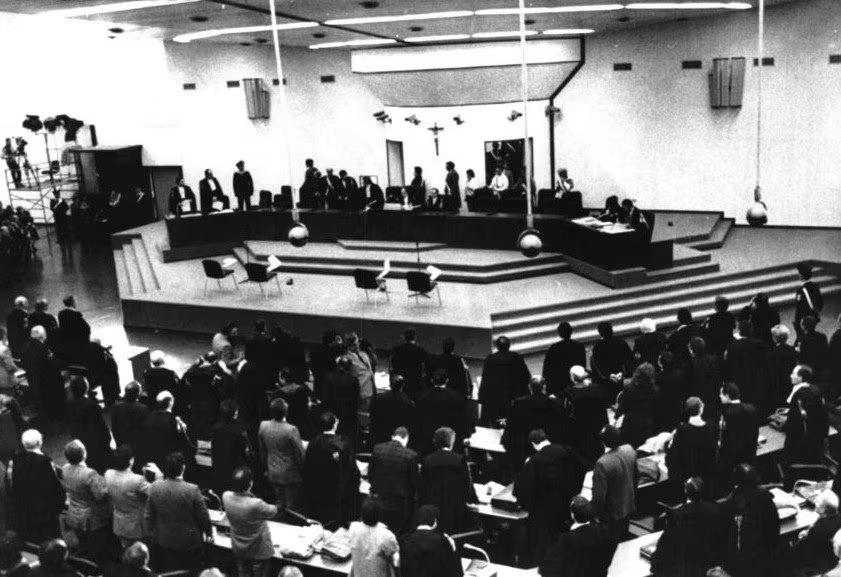
The Palermo maxi-trial was the largest criminal trial against the mafia, and was celebrated (in the three levels of judgement) between 10 February 1986 and 30 January 1992.
The first degree trial took place from 10 February 1986 to 16 December 1987 in the bunker room of the Ucciardone prison in Palermo. 475 members of Cosa Nostra were accused, including Totò Riina, Bernardo Provenzano and other bosses. The trial took place after the second mafia war, through which the Corleonesi had taken control of the “dome”, and was based on the revelations of Tommaso Buscetta and other repentants. Celebrated according to the code of criminal procedure in force between 1930 and 1989, the maxi-trial was instructed by Giovanni Falcone (it was the most important achievement of his career and of the Palermo anti-mafia pool) and Paolo Borsellino and ended with numerous convictions. The Italian judiciary thus began a fierce fight against the mafia, which continues to this day.
This is a process like any other, albeit immense. What I ask of you is not the condemnation of the mafia, already written in history and in the conscience of citizens, but the condemnation of the mafiosi who are reached by certain elements of responsibility.
– Public Prosecutor Domenico Signorino
What was the Palermo maxi-trial?
The maxi trial was the most important trial of the Sicilian mafia. It was celebrated in the three levels of judgment (court of assizes, appeal and cassation) between 1986 and 1992, although sometimes the expression “maxitrial” refers only to the first degree trial, which took place in Palermo from 10 February 1986 to 16 December 1987.
There were 475 people accused in the trial (which rose to 460 during the hearing), defended by over 200 lawyers. Among the defendants were the main bosses of Cosa Nostra, some of whom were fugitives, such as Totò Riina and Bernardo Provenzano, and others present in the courtroom, such as Michele Greco (arrested during the trial), the former head of the Corleonesi Luciano Liggio, Leoluca Bagarella, Pippo Calò and others.
The defendants had to answer for numerous murders, extortion, international drug trafficking, mafia association and other charges. Among other things, excellent murders were under discussion, such as those of judge Rocco Chinnici, general Carlo Alberto dalla Chiesa, policemen Beppe Montana and Ninni Cassarà. The maxi-trial, in essence, was a trial of Cosa Nostra as a whole.
Why he was celebrated: Buscetta’s revelations and Falcone and Borsellino’s investigations
The maxi-trial was made possible by the revelations of the repentants, in particular those of Tommaso Buscetta, the boss arrested in Brazil in 1983 and later extradited to Italy. Buscetta belonged to the defeated faction of Cosa Nostra, which had suffered very heavy retaliation from the victorious gangs, led by the Corleonesi and the ruthless Totò Riina. In the retaliations, numerous of Buscetta’s family members were also murdered.
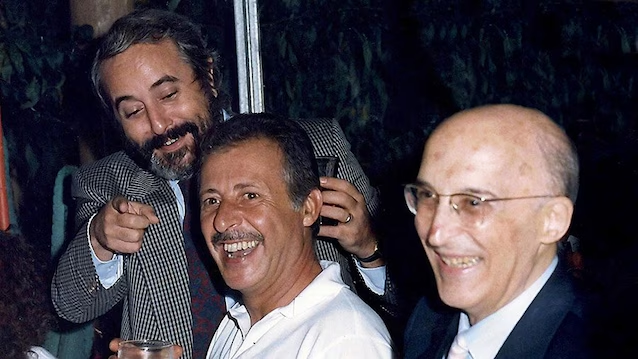
Buscetta decided to take revenge by collaborating with justice. He was interrogated by Giovanni Falcone, a member, together with Paolo Borsellino and other magistrates, of the anti-mafia pool led by Antonino Caponnetto. After Buscetta, other members of Cosa Nostra also “repented”, including Salvatore “Totuccio” Contorno, who made further revelations. Thanks to the statements of the repentants, the judiciary arrested numerous mafiosi, many of whom were handcuffed during the “San Michele blitz” of 29 September 1984.
After the confessions, Falcone and Borsellino were tasked with “instructing” the trial (which was held according to the old code of criminal procedure, according to which the investigating judge carried out the investigations and sent the defendants to trial). To prevent the mafia from eliminating them, in the summer of 1985 the Ministry of the Interior had the two judges transferred to a protected location, the Asinara prison, to write the order-sentence of indictment.
Judges, defendants and sentences: progress and outcome of the trial
To celebrate the maxi-trial it was necessary to build a special courtroom, because no court could accommodate such a large number of defendants. The octagonal-shaped “bunker room” was therefore built at the Ucciardone prison, equipped with high safety standards. The court was presided over by Alfonso Giordano; a side judge was Pietro Grasso and public prosecutors were Domenico Signorino and Giuseppe Ayala. The jury was made up of eight lay judges. The investigating judges, Falcone and Borsellino, who followed the trial from the outside, did not participate. However, numerous journalists, the defendants (imprisoned in special cages), their lawyers, numerous carabinieri and the public were present in the courtroom.
The trial took place in a tense atmosphere and some moments were particularly dramatic. One of the most tense was the deposition of Tommaso Buscetta, who confirmed the revelations made to Falcone, and the comparison of the repentant with Pippo Calò. Salvatore Contorno was also called to testify, speaking in strict Sicilian, to the point that the advice of a linguist was necessary to verbalize the statements.
There were also some tragicomic scenes. For example, one defendant, Turi Ercolano, blatantly sewed his lips together with a stapler; another defendant, Stefano Calzetta, stripped naked in the courtroom to pass himself off as crazy. Furthermore, some defendants had themselves taken to testify on a stretcher or in a wheelchair.
The lawyers almost all followed the same defensive line, arguing that the revelations of Buscetta and the other turncoats were not reliable. Furthermore, they tried to seize on all possible loopholes to slow down the proceedings.
In total, 349 hearings, 1314 interrogations and 635 defense arguments were held during the trial.
On November 11, 1987, the lay judges and magistrates met in a long council chamber, which lasted 35 days, during which they lived in complete isolation. On December 16, President Giordano read the sentence, which imposed heavy sentences on the defendants. The court in fact considered the “Buscetta theorem” reliable and recognized the validity of the thesis according to which Cosa Nostra was guided by a summit, the “dome”, which took all the important decisions and ordered the excellent murders.
It was not a foregone conclusion, because in the past other mafia trials had ended with acquittals or light sentences. The sentence demonstrated that the attitude of the institutions and the State (at least, of its healthy part) towards the mafia was becoming much less tolerant.
Trials in the Court of Appeal and in the Supreme Court
The appeal process took place between 1989 and 1990 and ended with a reduction in sentences (among other things, the life sentences went from 19 to 12), because the court considered Buscetta’s statements less reliable. Furthermore, in 1991 some mafiosi convicted at first instance and on appeal, including Michele Greco, were released from prison due to the expiry of the terms of precautionary custody on the decision of judge Corrado Carnevale. The decision sparked public outrage and prompted government intervention, which changed the terms of custody and allowed the defendants to be returned to prison.
However, the unknown factor of the Court of Cassation remained. The risk was that the appeal on the maxi-trial would be assigned to the first section, presided over by Carnevale, known for the ease with which he annulled the sentences of the mafiosi. However, the trial was assigned to another section of the court, presided over by judge Arnaldo Valente. On 30 January 1992 the Court issued the final sentence, which confirmed the sentences imposed on the defendants at first instance and annulled the acquittals.
Reactions and consequences
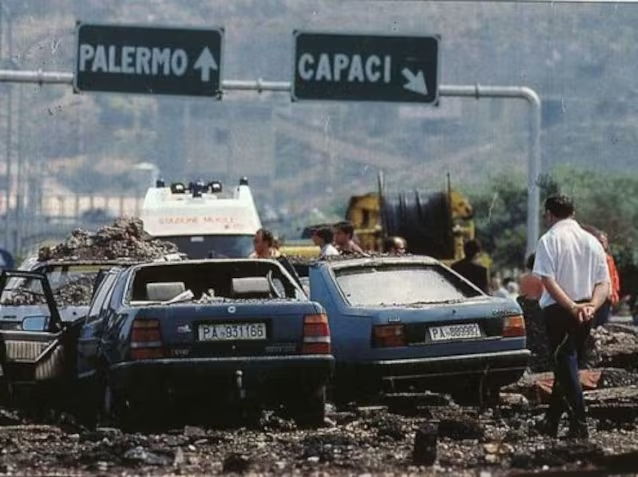
The maxi-trial was a huge success in the fight against the mafia and its outcome was commented in very positive terms at both a national and international level. For Cosa Nostra, the Supreme Court ruling was a severe blow, because it demonstrated that it was less omnipotent than it believed. Riina reacted by ordering excellent assassinations: among others, he had Salvo Lima assassinated, a colluding political exponent of the Christian Democracy, who had promised to “fix” the sentence, and judges Falcone and Borsellino, together with their respective escorts.
The fight against Cosa Nostra, however, did not stop and continues today, also thanks to the work of the heroic magistrates who allowed the maxi-trial to take place.