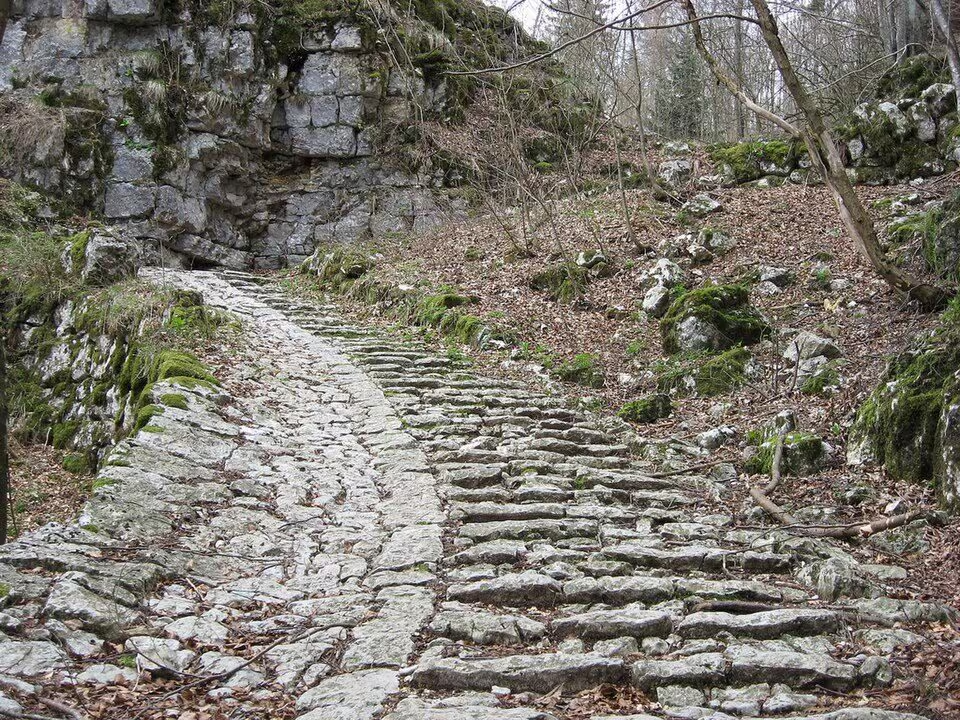
In the heart of Veneto, between the Asiago plateau and the Brenta valley, lies the Calà del Sasso: the longest staircase in Italy and one of the most impressive in the world. Built in the 14th century, it has 4,444 stone steps and connects the hamlet of Sasso di Asiago with Valstagna, in the municipality of Valbrenta in the province of Vicenza. About 2.5 kilometers long and with a difference in altitude of 744 metres, the Calà is today a hiking itinerary, but was born as a fundamental infrastructure for the economy and history of the Serenissima.
Calà del Sasso and its 4444 steps: a legendary and historic route
Today the Calà del Sasso coincides with the CAI path 778, a challenging and panoramic route that starts from the center of Valstagna, crosses the Val Frenzela and goes up to the church of Sasso di Asiago. Halfway through the walk, a capital dedicated to Sant’Antonio Abate marks a natural pause, a point of reflection before the last stretch, among excavated rock, woods and mountain silence.
Many hikers complete the ring by following trail 778b, known as the Sentiero del Vù. The name recalls Albino Celi, known as “El Vu”, born in Valstagna in 1884 and so called because in a dialect context in which everyone addressed each other as “tu”, he chose to address others with the respectful “you”. After the First World War Celi lived as a recoverer, searching the mountains of Asiago for metals and war residues left by the conflict. A risky job, carried out in an area still wounded by war. His story inspired Mario Rigoni Stern in the novel The seasons of James (1995) and Ermanno Olmi in the film The recoveries (1970).
Walking on this path means crossing trenches, tunnels and remains of the Great War, where the landscape still retains traces of history.
A seventeenth-century legend is also linked to Calà del Sasso, that of Loretta and Nicolò. In 1638, when Loretta became seriously ill, Nicolò rushed down the 4,444 steps to reach Padua in search of a cure. Upon his return, the inhabitants illuminated the steps with lit torches, forming a long trail of light in the night. Every year, on the second Sunday of August, the Calà torchlight procession recalls that episode: hundreds of people climb the steps guided only by torches and the moon, in a collective rite that unites memory, faith and landscape.
Calà del Sasso is much more than a hiking trail. It is a line of stone that runs through centuries of human labor, wars, legends and devotion. Walking along it means walking inside history, one step at a time, following the slow pace of 4,444 steps.
The longest staircase in Italy: medieval medieval ingenuity and Venetian symbolism
The Calà del Sasso was built to allow the transport of timber from the plateau to the Brenta river, from which the logs reached Venice. That wood was used to build ships, bridges, palaces: without these mountains, the power of the Serenissima would not have had solid foundations. Along the staircase still runs a paved channel dug into the rock, designed to slide the trunks down to the valley using the natural slope.
The number of steps tells a vision of the world. The 4.444, built on the repetition of four, refers to the biblical symbolic language, in which the four represents the totality of creation: the cardinal points, the seasons, the winds, the rivers of Eden. For Venice, those four rivers were the Brenta, the Adige, the Piave and the Po, the great water arteries that supported the economic life of the Republic. The Calà thus becomes not only a work of engineering, but also a construction full of spiritual and political meanings.