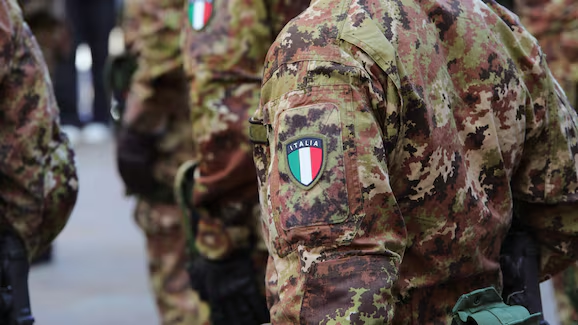
After the joint attack of the USA and Israel against Iran and the start of a new war in the Middle East, the issue of the use of military bases in Italy and their use was rekindled.
To better understand the issue, we must first make a distinction: in Italy there are NATO military bases, which are in common use for all Member States of the Atlantic Alliance, and American military bases, which are instead reserved for American soldiers. Sometimes, however, it is difficult to distinguish between the two, since it is possible for a military infrastructure to host Italian, US and NATO personnel.
The topic of their use, however, is not at all new: it is no coincidence that, way back in 2007, the International Affairs Service of the Senate of the Republic published a report dedicated precisely to the management of American bases on Italian territory and the legal foundations of their institution. Despite being a document from almost 20 years ago, the text offers an overview of the bilateral agreements that still regulate the use of military bases today, even in the event of armed conflict and in full compliance with Article 11 of the Italian Constitution.
Why there are American military bases in Italy: the founding agreements
First of all, as the Senate report also underlines, it must be specified that the territory on which a military base is located is not considered foreign territory, but is Italian territory. This means that the creation of the base does not imply any transfer of territorial sovereignty and that the military bases are Italian installations granted for use to NATO or the United States.
But why were these military bases established? The NATO Treaty does not contain precise provisions regarding military bases, which therefore must be regulated by bilateral agreements, i.e. between two countries.
In the case of American bases in Italy, the fundamental treaty is the Bilateral Infrastructure Agreement (BIA), stipulated between Italy and the United States on 20 October 1954, also known as the “Umbrella Agreement”, which, among other things, establishes the maximum number of American troops that can be stationed on Italian soil and contains technical annexes that outline the tasks of each individual base.
But there is also another agreement that regulates the use of bases in Italy, namely the 1995 Memorandum of Understanding between the Ministry of Defense of the Italian Republic and the Department of Defense of the United States of America (the so-called Shell Agreement) which, among other things, was born as a secret treaty and was made public by the Italian government only in 1998, after the Cermis cable car tragedy.
The presence of the armed forces of NATO countries is instead regulated by the London Convention of 1951 (also known as NATO SOFA) which regulates the legal status of military personnel from member states of the Atlantic Alliance present in the territory of another state party.
Who decides whether to use military bases in the event of armed conflict
Based on these agreements, then, who decides whether to use military bases to take part in an armed conflict? Since the latter are part of Italian territory, the answer would be, at least in theory, Italy.
A military base (whether NATO or American), in fact, should only be used for strictly defensive purposes, i.e. in the event that Italy or another member of the Alliance is the subject of an armed attack.
The problem is that, historically, the United States has adopted extensive interpretations of bilateral agreements to use bases as logistical hubs for operations that are not strictly defensive, taking advantage of these military outposts abroad to make up for the geographical distance from strategic areas, such as the Middle East.
In short, the use of military bases for purposes other than those established by the Treaty should not be permitted but, in practice, this principle has often been denied: over the course of almost 80 years, in fact, the concept of security has expanded and NATO has in fact undertaken a series of missions that go well beyond the notion of legitimate defense against an armed attack.
A precedent very similar to what is happening in recent weeks occurred during the US invasion of Iraq in 2003: on that occasion, in fact, Italy granted limited use – having declared itself non-belligerent – of the Ederle military base, near Vicenza, which was used for the departure of some American soldiers towards Iraq.
Article 11 of the Constitution and the prohibition of aggression
The problem is that the use of American military bases in Italy to launch attacks against Iran would be in conflict with the art. 11 of the Constitution, which establishes that «Italy repudiates war as an instrument of offense against the freedom of other peoples», but allows the State to become part of international organizations for defensive purposes.
NATO, in fact, is a mutual defense military alliance and, consequently, is not in conflict with Article 11: the point is that American bases must not be considered in isolation. This means that they could not be used for purposes contrary to international law.
Precisely for this reason, a NATO member state can prevent the use of military bases in its territory if it believes that the NATO mission is contrary to international law, given that the American bases do not have a completely independent status from the Atlantic Alliance (but were created to carry out some tasks of the organization).
What does all this mean? It means that, at least in theory, the Atlantic Pact (establishing NATO) and the Italian Constitution do not provide for the possibility of using American military bases for offensive war operations: if the USA wanted to use its military bases in Italy for non-defensive purposes, it would have to request it from the Italian government – as also confirmed by Prime Minister Giorgia Meloni – who could possibly consult with Parliament to evaluate a possible unconstitutionality, precisely on the basis of Article 11 of the Constitution.