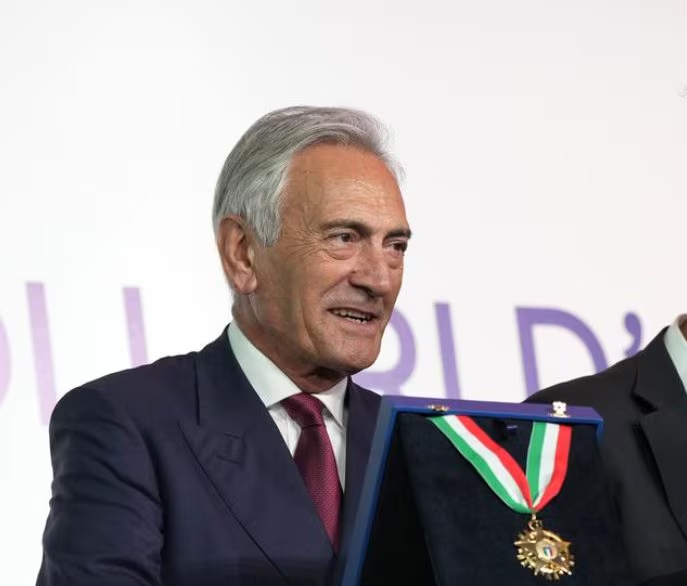
Italy will not participate in the World Cup for the third consecutive time, the fifth in its history. After the debacles against Sweden in 2018 and North Macedonia in 2022, the national team led by Rino Gattuso stopped in the play-off final of the UEFA qualifiers against Bosnia on penalties. A failure which includes our entire football system and which has opened a huge chasm within the FIGC, with the resigning president Gabriele Gravina (there will be elections on 22 June) who appeared before the cameras at a press conference a few minutes after the defeat. Among the passages that have caused the most discussion is his response to a journalist’s question “Why does Italy win in all other sports but not in football?”. A theme that we try to analyze with the official Sports and Health data, the algorithmic model of contributions (MaC) and the sporting results of recent years.
“Amateur sports”: the dichotomy between legal definition and results
“Football is a professional sport, the others are amateur sports and we must make relationships on the basis of equity. Because in amateur sports you can adopt a whole series of choices that cannot be implemented in professional sports. I am also referring to the use of many young people within the Under, within their own tournaments. Not to mention state sports, such as skiing, except Arianna Fontana, all the others are employees of our State” (Gabriele Gravina).
With this response, the No. 1 of Italian football infuriated the world of Italian sport, probably referring to the difficulties of bringing together large economic interests within an often disunited Football League. From Gianmarco Tamberi to Gregorio Paltrinieri, from Francesca Lollobrigida to Pietro Sighel up to Mattia Furlani, to name just a few athletes, they have expressed their indignation via social media.
Analyzing the declaration from a purely regulatory point of view, Gravina refers to the regulatory difference between professional and amateur sports: in Italy, CONI (the Italian National Olympic Committee) recognizes 50 sports federations. Of these, only six have obtained recognition of the professional sector pursuant to law no. 91 of 1981 and are football, basketball, cycling, boxing, golf and motorcycling. All the others are formally classified as amateur. The distinction concerns the nature of the sporting employment relationship: in amateur sport the athlete does not receive a salary for competitive activity, although he may receive expense reimbursements. In the professional one, however, the relationship is regulated by a subordinate employment contract in all respects.
However, if we shift attention from bureaucratic issues to actual numbersthe picture becomes more interesting. Putting aside for a moment the belonging of many champions to the sports groups of the Armed Forces and Police, the data shows that in recent years we have witnessed unprecedented structural growth on the part of the other Federations (above all tennis, volleyball, swimming, athletics and winter sports).
Then there is another crucial element to put on the table: the distribution of public funds. Analyzing the balance sheet, a notable disproportion in favor of football emerges. In 2026, CONI allocated 569 million in investments to Italian sport, of which 344 distributed among the federations. The FIGC received around 35.8 million, almost double the second federation in the ranking (in the table we analyze the first 6), that of swimming.
The distribution of contributions takes place through the MaC (Algorithmic Model of Contributions), the tool adopted by Sport and Health to guarantee transparency and efficiency in allocation. The system is based on three pillars: the growth of the sports movement (number of members, affiliated companies and coaches), sporting merit (results, media relevance and value of disciplines, Olympic and non-Olympic) and the ability to manage public resources, also assessed according to ESG criteria of environmental, social and governance sustainability.
Tennis, volleyball, swimming, athletics, winter sports: “minor” but virtuous sports
While football is sinking, in recent years the “other” sports (so-called “minor” in Italy), above all tennis, volleyball, swimming, athletics and winter sports, thanks to programming, youth training and talent have achieved results well beyond expectations (see, for example, the medal records in the last two editions of the Olympics, summer in Paris and winter in Milan-Cortina). The Italtennis and Italvolley systems represent virtuous examples from which football in crisis could take inspiration.
In 2025 the Italian Tennis and Padel Federation recorded for the first time the highest revenues among all the Federations, including football. Among the protagonists there is obviously the world number 2 Jannik Sinner, but we can boast three other Italians in the global top 20 (Musetti, Cobolli and Darderi). Looking more specifically at the numbers, Fitp closed the last financial year with a production value of over 230 million euros – FIGC stopped at just over 200 million. To the extraordinary results (Slam, Davis Cup, Billie Jean King Cup) are added the first-rate events on Italian soil, resulting from the virtuous model of Angelo Binaghi and the great work of diplomacy and sponsorships: in addition to the Italian Internazionali, from 2021 the calendar has been further enriched with the Nitto ATP Finals in Turin and from 2025 with the Davis Cup Final 8 in Bologna (which had already hosted the group stage) as well as a twenty Challenger tournaments scattered across the Peninsula which represent over 70% of the federal turnover, equal to approximately 157 million euros. The last decade shows a change in status also on a social level: tennis was once seen as an elitist, expensive sport, far from the middle class. Today the numbers show a substantial equality between Italian football and tennis members (for the record, starting from 2022 the FITP has progressively also included padel members).
And what about volleyball? Both the men’s and women’s national teams triumphed in their respective world championships in the Philippines and Thailand. A back to back succeeded only by the USSR in history. The boys coached by Fefè De Giorgi and the girls led by Julio Velasco (who also won gold at the Paris Olympics) are the flagships of a movement that makes capillarity its strong point: according to 2023 CONI data, volleyball is the second sport after football in terms of the number of affiliated sports clubs in the area. In support of these there are 21 Regional Committees and 65 Territorial Committees, for a total of 86 units active in every corner of the country. Amateurs yes, but only and exclusively on paper.