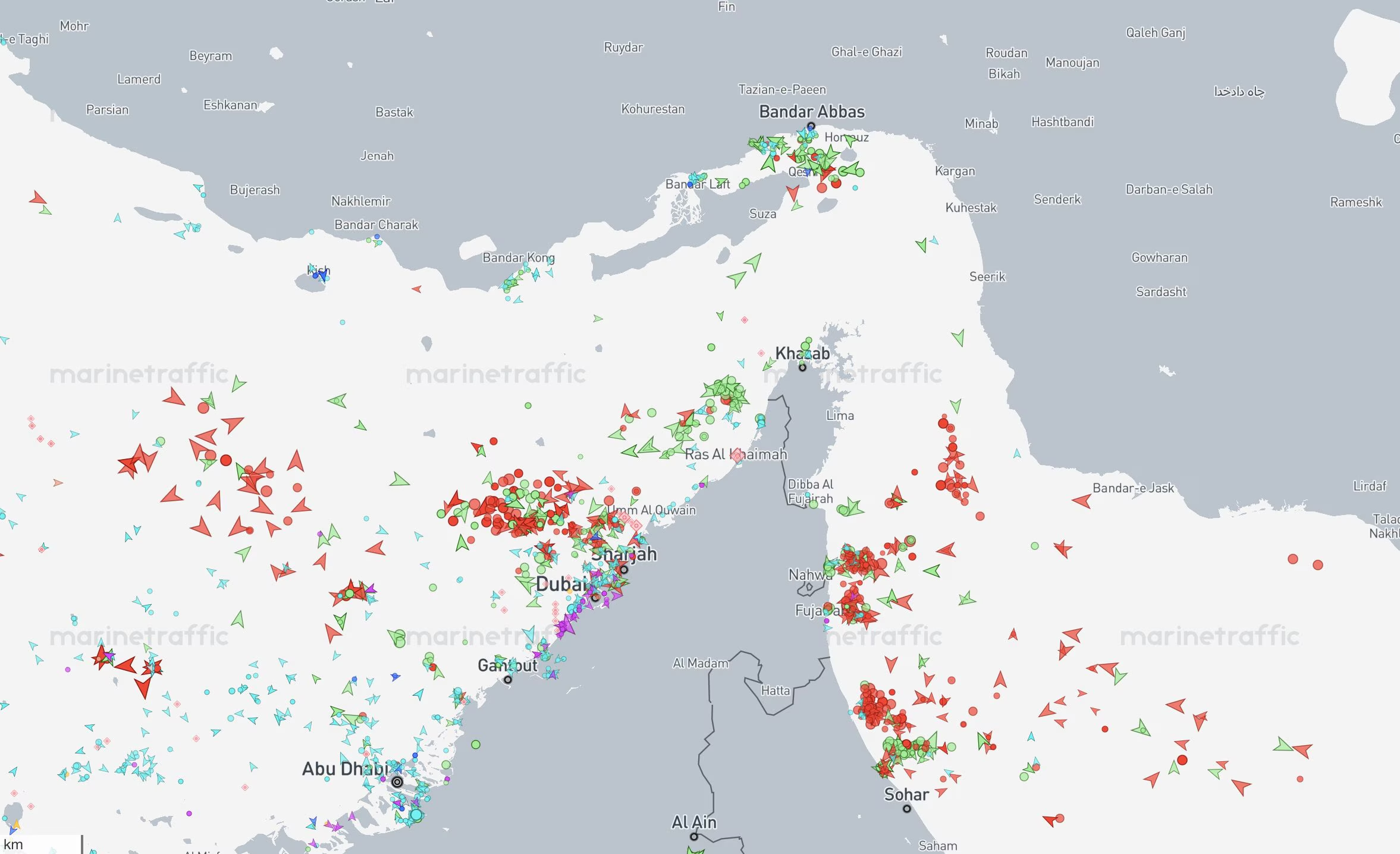
After the 14-day ceasefire accepted by the United States and Iran, there was talk of reopening the Strait of Hormuz, even if Tehran decided to close the passage to ships following the Israeli raids on Lebanon. The situation in shock point maritime therefore remains critical and the attention on traffic in the Strait is higher than ever. The main tool for monitoring vessel passage is the Marine Traffic naval geolocation portal, which offers the most comprehensive maritime database in the world and provides almost daily updates on crossings of the Strait of Hormuz.
The passage of ships at the moment can still only take place with the prior authorization of the Iranian navy, therefore – as Marine Traffic itself reports – there are still hundreds of boats stopped near the Strait waiting to cross it. At the time of writing, according to maritime data, only four ships carrying dry cargo managed to cross the Strait, the last of which at 10.45am on Wednesday 8 April (local time, 09.15am in Italy).
Meanwhile, Iranian official media said that due to the presence of mines, vessels must coordinate with the Iranian navy and use designated routes to pass through the Strait of Hormuz.
What the tracker is and how it works
By accessing the marinetraffic.com website you have, in almost real time, an overview of maritime traffic all over the world: the company actually has a database of hundreds of millions of boats, complete with static data (name and characteristics of the vessel) and dynamic data (position, route, destination). Marine Traffic, like other similar services (for example Vessel Finder), collects this enormous amount of data in a single database and offers a useful interface for monitoring global maritime traffic.
But where does all this data come from, in particular the dynamic data relating to the location of boats? They are provided directly by individual vessels via the AIS tracking system (Automatic Identification System), whose main objective is to avoid collisions between vessels present in the same area. Each ship is equipped with an AIS device which sends high frequency radio signals at regular intervals which reach other nearby ships but also ground stations. The same device also receives radio signals from other vessels, with an average signal range of approximately 40 nautical miles (74 km). In particular, the vessel’s position is identified via GPS or a similar sensor internal to the AIS device.
Data on passages in the Strait of Hormuz in the last month
Before the start of the conflict and the closure of Hormuz, the Strait was crossed by approximately 130 ships per day. In the last month, however, the average has been well below 10, as reported by this histogram published by Marine Traffic:
There has been a certain recovery starting from the first days of April, even if we are well below the value of March 1st, which was already very low compared to the average pre-conflict crossings. The direction of crossings over the last month is mainly outgoing from the Strait, but since the end of March there has also been a slight increase in incoming crossings, as shown by this graph from Marine Traffic: