Central heating will be turned off in almost all of Italy from tomorrow, Wednesday 15 April: like every year, the calendar of dates varies depending on the climate zones. In this case, the radiators will also have to be turned off in the cities of climate zones D and E, which include most of the cities in the Center and North such as Milan, Turin, Bologna, but also Florence, Genoa, Ancona and Pescara.
At this point, the heaters will only be able to remain on for the coldest cities such as Cuneo and Belluno, for which there is no time limitation. In some municipalities in zone E, especially the more northern ones, exceptions are foreseen in case of particular disturbances: in Milan, for example, switching on is considered justified when the average daily temperature drops below 13°C.
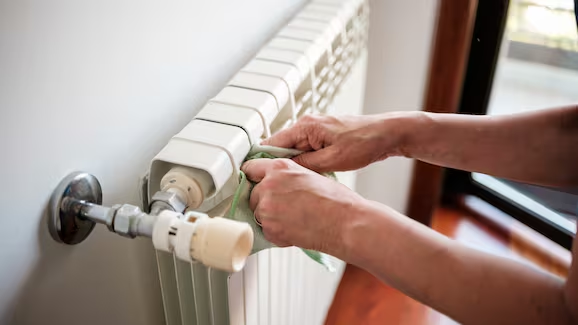
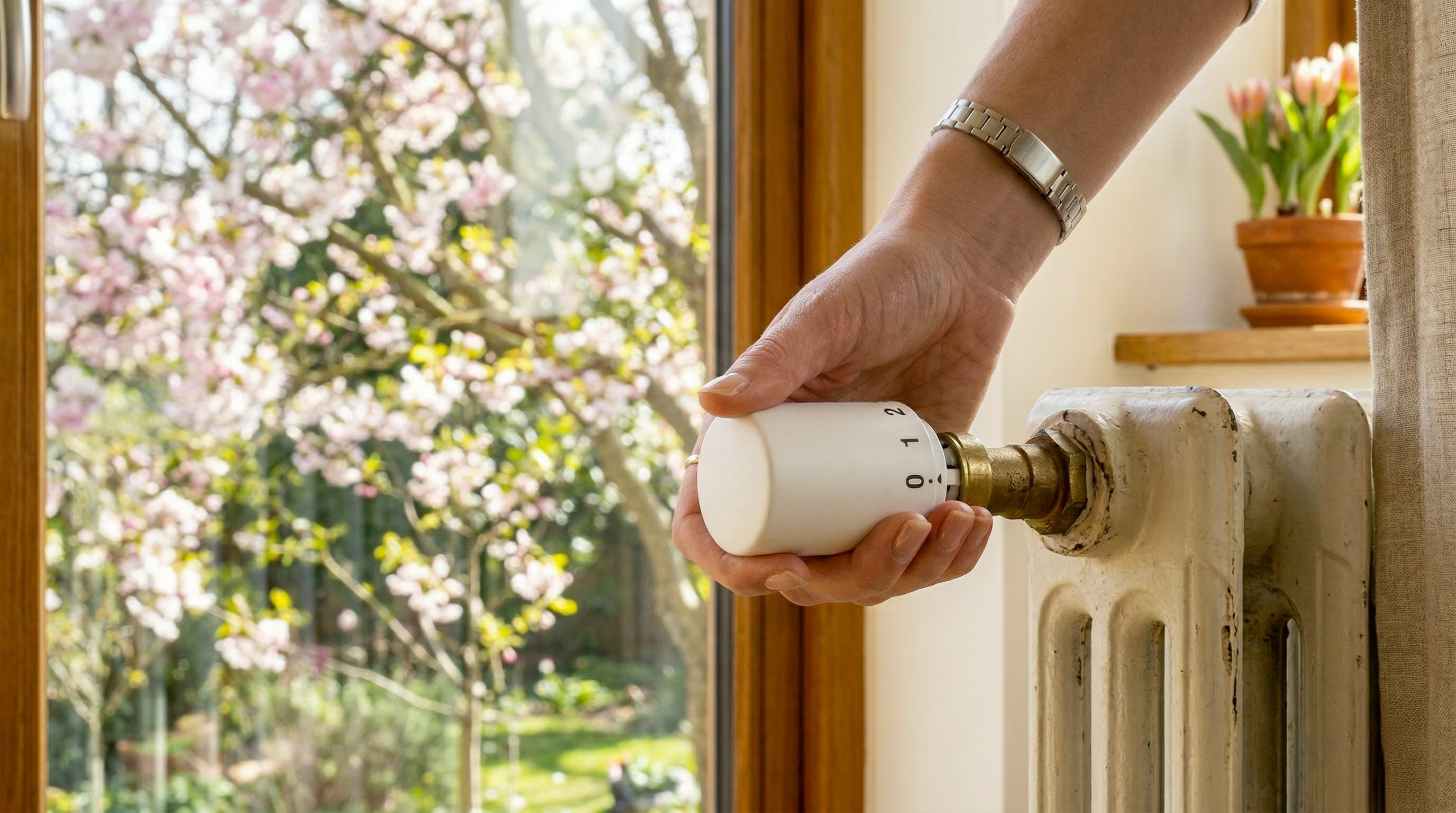
During the period of shutdown of the systems, ENEA recommends a series of activities to be carried out to guarantee energy efficiency and optimal functioning in the next season, from the positioning of the thermostatic valves to the cleaning of the radiators.
The first restart for 2026 is scheduled for 15 October, again for the locations that fall into climate band E.
Turning off the radiators according to the climate zones
In Italy, the regulation of heating systems is governed by the Decree of the President of the Republic n.74 of 16 April 2013, which divides the national territory into six climate zones – from A to F – each of which establishes different periods and times of operation.
Each municipality is placed in a climate zone on the basis of the so-called “degree days”, an indicator that sums over the entire year, for each day, the (positive) difference between the internal temperature of a building and the average daily external temperature.
| Climate zone | Degree days |
|---|---|
| TO | < 600 |
| B | 600-900 |
| C | 901-1400 |
| D | 1401-2100 |
| AND | 2101-3000 |
| F | > 3000 |
As visible in the map below, Zone A (the mildest, in red) allows the radiators to operate for 6 hours a day from 1 December to 15 March, while Zone F (the coldest, in blue) is not subject to any limitations during the year.
Most of the large cities in Northern Italy, from Milan and Turin to Bologna, fall into Zone E, where the ordinary shutdown is set for April 15th. The other cities of Central Italy such as Rome, Ancona and Pescara mainly belong to Zone D, with the end of the thermal season also scheduled for April 15th. The more southern and coastal areas are in zones C, B or A, with progressively earlier shutdown dates.
The decree also provides that the internal temperatures of heated environments must not exceed 19°C (with a tolerance of 2°C) for residential buildings and buildings used other than industrial, while for industrial and artisanal buildings the limit drops to 18°C with the same tolerance.
Shutdown of radiators 2026 according to climate zones
Each climate zone therefore provides a different period of switching off and on, as well as a variable number of hours of daily operation, which ranges from a maximum of 14 hours per day for zone E to a maximum of 6 hours for zone A. The shutdown on 15 April therefore concerns a wide range of cities, from Milan and Turin to Verona, Padua, Bergamo, Bolzano, Parma, Venice, Perugia, L’Aquila, Florence, Genoa, Ancona, Viterbo and Pescara. The only exception is Rome which, despite being in climate zone D, has scheduled the shutdown on April 7th.
For this year, the first restart is scheduled for 15 October 2026 for some cities in Northern Italy.
| Climate zone | Switch-on period and operating hours |
|---|---|
| A (e.g. Lampedusa) | 1 December – 15 March, 6 hours per day |
| B (e.g. Messina, Catania, Palermo, Agrigento) | 1 December – 31 March, 8 hours per day |
| C (e.g. Naples, Bari, Cagliari, Lecce) | 15 November – 31 March, 10 hours per day |
| D (e.g. Rome, Florence, Genoa, Pescara) | 1 November – 15 April, 12 hours per day |
| E (e.g. Milan, Turin, Bologna) | 15 October – 15 April, 14 hours per day |
| F (e.g. Cuneo, Belluno) | No limits for switching off |
While zone A is the smallest and includes only Lampedusa, Linosa and Porto Empedocle, zone E is actually the most populous, with around 4,000 municipalities involved and almost all the cities of the North, such as Milan, Turin, Bologna, Verona, Padua, Bergamo, Bolzano, Parma, Venice, Perugia and L’Aquila. Finally, zone F includes only Belluno and Cuneo.
Compliance with these periods is a legal obligation: however, exceptions are foreseen for these switch-on dates. The legislation, in fact, provides a margin of flexibility to independently manage any drops in temperature or intense disturbances.
In the specific case of the Municipality of Milan, for example, outside the ordinary period the systems can only be activated if climatic situations occur that justify their operation: switching on is considered justified when the average daily temperature drops below 13°C. In these exceptional cases the heating can remain on for a maximum of seven hours a day, i.e. half the hours foreseen for the ordinary heating period.