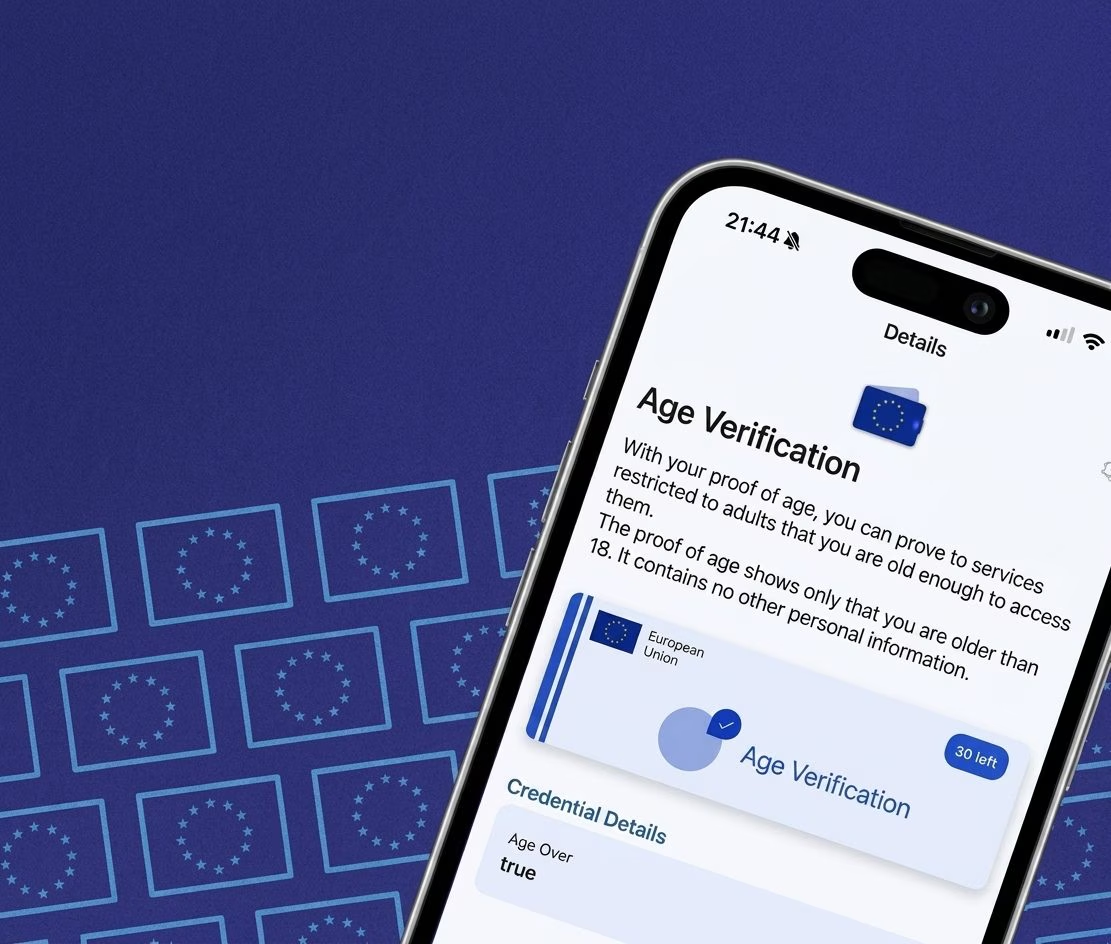
Ursula von der Leyen, president of the European Commission, recently announced the creation of an app to verify the age of online users. The objective is clear: to protect children and adolescents from dangerous phenomena – such as cyberbullying, solicitation by online predators and contact with adult content – which are increasingly widespread on the Web. The solution should allow users to demonstrate that they are of age when accessing online platforms.
The system is based on principles already tested during the COVID-19 pandemic, when solutions were developed with which to always carry with you certificates of vaccination, recovery, etc., but introduces a key element: the so-called “zero-knowledge proof”, a cryptographic technique that allows you to prove information (in this case age) without revealing the original data. The app will be free, interoperable between different devices and, above all, open source, i.e. with publicly accessible code for independent verification. Some member states (including Italy) are already working on integration into national digital wallets (such as IT-Wallet), while Brussels underlines that this solution could become a European standard. In parallel, the EU continues to strengthen enforcement of rules on digital platforms, signaling that the protection of minors is a priority over economic interests.
Why the need for an age verification app
Let’s start with one fact: the time that children and teenagers spend online is constantly growing. In part this is due to the design of the platforms, whose operation is often based on intensive engagement mechanisms (such as infinite scrolling or highly personalized content). The more a child is online, the more likely they are to encounter dangerous phenomena, such as cyberbullying. According to European bodies, one in six children is a victim of online bullying and one in eight children is an online bully. These are truly alarming figures.
It is within this framework that the European Commission has proposed a coordinated approach at a supranational level. The idea is to avoid regulatory fragmentation between member states, which would make protection measures ineffective. The heart of the proposal is the age verification app: a tool that works similarly to requiring an identity document to purchase age-restricted products, but transposed into the digital environment.
From a technical point of view, the system introduces a fundamental concept: “zero-knowledge proof”. In cryptography, this technique allows a user to demonstrate that they possess certain information without revealing it. Applied to the concrete case, it means that we can confirm that we are adults without communicating our date of birth or other personal data to the platform we are accessing. This approach drastically reduces the risk of tracking and profiling, i.e. the systematic collection and analysis of online behavior for commercial purposes.
The application is designed to be simple to use: after downloading, you can configure it by associating it with an official document, such as an identity card or passport. Once registration is complete, the system generates a digital proof of age, which is stored securely on your device. When we access an online service, we can show this attestation without exposing other data.
A relevant aspect concerns the open source architecture of the app. Since the app code is publicly accessible and verifiable, researchers, developers and institutions can check its functioning, identify any vulnerabilities and ensure maximum transparency. In a delicate area such as that of personal data management, this element represents a significant strong point.
How the Age Verification app works
The Age Verification app can be installed on both Android and iOS. At the moment, however, the application has not been published on the Google Play Store or on the Apple App Store. In fact, the following is explained on the European Age Verification Solution website:
(The app) is available for download on GitHub a pre-compiled Android app. You can install the APK file directly on your Android device for testing purposes. (…) An iOS version of the app is also available; however, due to platform restrictions, a precompiled version is not publicly distributed.
Having said this, we briefly describe the user experience of the Age Verification app. At least as far as this first demo version is concerned, the app works following a very specific sequence: after its first launch, there is the consultation of privacy information pages, the acceptance of the conditions of use and the configuration of a PIN for security. Biometric systems, such as facial recognition, can also be activated to facilitate access. Next, the user is asked to choose a registration method that allows them to obtain proof of age through a digital identity provider. Once generated, this attestation is stored locally and can be used for subsequent verification. We leave you with a short video that visually illustrates the steps we have just described.